
Flood Light Lens: Beam Angles, Lens Types and How Optics Change What You See
How the lens on an LED flood light shapes the beam: beam angles from 10° to 120°, symmetric and asymmetric optics, PC, PMMA and glass materials, glare control and choosing the right lens.
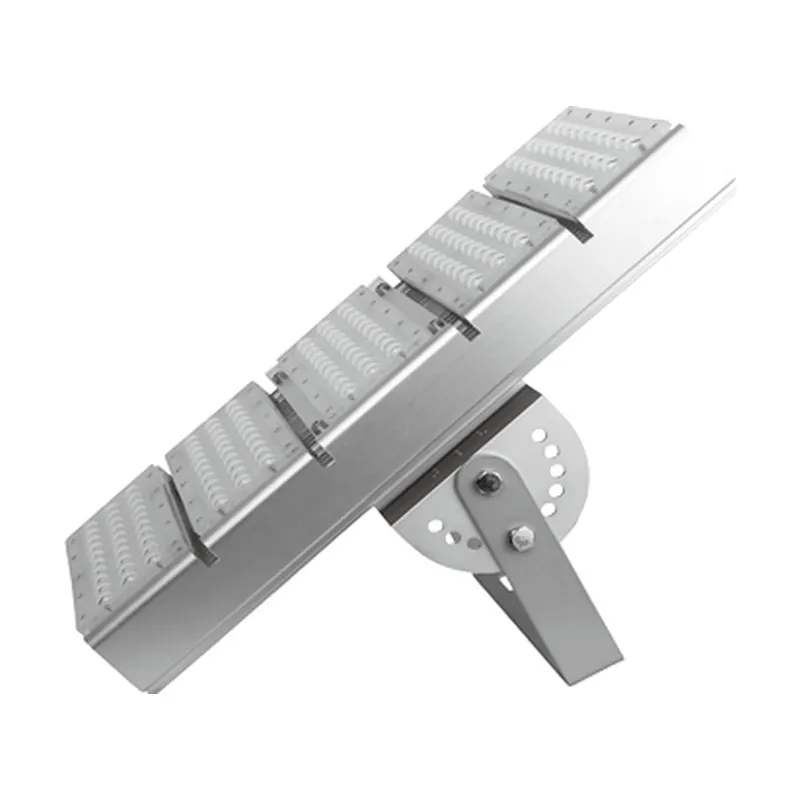
Key points
- The lens decides where a floodlight's lumens go; the same wattage can light a facade, a yard or a distant target depending on the optic.
- Narrow beams (10–30°) throw light far; medium beams (40–60°) suit poles at moderate height; wide beams (90–120°) suit close, large areas.
- Asymmetric optics push light forward with the floodlight nearly flat, which reduces glare and light spill.
- PC and PMMA lenses are common; glass covers resist UV and heat best; check the lens and cover are both rated for outdoor use.
Two floodlights with the same wattage and lumens can give completely different results. One lights a whole yard evenly; the other makes a bright spot and leaves the corners dark. The difference is the optic. This guide explains how floodlight lenses work and how to choose one.
What the lens does
LEDs emit light in a wide cone of about 120°. Without optics, a floodlight would spread light everywhere, including into the sky and the eyes of passers-by. The lens bends and focuses that light into a beam of a chosen shape. In LED floodlights, each LED usually has its own small lens, mounted in a lens array and covered by a front glass or polycarbonate cover.
Beam angles
| Beam angle | Typical use |
|---|---|
| 10–15° | Very long throw: high masts, stadium aiming at far side, tall facades |
| 20–30° | Sports fields, ports, tall poles, building tops |
| 40–60° | Car parks, yards, facades from moderate distance |
| 90° | Close-range area lighting, loading bays |
| 120° | Wide area at low height, under canopies, wall wash |
The beam angle is the angle within which intensity is at least half of the peak. A narrow beam concentrates the same lumens onto a smaller area, so the light reaches further and gives higher lux at the target.
Symmetric vs asymmetric optics
Symmetric optics give a round or square beam around the aiming point. To reach far, the floodlight must be tilted up, which causes glare.
Asymmetric optics throw most of the light forward and little backward or upward. The floodlight can be mounted nearly flat and still reach across a large area. This reduces glare, sky glow and spill onto neighbours. Asymmetric optics are common for sports fields, car parks and perimeter lighting.
Elliptical or batwing optics spread light more in one direction than the other, useful for long narrow areas such as roads, rail yards and paths.
Lens materials
PMMA (acrylic). High light transmission (around 92%) and good UV resistance. Used for many secondary lenses. Less impact-resistant than PC.
PC (polycarbonate). Very tough and heat-resistant, used for lenses and covers. Needs UV stabilisation to avoid yellowing outdoors.
Glass. Tempered glass covers resist UV, heat and scratching best and stay clear for many years. Often used over a lens array in floodlights.
Silicone optics. Used in some high-power and high-temperature fittings; resistant to heat and UV.
Ask suppliers what the lens and the cover are made of, and how they are protected from UV.
Lumen loss through the optic
Every lens and cover absorbs some light, usually a few percent each. Compare floodlights on system lumens measured from the complete fitting, not the LED chip rating. Our LED flood light wattage guide covers lumens and wattage by application.
Choosing a lens by mounting height and area
- Measure the mounting height and the distance to the far edge of the area
- For short throw (distance less than about twice the height), wide beams of 90–120° work
- For medium throw (two to four times the height), 40–60° or asymmetric
- For long throw (more than four times the height), narrow 15–30° beams
- Run a lighting calculation with the IES file of the exact optic for important projects
The flood light mounting guide explains how height and aiming interact with the beam.
Glare control
Even with the right beam, a floodlight can glare. Options:
- Asymmetric optics so the light stays nearly horizontal
- Glare shields or visors that cut light above a set angle
- Louvres for sports lighting near houses
- Aiming no higher than about 60–65° from vertical
Lenses for sports lighting
Sports floodlights are usually supplied with several beam options, mixed on each pole: narrow beams aimed at the far side of the pitch, medium beams in the middle and wide beams near the pole. This gives even light across the field. Our modular LED sports floodlight and heat-pipe stadium and port floodlight are available with a range of optics. See also soccer field lighting.
Lenses for facades and architecture
Facade lighting uses narrow beams to graze tall walls from the base and wide beams to wash broad surfaces. Coloured light needs optics that mix colours evenly; see RGB colour-changing floodlights.
Reading a floodlight’s photometric data
Beam angle on a datasheet is only a summary. The IES or LDT file of the exact optic shows how intensity is distributed in every direction, and lighting software uses it to calculate lux on the ground, uniformity and glare. When comparing floodlights from different suppliers, ask for the file of the exact wattage and lens, not a similar model. Two floodlights labelled “60°” can have quite different shapes: one with a smooth fall-off at the edge, another with a sharp cut-off and a hot spot in the centre. The smooth one usually gives more even results when several floodlights overlap. For yards, car parks and sports areas, a short calculation with real files avoids surprises after installation.
Cleaning and maintenance
Dirt on the front cover can cut output by 10–20% in dusty or industrial areas. Clean covers with water and a mild detergent; avoid solvents, which can craze polycarbonate. Check gaskets when cleaning, because water inside the lens fogs the optic. See waterproof LED flood lights.
Our floodlights
Our modular LED floodlights and slim floodlights are available with several beam angles and asymmetric options. Tell us the mounting height, the area and what you need to light, and we will suggest optics and send IES files for a lighting calculation.
Sources
Frequently asked questions
What does the lens on a flood light do?
It shapes the light from the LEDs into a beam of a chosen angle and pattern, so the light lands where it is needed rather than spreading everywhere.
What beam angle is best for a flood light?
For long throw on tall poles, 15–30°. For car parks and yards on 6–10 m poles, 40–60° or an asymmetric optic. For close-range areas and walls, 90–120°.
Can I change the lens on an LED flood light?
On modular and sports floodlights, lenses are often available in several angles and can be specified at order. On sealed one-piece floodlights, the lens is usually fixed.