Cost of Floodlighting a Football Pitch: What You Pay For and What It Costs to Run
What drives the cost of floodlighting a football pitch: floodlights at 75, 200 and 500 lux, masts, foundations and cabling, plus running cost per hour and season.
Key points
- The light level decides almost everything: a full-size pitch needs about 12 kW of LED floodlights at 75 lux, 30 kW at 200 lux and 74 kW at 500 lux.
- Floodlights are only one part of the bill. Masts, foundations, cabling, the supply connection and design often cost as much or more.
- Running cost is easy to work out: at 0.15 per kWh, a 30 kW installation costs 4.50 an hour to run.
- Replacing 24 metal halide floodlights of 2,000 W with 1,000 W LED saves about 13,900 kWh over a 500-hour season, or 54%.
- Ask for quotations against the same lux level and uniformity, not the same number of fittings.
Clubs and schools usually start with one question: what will floodlights cost? We cannot give a single figure that is honest for every ground, and neither can anyone else, because two pitches of the same size can differ several times over in cost. What we can do is show what you pay for, how each choice changes the bill, and how to work out the running cost exactly.
The light level sets the scale
Football lighting is designed to a class. EN 12193 gives 75 lux for training and recreation, 200 lux for club competition and 500 lux for the top level. For a full-size pitch of 105 × 68 m, the lumen method (utilisation factor 0.55, maintenance factor 0.8, floodlights at 110 lm/W) gives:
| Level | Total lumens needed | 1,000 W LED floodlights | Connected load |
|---|---|---|---|
| 75 lux, training | 1.22 million | 12 | 12 kW |
| 200 lux, club matches | 3.25 million | 30 | 30 kW |
| 500 lux, top level | 8.11 million | 74 | 74 kW |
So the same pitch can need 12 floodlights or 74. Before asking for prices, decide which level you really need. The league’s ground rules usually answer that. Our football field lighting guide covers the classes and layouts in more detail.
What you pay for
| Item | What decides its cost |
|---|---|
| Floodlights | Light level, efficacy, beam options, glare shields |
| Masts or columns | Number and height: 4 tall masts or 6–8 shorter ones |
| Foundations | Mast height, wind zone and soil; poor ground needs larger bases |
| Head frames and brackets | Number of floodlights per mast |
| Cabling and trenching | Distance from the supply and around the pitch |
| Distribution board and controls | Switching groups, dimming, timers |
| Supply connection | Whether the existing supply can carry the load |
| Design and aiming | Photometric design, aiming on site, measurement report |
| Planning and surveys | Local rules on spill light and hours of use |
On a new installation, the items that are not floodlights often add up to more than the floodlights themselves. This is why two quotations with the same fittings can differ so much: one may include masts, bases and the supply upgrade, and the other may not.
Choices that change the cost most
Mast height. Taller masts cost more each, and need larger foundations, but give better uniformity and less glare with fewer positions. Short masts are cheaper but need more of them, and the floodlights must be tilted higher, which causes glare and spill.
Four masts or more. Four corner masts are common at club level. Six or eight masts along the touchlines suit training pitches, with lower heights.
Reusing what is there. If the ground already has sound masts, cables and a supply, changing only the floodlights is by far the cheapest route.
The supply. A 74 kW load may need a new or larger connection. A 12 kW load usually does not. LED has made many projects possible on the existing supply.
Distance. Trenching around a pitch is roughly 350 m for a full circuit. The run back to the supply point can add much more.
Running cost: work it out exactly
Energy cost is simple arithmetic: load in kW × hours × price per kWh.
| Installation | Load | Cost per hour at 0.10 / kWh | at 0.15 / kWh | at 0.25 / kWh |
|---|---|---|---|---|
| 75 lux | 12 kW | 1.20 | 1.80 | 3.00 |
| 200 lux | 30 kW | 3.00 | 4.50 | 7.50 |
| 500 lux | 74 kW | 7.40 | 11.10 | 18.50 |
The figures are in your own currency: use your tariff. Over a season:
| Installation | Hours a year | Energy | Cost at 0.15 / kWh |
|---|---|---|---|
| 75 lux training pitch | 300 | 3,600 kWh | 540 |
| 200 lux club pitch | 400 | 12,000 kWh | 1,800 |
| 500 lux ground | 500 | 37,000 kWh | 5,550 |
For most clubs the electricity for floodlights is a modest part of the season’s budget. The larger cost is the installation itself, which is why reusing masts and getting the level right matter more than the last few lumens per watt.
Replacing metal halide: the saving
Many grounds still have 2,000 W metal halide floodlights. With the control gear, each draws about 2,160 W. Our LED retrofit savings calculator gives, for 24 floodlights used 4 hours on 125 nights (500 hours a year):
| Metal halide 2,000 W | LED 1,000 W | |
|---|---|---|
| Load, 24 floodlights | 51.8 kW | 24 kW |
| Energy per year | 25,920 kWh | 12,000 kWh |
| Energy cost at 0.15 / kWh | 3,888 | 1,800 |
| Saving | 13,920 kWh, 54%, 2,088 a year |
Open the example and enter your own numbers, including the price you have been quoted, to see the payback.
At 500 hours a year, the energy saving alone pays back slowly. The other gains often matter more to a club:
- no warm-up and no wait to re-strike after a power dip, so lights can be switched off between sessions;
- no lamp changes at height, which need a platform or a lowering system each time;
- dimming and half-pitch switching for training;
- better uniformity from modern optics, so the same lux can be met with less spill.
The one-for-one wattage is not fixed. See our metal halide to LED guide for the conversion ratios.
Ways to keep the cost down
- Design to the class you need, not the next one up. Going from 200 to 500 lux multiplies the floodlights by about 2.5.
- Keep sound masts and foundations, after an inspection.
- Wire in groups, so that training uses half the lights.
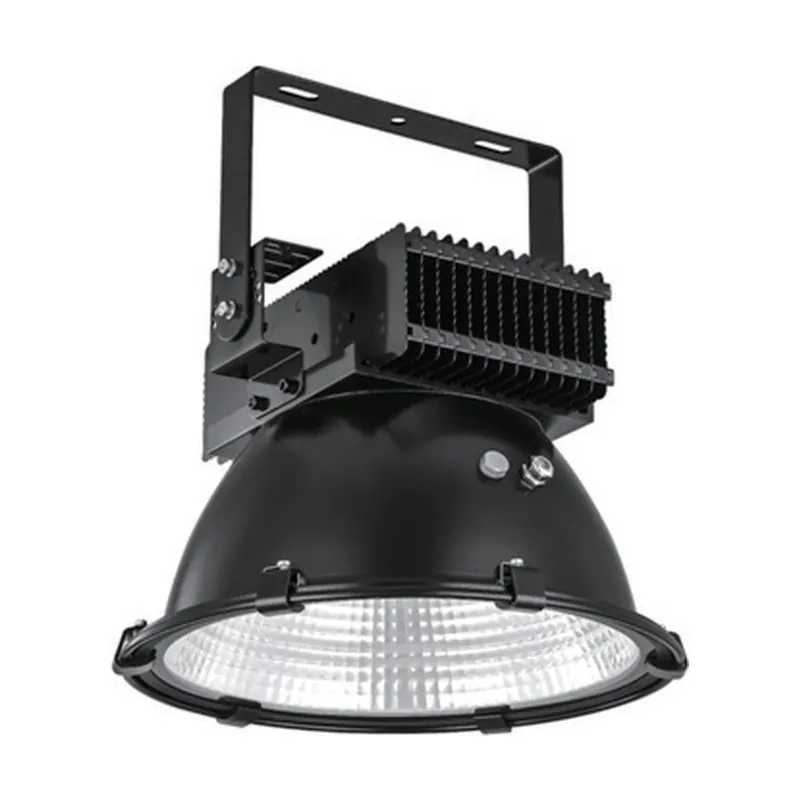
- Choose floodlights with several beam angles so the design can use fewer fittings. Our heat-pipe stadium floodlight comes in 25°, 40°, 60° and 90° beams, from 200 W to 1,500 W.
- For five-a-side and school pitches, use smaller asymmetric fittings on 8–10 m columns instead of stadium floodlights. The 50–300 W modular sports floodlight is made for this.
- Fix the lighting hours early. Planning limits on hours can change which level is worth paying for.
How to compare quotations
Ask every supplier to quote against the same written requirement:
- average lux and uniformity on the pitch, maintained;
- mast positions and heights, or freedom to propose them;
- what is included: masts, foundations, cabling, board, aiming, measurement;
- floodlight data: watts, lumens, beam angles, protection rating, warranty;
- a calculated lux grid for the proposed layout.
A quotation with fewer floodlights is not cheaper if it does not reach the level. A calculated grid lets you compare like with like.
What to send us
The pitch size and a plan, the level of play, any existing masts with their heights, the supply voltage and the distance to the supply. We reply with a floodlight schedule and a lux calculation, and you can price the civil works locally against it.
Sources
Frequently asked questions
How much does it cost to floodlight a football pitch?
There is no single figure, because the answer depends on the light level, the number and height of masts, the ground conditions and the distance to the power supply. A training pitch at 75 lux needs about a sixth of the floodlights of a 500 lux stadium. Get quotations against a stated lux level and uniformity.
How much does it cost to run football floodlights per hour?
Multiply the connected load in kW by your electricity price. A 12 kW training installation at 0.15 per kWh costs 1.80 an hour; a 30 kW club installation costs 4.50; a 74 kW installation costs 11.10.
Can I reuse existing floodlight masts?
Often, yes, and it is the largest saving available. LED floodlights are usually lighter than the metal halide units they replace, but the masts and foundations should be inspected, and the wind load of the new fittings checked against the mast design.
Is it cheaper to light half the pitch for training?
Yes. Wiring the floodlights in groups lets you light one half, or run a lower level across the whole pitch. LED floodlights can also be dimmed, which metal halide cannot do well.