Indoor Pickleball Court Lighting: Lux Levels and High Bay Counts for One Court and a Four-Court Hall
How to light indoor pickleball courts: 300 and 500 lux targets, high bay counts for one court and a four-court 36 × 20 m hall from our lighting calculator, layout over the courts, glare and flicker.
Key points
- A pickleball court is 20 × 44 ft (6.10 × 13.41 m); with run-off, plan a playing area of at least 30 × 60 ft (9.14 × 18.29 m) per court.
- There is no separate European class for pickleball; tennis values are a sensible reference: about 300 lux for recreational play and 500 lux for club competition indoors.
- In our lighting calculator, a four-court hall of 36 × 20 m with a 8 m mounting height needs 35 high bays of 150 W at 100 lm/W for about 358 lux, or 54 for about 552 lux.
- Players look up for lobs: place rows along the sidelines and between courts, not over the middle of a court, and choose diffused or low-glare optics.
- Converted gyms and warehouses are common pickleball venues; check the existing fittings for flicker, glare and colour before reusing them.
Pickleball has moved indoors fast: into school gyms, church halls, converted warehouses and purpose-built centres. Many of these buildings were never designed for a fast sport where players look up at a ball against the ceiling. This guide sets the light levels, works out the high bay count for a single court and for a typical four-court hall, and explains how to place the fittings so players can see the ball without glare.
The court and the space around it
A pickleball court is 20 × 44 ft (6.10 × 13.41 m), the same size for singles and doubles. Players need space around it: USA Pickleball recommends a total playing area of at least 30 × 60 ft (9.14 × 18.29 m) per court, and more where space allows. A tennis-court-sized area can hold four pickleball courts, which is why many centres use the same footprint.
How much light
The European sports lighting standard EN 12193 does not have a separate entry for pickleball. Indoor tennis is the closest reference, because the ball speed, the volleying at the net and the lobs are similar:
| Level | Reference value | Uniformity |
|---|---|---|
| Recreational and social play | about 300 lux | 0.7 |
| Club competition, leagues, tournaments | about 500 lux | 0.7 |
| High-level competition, filmed events | about 750 lux | 0.7 |
Most community and club venues work at 300–500 lux. The ball is perforated plastic in bright colours, easy to see against a dark ceiling but easy to lose in glare.
Calculation 1: a four-court hall
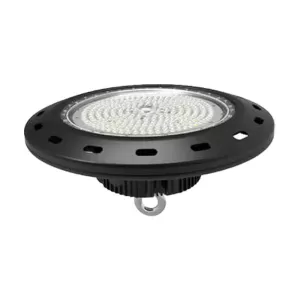
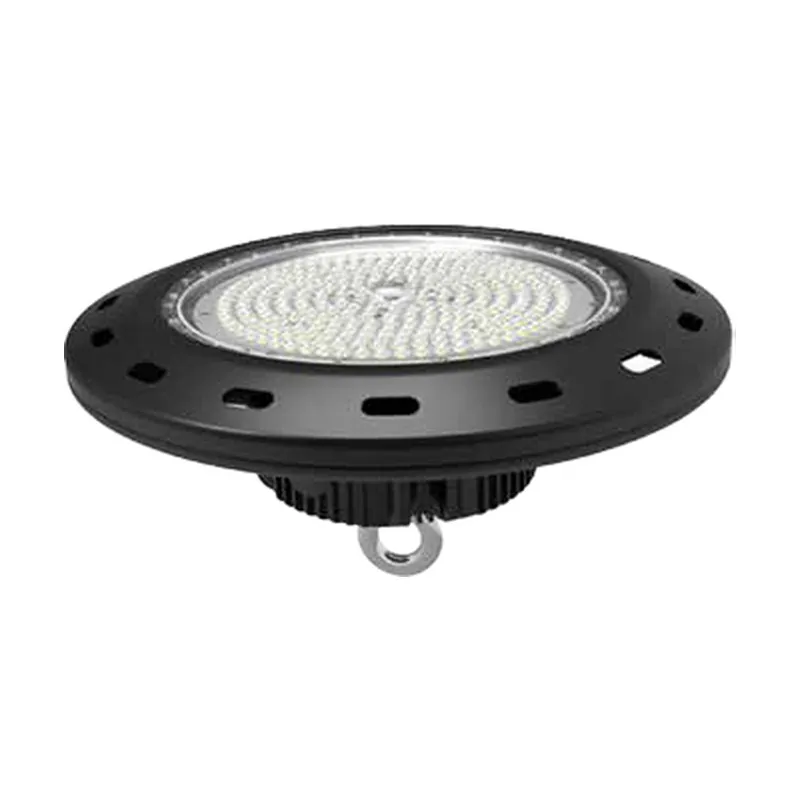
We used our lighting calculator, which applies the lumen method, for a hall of 36 × 20 m with four courts, fittings mounted at 8 m, working plane at the floor, medium wall reflectance and a maintenance factor of 0.8. The fitting is our UFO LED high bay GKP40F at 150 W and 100 lm/W, with a medium beam.
| Target | High bays | Layout | Average | Load | Per court |
|---|---|---|---|---|---|
| 300 lux | 35 | 7 × 5 | about 358 lux | 5.25 kW | about 9 |
| 500 lux | 54 | 9 × 6 | about 552 lux | 8.1 kW | about 13 to 14 |
Open the example and enter your own hall.
At 300 lux the load is about 7.3 W per square metre. For the 300 lux layout the calculator reports that about 126 W per fitting would be enough, so 150 W fittings leave margin for dust and ageing, or can be dimmed.
Calculation 2: one court in its own building
A single court in a small building of 18.3 × 9.15 m, fittings at 7 m, with 100 W high bays at 100 lm/W and a wide beam, needs 15 fittings for about 316 lux.
That is more per court than in the four-court hall. In a small building a larger share of the light falls on the walls before it reaches the floor, so the utilisation factor drops: about 0.44 here against about 0.61 in the larger hall. Light-coloured walls help; dark walls make it worse.
Layout: keep fittings out of the lob
Players spend much of a game at the kitchen line watching the ball at head height, then look straight up when an opponent lobs. Placement matters:
- Rows along the sidelines and between courts. Put fittings over the gaps between courts and along the outer sidelines rather than over the centre of each court.
- No bright fitting over the kitchen line or the net. That is exactly where players look up.
- Even spacing. The spacing should not exceed the fitting’s spacing limit for the mounting height, or dark bands appear between rows. Our calculator checks this.
- Light the walls a little. In converted halls with dark walls, light reaching the walls makes the space feel brighter and reduces contrast glare.
Our comparison of UFO and linear high bays explains which shape suits rows over courts, and our guide to high bay reflectors and lenses covers beam and glare control.
Glare and optics
A bare LED high bay at 6–8 m is very bright to look at directly. For sports:
- Choose a diffused lens or anti-glare reflector, or fittings designed for sports.
- Use wider beams with more fittings rather than a few narrow, intense ones.
- Avoid shiny ceiling decks behind the fittings, which add reflected glare.
The same problem appears in badminton halls; our badminton court lighting design guide goes deeper. Our squash court lighting guide shows the effect of a small room with tall walls.
Flicker and colour
- Flicker-free drivers. A fast ball under flickering light looks like a series of dots, and phone video shows dark bands. This matters for centres that film or stream games.
- 4000–5000 K neutral white gives good contrast with the bright ball colours.
- CRI 80 or higher keeps court colours and line markings clear.
Converting existing gyms and warehouses
Many pickleball venues start in a building with lights already installed:
- Measure the lux on each court with a meter at several points.
- Look up from the kitchen line and the baseline. If a fitting is in your eye line, it will cause problems.
- Check for flicker with a phone camera in slow-motion mode.
- Check the start-up. Metal halide fittings take minutes to warm up and longer to restrike after a power dip; LED switches instantly.
If the existing lights fail on any of these, our guide to how many LED high bays you need shows how to plan a replacement, and the sports hall project shows our fittings in basketball arenas and a training hall.
Impact protection and controls
- Guards or impact-resistant covers where balls can reach the fittings, typically IK08 or higher for sports.
- Switching by court: wire each court or pair of courts on its own circuit so empty courts can be switched off.
- Two levels: a lower level for social play and practice, full output for leagues and events.
Outdoor courts
For outdoor pickleball, the courts are lit with floodlights on poles rather than high bays; our basketball court lighting guide covers outdoor pickleball and basketball together.
For centre owners and contractors
Send us the hall dimensions, mounting height, number of courts, wall and ceiling finish, and the level of play. We will run the calculation, suggest a fitting layout that keeps the fittings out of the players’ lob line, and list the high bays with guards for your quotation.
Sources
Frequently asked questions
How many lux do indoor pickleball courts need?
About 300 lux for recreational and social play, and about 500 lux for club competition and tournaments, using indoor tennis values as the reference. Even light matters as much as the average.
How many lights do I need for an indoor pickleball court?
In a four-court hall of 36 × 20 m at 8 m, our calculation gives 35 high bays of 150 W for about 358 lux, roughly 9 per court. A single court in its own small building needs more per court, because more light lands on the walls.
Where should lights go over a pickleball court?
In rows along the sidelines and in the gaps between courts, so players looking up for a lob do not stare into a fitting. Avoid placing a bright fitting directly over the kitchen line or the middle of a court.
Can I use the existing gym lights for pickleball?
Often, if they give enough even light without glare and flicker. Measure the lux on the court and look at the fittings from a player's position. Old metal halide or fluorescent fittings are often too dim, slow to start or flickering.