Squash Court Lighting Design: Lux Levels, Panel Counts and Glare Control for a Standard Court
How to light a squash court: 300, 500 and 750 lux by level of play, fitting counts for a 9.75 × 6.4 m court from our lighting calculator, layout, glare, impact protection and flicker.
Key points
- A singles squash court is 9.75 × 6.40 m with a minimum clear height of 5.64 m; the small floor and tall white walls change the lighting calculation compared with a large hall.
- EN 12193 gives about 300 lux for recreational squash, 500 lux for club competition and 750 lux for high-level competition, with a uniformity of 0.7.
- In our lighting calculator, a court with a 6 m ceiling and light walls needs 15 low-glare 36 W panels for about 337 lux, 24 for about 539 lux and 35 for about 786 lux.
- The ball is small, fast and often in the air, so use diffused, low-glare fittings, keep bright sources out of the players' view of the front wall, and protect fittings against impact.
- Flicker-free drivers matter: a fast ball under flickering light looks like a string of dots, and phone video shows bands.
Squash is played with a small, fast, dark ball in a white box, and players look up at the front wall and follow lobs high into the court. That makes lighting a squash court a particular job: the light must be even on all four walls as well as the floor, without bright spots in the players’ view. This guide works out the light levels and fitting counts for a standard court and explains how to lay them out.
The court
A singles squash court is 9.75 m long and 6.40 m wide, a floor area of about 62 m². The World Squash Federation’s specification calls for a minimum clear height of 5.64 m above the floor. The walls are white or near-white, and the back wall is often glass for spectators.
Compared with a sports hall, a squash court is a small floor with tall, bright walls. In lighting terms it has a low room index, which means a larger share of the light lands on the walls before it reaches the floor. The bright walls help by reflecting light back, but more lumens are needed per square metre of floor than in a large hall.
Light levels
EN 12193, the European sports lighting standard, gives these horizontal values for squash:
| Class | Use | Average | Uniformity |
|---|---|---|---|
| III | Recreational play, training, schools | 300 lux | 0.7 |
| II | Club and league competition | 500 lux | 0.7 |
| I | High-level national and international competition | 750 lux | 0.7 |
Check the current edition and any federation rules for your project; televised events have their own requirements for vertical light towards the cameras. Uniformity matters as much as the average: a dark corner at the back or a bright patch on the front wall makes the ball harder to follow.
The calculation
We used our lighting calculator, which applies the lumen method to any room, with:
- Court 9.75 × 6.40 m, fittings at 6 m, working plane at the floor.
- Light wall reflectance (white walls), wide beam, maintenance factor 0.8.
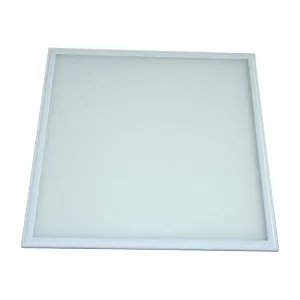
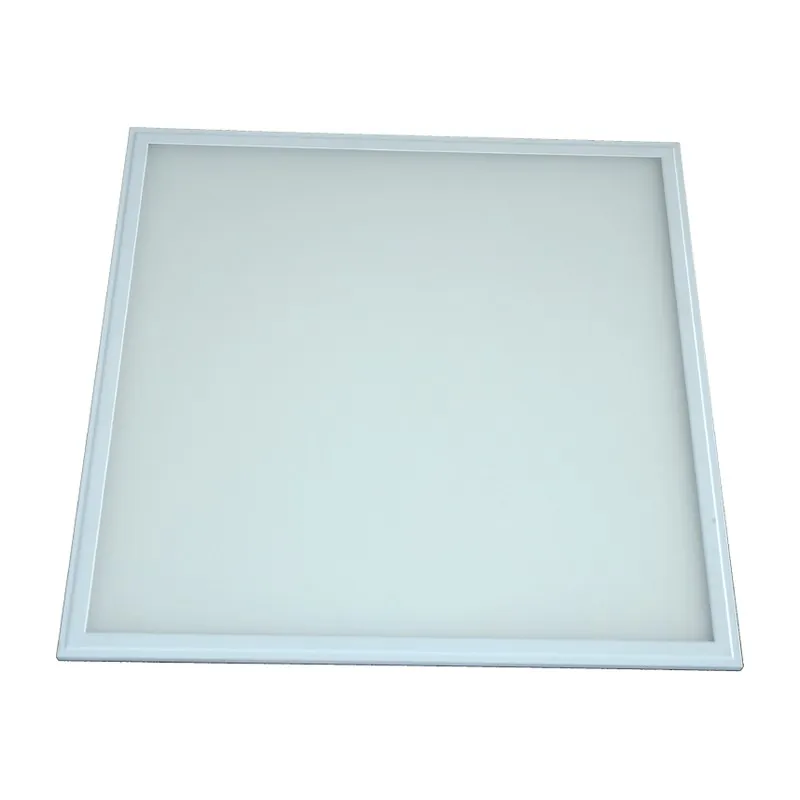
- Our low-glare 36 W LED panel: 595 × 595 mm, 4,320 lm at 4000 K, 120 lm/W, anti-glare optic, flicker-free.
| Target | Panels | Layout | Average | Load |
|---|---|---|---|---|
| 300 lux (Class III) | 15 | 5 × 3 | about 337 lux | 540 W (8.7 W/m²) |
| 500 lux (Class II) | 24 | 6 × 4 | about 539 lux | 864 W (13.9 W/m²) |
| 750 lux (Class I) | 35 | 7 × 5 | about 786 lux | 1,260 W (20.2 W/m²) |
Open the example and enter your own court height and fitting.
The calculator gives a utilisation factor of about 0.41 for this court, much lower than the 0.6–0.7 typical of a large hall, which is why the counts look high for such a small floor. A darker wall finish or a dusty ceiling would push the count up further.
The same lumens can come from fewer, more powerful fittings, but squash is the sport where that works least well: fewer sources mean brighter points to look at and less even light on the walls.
Layout
- Rows parallel to the side walls. Players mostly face the front wall; rows running front to back put the fittings to the side of their view rather than across it.
- Even spacing to the walls. The walls are part of the playing surface. Keep the outer rows close enough to the side walls that the upper walls are lit, not left in shadow.
- Avoid a fitting directly above the “T” if it is very bright. Players look up there for lobs; diffused panels are much more comfortable than bare high bays.
- Light the front wall evenly. The ball is read against the front wall; a bright band near the top and a darker area near the tin makes judging height harder.
Glare
Squash players look up often, so glare control matters as much as in badminton. Choose fittings with a diffuse, low-luminance face rather than visible LED points. Our article on UGR glare ratings explains the numbers; our badminton court lighting design guide covers the same problem in a larger hall.
Impact protection
The ball travels at high speed and can strike the ceiling area. Use:
- Recessed or close-mounted fittings so there are no edges for the ball to catch.
- Impact-resistant covers or wire guards. Sports fittings are commonly specified at IK08 or higher.
- Secure fixings that will not loosen with repeated impacts.
Flicker and video
A squash ball can travel very fast. Under flickering light it appears as a series of images rather than a smooth path, which makes it harder to follow. Flicker-free drivers avoid this and also prevent bands on phone and broadcast video, which matters for clubs that stream matches.
Colour temperature and colour rendering
Neutral white of 4000–5000 K gives crisp contrast between the dark ball and the white walls. CRI 80 or more renders skin and clothing naturally. Use the same colour temperature on every court so players do not adjust when they change courts.
Energy and controls
A court at 500 lux with 24 panels draws 864 W. If it is booked 6 hours a day, 360 days a year, that is about 1,870 kWh a year. Linking the lights to the booking system, or to an occupancy sensor with a short delay, switches off courts that are empty between bookings.
Multi-court centres
For a centre with several courts, the same calculation applies court by court, because each court is a closed box. Corridors, viewing areas and changing rooms can use standard panels; our guide to gym lighting covers fitness areas, and the sports hall project shows our fittings in basketball arenas and a training hall.
For contractors and club owners
Send us the number of courts, the ceiling height and type, the wall finish and the level of play. We will run the calculation for each court, suggest the panel count and layout, and list the fittings with impact protection for your quotation.
Sources
Frequently asked questions
How many lux does a squash court need?
About 300 lux for recreational play and training, 500 lux for club competition and 750 lux for high-level competition, under EN 12193, with a uniformity of about 0.7. Televised events need more, set by the broadcaster.
How many lights does a squash court need?
In our calculation for a standard court with a 6 m ceiling and white walls, 15 low-glare 36 W panels give about 337 lux, and 24 give about 539 lux. Fewer, higher-output fittings are possible but give more glare and less even light.
What colour temperature is best for squash courts?
Neutral white, around 4000–5000 K, gives good contrast between the ball and the white walls. Keep the same colour temperature on every court in a centre.
Should squash court lights be protected?
Yes. The ball can reach the ceiling area at speed. Use fittings with impact-resistant covers or guards, mounted flush or close to the ceiling.