
High Mast Lighting Pole Specification: The Items a Tender Must Fix, with a 32 m Plant Example
The items a high mast pole specification must state: height, sections, wind design, galvanizing, lowering system, ring and foundation, with our 32 m steel plant masts as the example.
Key points
- A high mast specification must fix the height, the design wind speed and terrain, the head load (number, weight and area of floodlights), the steel and section shape, the galvanizing, the lowering system and the foundation.
- Our 2025 steel pipe plant project in Xiangtan used two 32 m masts: one full ring with 10 × 600 W LED floodlights and one three-quarter ring with 8.
- At an assumed 130 lm/W, a 10 × 600 W ring delivers about 780,000 lm; spread over a 60 m radius (about 11,300 m²) that is roughly 28 lux average by the lumen method in our estimate.
- Write the head load as a number of fittings with weight and projected area, not only watts, because the wind load on the head frame sizes the mast.
A high mast is a structure first and a light second. A 30 m steel column with a ring of floodlights at the top must stand up to the design wind for decades, and it must let the maintenance team bring those floodlights down to the ground safely. When a tender asks only for “30 m high mast with 12 floodlights”, every supplier fills in the rest differently, and the prices are impossible to compare. This guide lists the items a high mast specification must fix, using the two 32 m masts we supplied to a steel pipe plant as the example.
The example: two 32 m masts in a steel pipe yard
In 2025 we supplied and installed two high masts in the outdoor yard of a steel pipe plant in Xiangtan, Hunan (project page). Pipes are stacked, lifted and loaded at night, and many short poles would have obstructed cranes and trucks.
| Item | Mast 1 | Mast 2 |
|---|---|---|
| Height | 32 m | 32 m |
| Ring | Full ring | Three-quarter ring |
| Floodlights | 10 × 600 W LED | 8 × 600 W LED |
The three-quarter ring on the second mast is a good example of why the head layout belongs in the specification: that mast stands near the edge of the yard, so floodlights facing outward would light nothing useful.
What the ring delivers
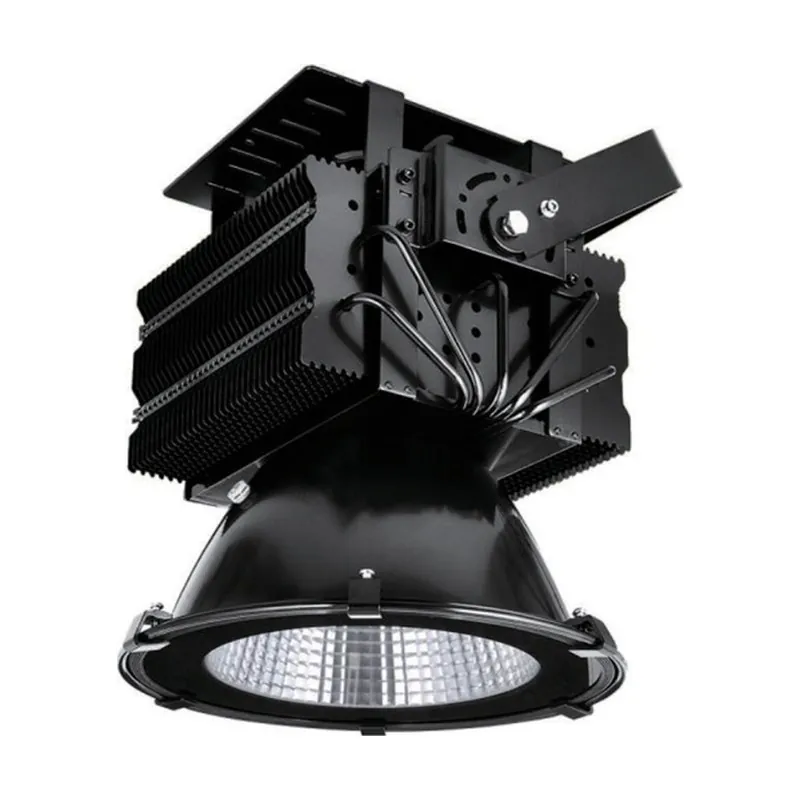
To show the scale of light from such a ring, we estimated the average illuminance with the lumen method. At an assumed 130 lm/W, the rating of our BG-TS heat-pipe port floodlight, 10 × 600 W gives about 780,000 lm. With a utilisation factor of 0.5 and a maintenance factor of 0.8, spread evenly over a circle:
| Radius | Area | Average |
|---|---|---|
| 50 m | about 7,850 m² | about 40 lux |
| 60 m | about 11,300 m² | about 28 lux |
| 70 m | about 15,400 m² | about 20 lux |
This is an illustration, not the project’s design calculation: real yards are not circles, and aiming, beam angles and overlap with the next mast change the result. A full photometric design is needed for each site. Our guide to high mast lighting coverage area shows how coverage changes with height.
The items a specification must fix
1. Height and location
State the height above the foundation top and each mast’s coordinates. Height follows from the area and the light distribution; see our high mast lighting guide for typical choices.
2. Design wind and terrain
The wind load sizes the mast. State the design (basic) wind speed for the site, the terrain category (open sea, open country, suburban, urban) and the code to be used: EN 40-3-1 and EN 1991-1-4 in Europe, or the national code. Coastal and port sites usually need higher values. Without this, two suppliers may offer masts of very different strength for the same height.
3. Head load
Write the head load as the number of floodlights, the weight of each and the projected area of each, plus the ring and any cameras, antennas or obstruction lights. Watts alone tell the structural engineer nothing; two 600 W floodlights of different designs can differ greatly in area.
4. Steel and sections
Specify the steel grade (for example S355 or equivalent), the section shape (typically 12-, 16- or 20-sided polygonal, tapered), the minimum wall thickness for each section, and how sections join (slip joints with a stated overlap, or flanges). Ask for the structural calculation with the offer.
5. Corrosion protection
Hot-dip galvanizing to ISO 1461 inside and out, with the minimum mean coating thickness (85 µm for steel over 6 mm thick). For aggressive sites, such as ports, chemical plants and coastal yards, specify a duplex system (galvanizing plus paint). Our guide to galvanized steel light poles explains coating life by environment.
6. Lowering system
For masts over about 20 m, specify a raising and lowering system: winch type (built-in motor, or a portable power tool driving a built-in winch), the number and grade of stainless steel wire ropes, the safe working load, the latching system that takes the ring’s weight off the ropes at the top, and the trailing cable to the ring. Ask for the lowering test to be part of commissioning.
7. Ring and floodlight brackets
Full ring, part ring or fixed head frame; the number of bracket positions (including spares for future floodlights); the bracket’s aiming adjustment and angle scale.
8. Door and electrical
Base door size and lock type, an internal mounting plate for the distribution board, an earthing terminal, and the cable entry from the foundation. State whether the supplier provides the distribution board, surge protection and lighting control.
9. Foundation
State the soil data (or that the supplier must assume a stated bearing capacity), the anchor bolt cage and template, and who designs the concrete foundation. Anchor bolts and the base plate must match the mast’s calculation.
10. Documents and tests
Structural calculation, galvanizing certificate, wire rope certificates, winch test, photometric layout, installation manual, and an inspection plan. Our high mast installation guide covers the site sequence.
A copyable summary table
| Item | Write in the specification |
|---|---|
| Height | __ m above foundation top |
| Wind | __ m/s basic wind speed, terrain category __, code __ |
| Head load | __ floodlights × __ kg, __ m² projected area each; other equipment __ |
| Steel | Grade , -sided tapered, min. wall __ mm per section |
| Joints | Slip joint (overlap ≥ __ × diameter) or flanged |
| Galvanizing | ISO 1461, min. mean __ µm; duplex paint __ (if any) |
| Lowering | Winch type __, __ × stainless ropes, SWL __ kg, latching at top |
| Ring | Full / part ring, __ bracket positions (__ spare) |
| Electrical | Door , board , earthing, SPD __, control __ |
| Foundation | Soil data __; anchor cage and template supplied by __ |
Common mistakes
- Specifying wattage instead of head load.
- No wind speed or terrain category, so offers are built to different strengths.
- Copying a full ring onto every mast, including those at the site edge.
- Leaving out the lowering test at commissioning.
Send us the site plan, the area to be lit, the target lux, the wind data and any obstructions, and we will return a mast and floodlight layout with the specification table filled in.
Sources
Frequently asked questions
What should a high mast pole specification include?
Height; design wind speed and terrain category; the number, weight and projected area of the floodlights; steel grade, section shape and wall thickness; galvanizing standard and thickness; lowering system type and capacity; head frame or ring layout; door and electrical fittings; and the foundation design basis.
How tall are high mast lighting poles?
Usually 15–40 m. Ports, large yards and highway interchanges commonly use 25–35 m. Our steel pipe plant project used 32 m masts.
Do high mast poles need a lowering system?
Above about 20 m, almost always. A motorised or portable winch lowers the ring to the ground for maintenance, so no crane or aerial platform is needed.
How many floodlights go on a 32 m high mast?
It depends on the area and the light level. Our 32 m plant masts carry 10 × 600 W floodlights on a full ring and 8 × 600 W on a three-quarter ring. The design starts from the area and target lux, not from the mast.
