
Motion Sensor Flood Lights: PIR vs Microwave, Range and Settings
How motion-activated flood lights work: PIR and microwave sensors, detection range and mounting height, time and lux settings, avoiding false triggers, dimming modes and solar versions.
Key points
- PIR sensors detect body heat moving across their zones; microwave sensors detect any movement, even through thin plastic, and reach further but trigger more easily.
- Most PIR flood lights cover about 8–12 m at 2.5–3 m mounting height; detection falls quickly above about 4 m.
- Set the lux threshold so the light works only after dark, the time delay to 30 s–3 min, and sensitivity to ignore trees and passing cars.
- Dim-plus-motion modes (20–30% background, full on movement) suit car parks and perimeters better than off-and-on.
Motion sensor flood lights do two jobs at once: they save energy by staying off or dim most of the night, and they draw attention when someone moves. They are used on homes and also on warehouses, car parks, construction sites and farms. Getting them to trigger when they should, and only then, comes down to the sensor type and a few settings.
PIR or microwave?
| PIR (passive infrared) | Microwave (radar) | |
|---|---|---|
| Detects | Heat moving across its zones | Any movement reflecting its signal |
| Typical range | 8–12 m | 10–15 m or more |
| Through materials | No (needs line of sight) | Yes, through glass, thin plastic and some walls |
| False triggers | Warm air, sun on surfaces | Trees, rain, traffic behind walls |
| Best direction | Movement across its view | Movement towards it or across |
| Typical use | Homes, doors, paths | Warehouses, car parks, inside fixtures |
PIR suits most outdoor floodlights: cheap, reliable, and it ignores things that do not give off heat. Microwave sensors fit inside sealed fixtures, which is why many high bays and street lights use them.
Mounting height and range
PIR detection drops sharply with height because the sensor sees a smaller ground area and people look smaller in its zones:
| Mounting height | Typical PIR detection |
|---|---|
| 2.5–3 m | 8–12 m ahead, 120–180° wide |
| 4–5 m | 6–8 m, narrower |
| 6 m and above | Often unreliable; use microwave or a separate sensor |
For lights on poles above about 5 m, a separate sensor lower down, or a microwave sensor, works better than a sensor on the floodlight.
The three settings
- Lux (dusk) threshold. Sets how dark it must be before the sensor works. Set it after dark so the light does not trigger in daytime.
- Time delay. How long the light stays on after the last movement: 30 seconds to 3 minutes for security, longer for work areas.
- Sensitivity / range. Lower it if trees, roads or animals cause false triggers.
Aim the sensor slightly downward, away from roads, trees and vents. Many sensors have lens masks to block part of the view.
Off-and-on or dim-and-bright?
- Off until motion: maximum saving, good for gates, doors and storage yards.
- Dim plus motion: 20–30% background light, 100% on movement. Better for car parks, walkways and perimeters with cameras, because the area is never dark and the change in brightness is still noticed.
LED makes both possible; old metal halide floodlights could not restart instantly.
Wattage
Choose the floodlight wattage for the area, then add the sensor. For example, 30–50 W for a driveway or yard at 3–4 m, 100–200 W for a loading area at 6–8 m. Our LED flood light wattage guide covers sizes by application.
Solar motion flood lights
Motion sensing matters most on solar lights: the battery lasts far longer when the light stays dim. A solar flood light with a real 10 W panel that runs a few watts all night can deliver bright bursts when people pass. See our solar flood lights and the solar street light motion sensor guide, which shows the energy saving in numbers.
Common problems and fixes
| Problem | Fix |
|---|---|
| Turns on with no one there | Lower sensitivity, re-aim away from trees and roads, mask the lens |
| Does not detect people walking towards it | Re-aim so paths cross its view; PIR is least sensitive to direct approach |
| Turns on in daytime | Lower the lux threshold |
| Stays on too long | Shorten the time delay |
| Stops working in hot weather | PIR loses contrast when the ground is as warm as people; microwave helps |
Typical set-ups by place
| Place | Mounting | Sensor | Mode |
|---|---|---|---|
| House driveway | 2.5–3 m | PIR | Off until motion, 1–2 min |
| Warehouse yard | 6–8 m | Microwave or separate PIR | Dim 30% plus motion |
| Car park | 6–8 m on pole | Microwave | Dim 20–30% plus motion |
| Farm buildings | 3–5 m | PIR | Off until motion |
| Construction site | 4–6 m on mast | PIR or microwave | Dim plus motion, solar or generator |
Sensor quality matters
Cheap sensors drift: sensitivity changes with temperature, lenses yellow in the sun, and seals let in water that fogs the lens. For commercial sites, ask for the sensor’s IP rating, operating temperature range and whether it can be replaced without changing the floodlight.
Wiring several lights together
On a perimeter, one sensor can switch several floodlights so the whole side lights up at once, rather than one by one as someone walks. Use a sensor with a relay rated for the total load, or a control module that sends a signal to the drivers. Smart systems can also send an alert or start recording on cameras when the lights trigger.
What to specify for projects
- Sensor type (PIR or microwave) and detection pattern
- Mounting height and coverage required
- Modes: off/on or dim/bright, with adjustable levels and times
- IP65 or better for the sensor as well as the lamp
- Surge protection for exposed installations
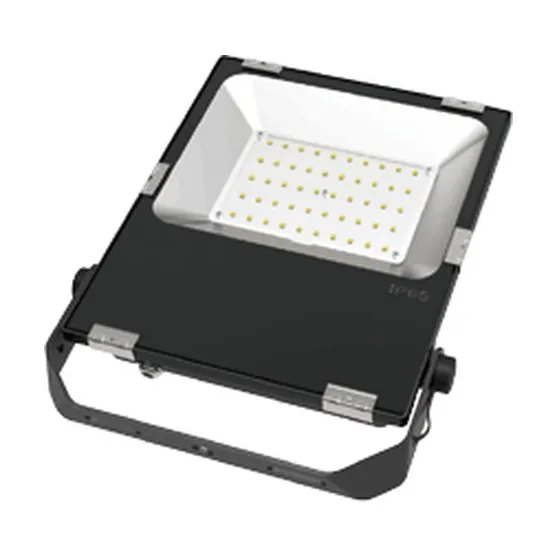
Our slim LED flood lights (50–200 W) and modular LED flood lights can be combined with external or integrated sensors for project use. Send us the area, mounting points and how you want the lights to behave.
Sources
Frequently asked questions
How do motion sensor flood lights work?
A sensor watches the area in front of the light. When it detects movement, and the surroundings are dark enough, it switches the floodlight on or to full brightness for a set time, then turns it off or dims it again.
How far can a motion sensor flood light detect?
Typical PIR sensors detect people about 8–12 m away when mounted at 2.5–3 m. Microwave sensors can reach further, often 10–15 m, but are more prone to false triggers from moving branches, rain or traffic behind walls.
Why does my motion sensor flood light keep turning on?
Common causes are trees or bushes moving in the wind, passing cars, animals, warm air from vents, or a sensitivity set too high. Re-aim the sensor downward, reduce sensitivity, or mask part of the lens.