
Eave and Ceiling Mount Flood Lights: Soffit Mounting, Brackets and Aiming
How to choose and install eave, soffit and ceiling mount flood lights: under-eave brackets, junction boxes, wattage by height, aiming without glare, motion sensors and canopy use.
Key points
- Eave and ceiling mount floodlights hang under a soffit, canopy or ceiling and aim down and out, which keeps them sheltered and out of reach.
- Use a weatherproof junction box or eave bracket, and choose a floodlight whose bracket allows downward aiming.
- At 3–4 m under eaves, 20–50 W suits homes; 50–100 W suits small commercial yards; loading bays and canopies need more.
- Aim floodlights down at 45° or steeper to avoid glare, and keep them away from bedroom windows and roads.
Mounting floodlights under the eaves is one of the neatest ways to light a yard, drive or building perimeter. The overhang shelters the floodlight from rain and sun, keeps it out of reach and hides the cable. The same principles apply to floodlights on ceilings of porches, carports and canopies. This guide covers mounting, sizing and aiming.
Where eave and ceiling floods are used
- Homes: driveway, back yard, side passage, garage door
- Small commercial buildings: car parks, perimeter, bins and service yards
- Loading bays and docks under canopies
- Carports, covered parking and walkways
- Petrol forecourts and other canopies (often with dedicated canopy lights)
Mounting methods
Eave junction box. A round weatherproof box fixed to the soffit framing, with the floodlight’s bracket screwed to it. Cable enters from the roof space above, out of sight.
Surface mount plate. For solid soffits and concrete ceilings, a mounting plate or the floodlight’s own U-bracket fixed with suitable anchors.
Knuckle or swivel mount. Allows aiming in two directions; useful when the soffit is not parallel to the area to be lit.
Pendant or rod mount. For high ceilings in canopies and warehouses, the floodlight hangs on a rod or chain to bring it to the right height.
Check that the soffit or ceiling material can carry the weight and that fixings reach solid timber or structure, not just thin cladding.
Wattage by mounting height
| Mounting height | Typical LED floodlight | Typical use |
|---|---|---|
| 2.5–3 m | 10–30 W | Porch, side passage |
| 3–4 m | 20–50 W | Home yard, driveway |
| 4–6 m | 50–100 W | Small commercial yard, car park edge |
| 6–8 m | 100–200 W | Loading bay, warehouse perimeter |
These are starting points. The LED flood light wattage guide explains how to size for area and lux level.
Aiming without glare
Eave floods are often aimed too high, throwing glare into neighbours’ windows, onto the road and into drivers’ eyes.
- Aim down at 45° or steeper from horizontal for most home use
- Use the beam’s edge, not its centre, to reach the far side of the area
- Choose asymmetric or narrower optics if you need more reach without tilting up
- Check at night from the street and neighbouring windows
The flood light lens guide explains beam angles and optics.
Brackets that point down
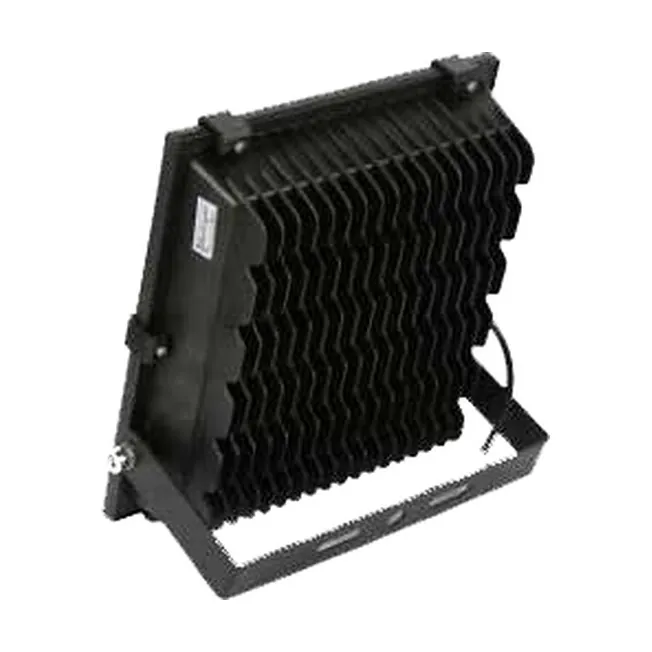
Many floodlights have U-brackets designed for wall mounting, which makes them hard to aim from a ceiling. Check that the bracket rotates far enough to point down and outward from a horizontal surface. Some models offer a ceiling bracket or a knuckle mount as an option. Our slim LED floodlights have adjustable brackets with an angle scale.
Motion sensors and controls
Eave floodlights are often used for security. Options include:
- Built-in PIR motion sensors with adjustable range and timer
- Dusk-to-dawn photocells with a low “glow” mode and motion boost
- Smart switches for app control and schedules
Mount sensors where they see the approach paths, not just the yard. See motion sensor flood lights for range and settings.
Weather protection
Under an eave, floodlights are sheltered from direct rain, but wind-driven rain, condensation and insects still get in. Choose IP65 or better, with the cable entry sealed. Seal around the junction box to stop moisture entering the roof space. In coastal areas, choose corrosion-resistant finishes.
Heat under the soffit
LED floodlights need air around them to cool. Avoid mounting them tight into an enclosed corner where heat builds up, and keep them away from heat-sensitive soffit materials like some vinyls.
Canopies and loading bays
Under canopies, floodlights or dedicated canopy lights light the area beneath for loading, fuelling or parking. Use wide-beam optics and mount high enough to avoid being hit by vehicles. Petrol station canopies have their own requirements; see our gas station canopy LED strip for one option, and our Sinopec petrol station project.
Wiring safety
Eave lighting is usually mains-powered and must be installed to local codes by a qualified electrician, with circuit protection and earthing. Work at height needs a stable platform. Isolate the circuit before work.
Planning several eave lights around a building
Walk around the building at night and note the areas that need light: doors, the drive, the side passage, bins, the garden. Light each zone from the nearest eave, overlapping beams slightly so there are no dark gaps between them. Corners are useful mounting points because one floodlight can cover two sides, but a single bright light on a corner throws long shadows; two smaller lights on adjacent walls often give more even results. Keep switching simple: one sensor or photocell per zone works better than many independent units that trigger at different times.
Common mistakes
- Aiming floods horizontally, causing glare and complaints
- Fixing to thin soffit boards without reaching structure
- Using wall-only brackets that cannot point down
- Very cool colour temperatures on homes, which look harsh
- Sensors placed where they trigger from passing traffic
Choosing the colour temperature
For homes, 3000 K looks welcoming and matches porch and wall lights. For security and commercial yards, 4000–5000 K is common.
Project supply
For warehouses, shops, factories and housing projects, we supply floodlights with brackets and optics to suit eave, wall and pole mounting. See also our flood light mounting guide. Send us the mounting heights and the areas to light, and we will suggest models and aiming.
Sources
Frequently asked questions
Can you mount a flood light under an eave?
Yes. Under-eave mounting is common and protects the floodlight from rain. Use a round or eave junction box fixed to the soffit framing, and a floodlight whose bracket can point down and outward.
What is a ceiling mount flood light?
A floodlight fixed to a ceiling or canopy underside, aimed down or at an angle. It is used under porches, carports, loading bay canopies and covered walkways.
What wattage flood light for under the eaves?
For homes with eaves at about 3–4 m, 20–50 W LED (about 2,000–6,000 lm) is usually enough. Larger yards and commercial buildings may need 50–100 W.