
LED Wall Pack Lights: Wattage, Cutoff and Photocell Guide
How to choose LED wall packs for warehouses, docks and perimeters: wattage by mounting height, full vs semi cutoff, photocells, emergency backup, metal halide swaps.
Key points
- A wall pack is a compact light mounted on an outside wall to light the area in front of a building: entrances, loading docks, car parks and perimeters.
- Typical LED sizes: 20–40 W at 3–5 m, 40–80 W at 5–8 m and 80–150 W at 8–10 m mounting height.
- Full cutoff wall packs send no light above the horizontal, which reduces glare and meets most dark-sky and planning rules.
- LED wall packs of 40–120 W typically replace 150–400 W metal halide units and pay back in one to three years.
Walk around almost any warehouse, factory or school at night and the light comes from wall packs: compact fixtures bolted to the outside walls, lighting doors, loading bays and the ground around the building. They are simple products, but choosing the wrong size or optic is common, and the result is either dark gaps or glare in the eyes of drivers and neighbours.
Where wall packs are used
- Entrances and exits, including fire exits
- Loading docks and yards beside the building
- Building perimeters for security cameras and patrols
- Car parks and drives next to the building
- Walkways and service areas
For open yards far from the wall, or for lighting a facade, a floodlight on a pole or bracket is usually better.
Wattage by mounting height
| Mounting height | Typical LED wall pack | Typical area lit in front |
|---|---|---|
| 3–5 m (10–15 ft) | 20–40 W | Doors, walkways, small car parks |
| 5–8 m (15–25 ft) | 40–80 W | Loading docks, building sides |
| 8–10 m (25–35 ft) | 80–150 W | Yards, larger car parks |
Brightness depends on lumens, not watts: a 60 W wall pack at 130 lm/W gives about 7,800 lumens. For light levels, parking and loading areas are often lit to about 20–50 lux, entrances higher.
Full cutoff, semi cutoff and forward throw
| Type | Light above horizontal | Use |
|---|---|---|
| Full cutoff | None | Most sites; required by many local and dark-sky rules |
| Semi cutoff | A little | Where more reach is needed, away from homes |
| Forward throw / non-cutoff | Some | Older style; more glare and sky glow |
Full cutoff wall packs also look less bright from a distance while putting more light on the ground, because the light goes where it is needed. Near housing or roads, choose full cutoff.
Photocells, timers and sensors
- Photocell (dusk to dawn): switches on at dusk and off at dawn; built into many wall packs. Mount so the sensor is not lit by the fixture itself or other lights. Our photocell guide explains how they work.
- Motion sensor: dims to 20–30% and brightens when someone approaches; good for perimeters with little traffic.
- Timer or building management: switches off or dims at fixed hours.
Combining a photocell with motion dimming often saves more than half the energy of an always-on wall pack.
Emergency backup
Wall packs over exit doors may need to work in a power cut. Emergency versions include a battery that powers the LED at reduced output for 90 minutes, which matches common egress lighting requirements. Check the local code for exit discharge lighting.
Replacing metal halide and HPS wall packs
| Old wall pack | Power with ballast | LED replacement |
|---|---|---|
| 100–150 W metal halide | about 120–180 W | 20–40 W |
| 175 W metal halide | about 210 W | 40–50 W |
| 250 W metal halide | about 290 W | 60–80 W |
| 400 W metal halide | about 450 W | 100–120 W |
Take 20 wall packs of 250 W metal halide (about 290 W each) replaced with 70 W LED, running 12 hours a night at US$0.15/kWh: the saving is about 220 W × 20 × 4,380 h ≈ 19,300 kWh and US$2,900 a year, before lamp replacements. Try your own numbers in the LED retrofit savings calculator, and see the HPS to LED conversion chart for other sizes.
What else to check
- Lumens and efficacy of the complete fixture
- Colour temperature: 4000K or 5000K for security and cameras, 3000K near homes
- IP65 or better, and a housing that keeps water out of the junction box
- Surge protection of at least 6 kV for exposed walls
- Mounting: fits the existing junction box, or needs a new back plate
- Warranty of at least five years on the LED and driver
Spacing wall packs along a building
A rough rule for full cutoff wall packs is a spacing of about three to four times the mounting height. At 6 m, that is one wall pack every 18–24 m along the wall; closer spacing gives more even light for cameras. Put an extra unit over every door, and make sure corners are covered from both sides so no one can stand in a dark angle.
Common mistakes
- Choosing wattage from the old metal halide label instead of the area to be lit, which leaves sites over-lit and glaring
- Semi cutoff units next to houses or roads, causing complaints
- Photocells mounted where the wall pack lights them up, so they cycle
- No surge protection on exposed walls in storm-prone regions
Colour and cameras
Security cameras see better under white light with good colour rendering. 4000K with Ra 70–80 is usually a good balance; 5000K gives a slightly brighter look to the eye. Avoid pointing wall packs at camera lenses, and check that the beam reaches the edge of the camera view rather than stopping short.
Our options
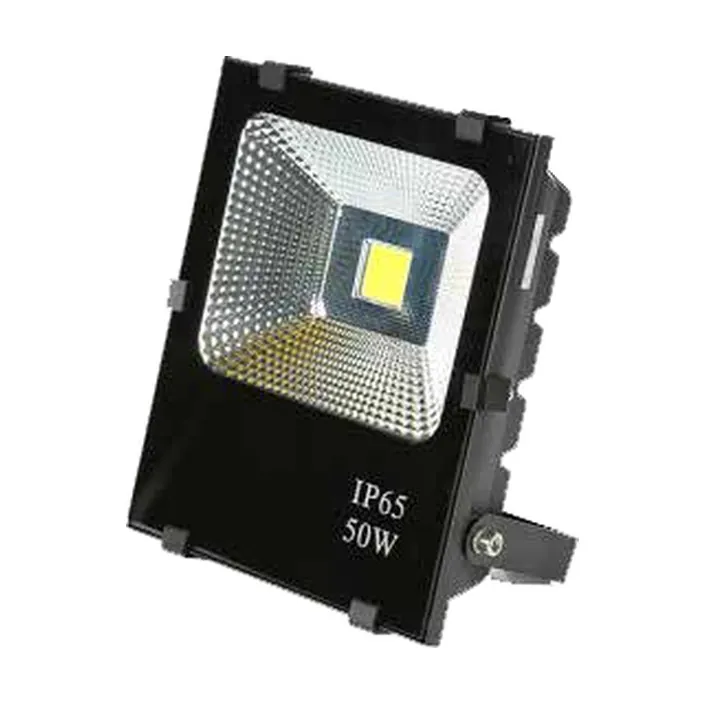
We supply LED wall packs for perimeter and dock lighting through our partner factory, alongside our own slim LED flood lights for walls that need a longer throw. Send us the building elevations, mounting heights and what you are replacing, and we will propose sizes and optics.
Sources
Frequently asked questions
What is a wall pack light?
A wall pack is an outdoor light fixed to the wall of a building, usually at 3–10 m, that lights the ground in front of it. It is used on warehouses, factories, schools, shops and car parks for security and access lighting.
What is the difference between full cutoff and semi cutoff wall packs?
A full cutoff wall pack sends no light above the horizontal plane; all light goes down and forward. A semi cutoff or forward-throw wall pack sends some light higher, reaching further but causing more glare and sky glow.
What size LED wall pack replaces a 250 W metal halide?
Usually an LED wall pack of 60–80 W, depending on the optics and how bright the old fixture really was. A 400 W metal halide wall pack is typically replaced with 100–120 W of LED.