Semi High Mast Lights: Heights, Where They Fit and How Many Floodlights They Carry
What a semi high mast light is, how it differs from street light poles and high masts, where it is used, and how to size the floodlights for a junction or a wide road, worked out in our calculators.
Key points
- A semi high mast is a pole of roughly 12–20 m carrying two to six floodlights or street light heads on a fixed ring or bracket; it sits between a street light pole and a 25–40 m high mast.
- It is used at junctions, roundabouts, toll plazas, bus depots, yards and wide roads, where a street light pole is too short but a full high mast with a lowering winch is more than the site needs.
- By our lumen-method estimate, a 40 × 40 m junction at 20 lux needs about 89,000 lumens: four or five 200 W modular floodlights at 110 lm/W on one semi mast.
- In our spacing calculator, a 21 m wide road lit from 12 m poles on both sides with 250 W heads reaches about 24 lux at 42 m spacing, meeting class M2.
Between an ordinary street light pole and a 30 m high mast there is a gap that many projects fall into: a junction too big for a few street lights, a bus depot too small to justify a high mast, a toll plaza that needs even light over many lanes. The semi high mast fills it. This guide explains what a semi high mast is, where it fits and how to size its lights, with numbers from our calculators.
What a semi high mast is
A semi high mast is a tapered steel pole, usually hot-dip galvanised, of about 12–20 m, with a fixed ring, cross-arm or bracket carrying two to six luminaires. The term is used widely in India, the Middle East, Africa and South-East Asia; elsewhere the same thing may simply be called a tall lighting column or a mid-height mast.
| Type | Height | Fittings | Maintenance |
|---|---|---|---|
| Street light pole | 6–12 m | 1–2 heads | Bucket truck |
| Semi high mast | 12–20 m | 2–6 floods or heads | Bucket truck or platform |
| High mast | 25–40 m | 6–20+ floods | Lowering ring and winch |
The main practical difference from a high mast is maintenance: most semi masts are low enough to reach from a truck, so they do not need a lowering ring and winch. That saves cost but means a vehicle must be able to reach the base. For the full high mast picture, see our high mast lighting guide.
Where semi high masts are used
- Road junctions and roundabouts, where one central mast lights the conflict area evenly and avoids a cluster of poles.
- Wide urban roads with 6–8 lanes and a central median.
- Toll plazas and checkpoints, where many lanes need even light.
- Bus depots, truck parks and logistics yards, where tall poles keep masts out of the way of vehicles.
- Railway station forecourts and public squares.
- Small sports grounds and school fields used for recreation.
Worked example 1: a junction
Take a 40 × 40 m junction (1,600 m²) lit to 20 lux, about class C2 for conflict areas. With one central semi mast and floods aimed outward, we use a utilisation factor of 0.45 and a maintenance factor of 0.8:
lumens needed = 20 × 1,600 ÷ (0.45 × 0.8) ≈ 89,000 lm
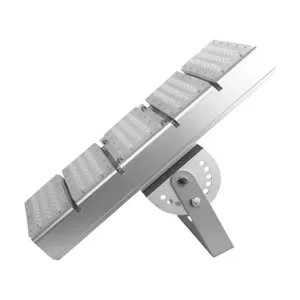
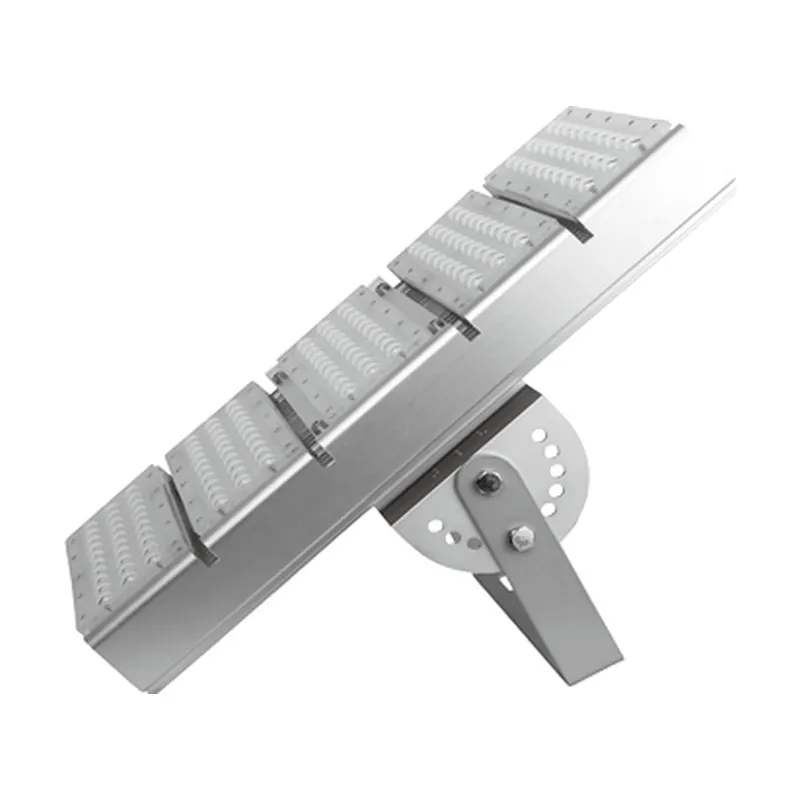
Our TLM30C modular flood light gives more than 110 lm/W, so a 200 W module delivers about 22,000 lm. That makes four or five 200 W floods on one mast of about 15 m, aimed in four directions, about 0.8–1 kW in total. The TLM30C uses a 140° × 80° road-type optic, IP67, with other lenses on request; an asymmetric lens keeps the light on the junction rather than spilling beyond it.
A photometric layout with the real optic then checks the uniformity and the light on approaching roads. Our article on high mast lighting coverage area explains how height sets coverage.
Worked example 2: a wide road
A 21 m wide road (six lanes) with poles on both sides, opposite each other, lit to class M2 (22 lux) with 12 m semi masts and 250 W heads at 110 lm/W. Our pole height and spacing calculator gives:
- spacing 42 m, the limit set by 3.5 times the mounting height;
- average about 24 lux, above the 22 lux required;
- 48 heads and about 12 kW per kilometre.
At 9 m height the spacing would drop to about 31 m and the pole count rise accordingly, so on wide roads taller poles often save money despite their higher unit cost. For highways and interchanges, our highway high mast lighting guide covers the larger scale.
Pole design points
- Wind load. A 15 m pole with four floods carries a large sail area at the top. The pole is designed to the local wind speed with the actual fitting areas and weights; ask the pole maker for the calculation.
- Foundation. Usually a reinforced concrete block with an anchor bolt cage, sized from the base moment and the soil report.
- Door and wiring. A base door gives access to the junction box, circuit protection and, where used, the controller for dimming.
- Galvanising. Hot-dip galvanising to a recognised standard protects the steel for decades; coastal sites may add a paint system.
Our high mast pole specification article lists what to put in a pole tender; most of it applies to semi masts too.
Controls
Junction and yard masts often run all night. Dimming to 50–70% after midnight, by a programmed driver or a central management system, cuts energy without leaving the area dark. A photocell or astronomical timer in the base cabinet switches the mast.
Common mistakes
- Too many fittings on too short a pole, causing glare for drivers.
- Symmetric floods aimed outward, which spill light onto buildings and the sky.
- No vehicle access for maintenance, forcing a crane hire later.
- Pole designed for fewer fittings than installed, a wind load risk.
For contractors and road authorities
Send us the site plan, the area or road width, the light class and the pole height you prefer. We will work out the number and wattage of floodlights or street light heads per mast and the spacing, and supply the luminaires for your pole supplier’s design.
Sources
Frequently asked questions
What is the height of a semi high mast?
Usually about 12–20 m. Below that it is treated as a street lighting column; above about 20–25 m it becomes a high mast, usually with a lowering ring for maintenance.
How many lights does a semi high mast carry?
Typically two to six floodlights or street light heads, depending on the area and the light level. A 40 × 40 m junction at 20 lux needs four or five 200 W modular floodlights by our estimate.
Does a semi high mast need a lowering system?
Usually not. Most are maintained from a bucket truck or an elevated work platform, which reaches 12–20 m. High masts of 25 m and above normally use a winch and lowering ring.
What is the difference between a semi high mast and a high mast?
Height, number of fittings and maintenance method. High masts of 25–40 m carry 6–20 or more floodlights on a lowering ring and light very large areas. Semi masts are shorter, carry fewer lights and light a junction, a yard or a road section.