
Highway High Mast Lighting: Masts or Conventional Poles at an Interchange?
When highways use high masts instead of poles: an interchange example comparing 30 m masts at 20 lux with 12 m poles on the ramps, with counts, loads and the maintenance and safety trade-offs.
Key points
- High masts suit interchanges, toll plazas and wide junctions, where many ramps cross a large area; long straight carriageways are usually lit better with conventional poles.
- By our spacing calculator, a 7.5 m ramp lit to class M2 with 150 W LED on 12 m poles needs a pole every 38 m: about 27 poles and 4 kW per kilometre.
- For an example interchange with 3.5 km of ramps, that is roughly 95 poles and 14 kW; covering the same 300 × 300 m area with 30 m masts at 20 lux takes about 6 masts and 36 kW.
- Masts use more energy because they light the whole area, including the land between ramps, but they put far fewer structures beside fast traffic and are maintained from outside the carriageway.
- Many interchanges combine both: masts over the core, poles on the outer ramps and approach roads.
Drive through a large motorway interchange at night and you will often see a few tall masts instead of rows of street lights along every ramp. On the main carriageway beyond, the masts give way to ordinary poles again. The choice between the two is not about looks; it comes down to geometry, safety and maintenance. This article works through an example.
Where masts make sense
High masts are used where many traffic lanes cross one area:
- cloverleaf and other multi-level interchanges;
- toll plazas and border crossings;
- large roundabouts and signalised junctions;
- service areas, truck parks and weigh stations;
- complex merges where many poles would crowd the verges.
On long straight sections, conventional poles light the carriageway efficiently: the light goes where the road is. Masts there would waste light on the verges and fields.
Option 1: conventional poles on the ramps
We used our pole height and spacing calculator for a typical ramp: 7.5 m wide (one lane with shoulders), lit to class M2 of EN 13201 (about 22 lux average illuminance, a common choice for interchange ramps), with 150 W LED at 130 lm/W on 12 m poles, single-sided:
| Road | Pole height | LED | Class | Spacing | Average | Per km |
|---|---|---|---|---|---|---|
| 7.5 m ramp | 12 m | 150 W | M2 | 38 m | 22 lux | 27 poles, 4.05 kW |
| 11 m two-lane ramp | 12 m | 150 W | M2 | 31 m | 22 lux | 33 poles, 4.95 kW |
| 7.5 m ramp | 10 m | 100 W | M3 | 35 m | 18 lux | 29 poles, 2.9 kW |
Take an example cloverleaf with four loop ramps and four outer ramps, about 3.5 km of single-lane ramp in total. Lit with the first row of the table, that is about 95 poles and 14 kW, plus extra poles at gores, merges and curves, where spacing has to shorten.
Option 2: high masts over the core
Our article on high mast coverage area gives the area one mast can light by the lumen method (utilisation factor 0.5, maintenance factor 0.8, floodlights at 130 lm/W). A 30 m mast with 10 × 600 W floodlights covers about 15,600 m² at 20 lux, a radius of about 70 m.
If the core of the same interchange is about 300 × 300 m (90,000 m²), it needs about 6 masts, each carrying 6 kW: 36 kW in total. In practice the layout is set by the ramp geometry and a photometric design, but six to eight masts is a realistic order.
Comparing the two
| Conventional poles | High masts | |
|---|---|---|
| Structures beside traffic | About 95, many on curves and gores | About 6, set well back |
| Installed load | About 14 kW | About 36 kW |
| Light on non-road areas | Little | Much of the area between ramps |
| Uniformity at merges and gores | Needs careful pole placement | Even over the whole area |
| Maintenance | From the carriageway, needs lane closures | From the mast base, outside traffic |
| Foundations | Many small | Few large |
| Visual impact | Many poles at low height | Few very visible masts |
The masts use roughly two and a half times the energy, because they light everything within their radius, including the grass between ramps. What they buy is safety and maintainability: dozens fewer poles where a vehicle can leave the road, and no lane closures for routine work. On busy interchanges, the cost and risk of a lane closure for every pole repair can outweigh the extra energy.
Making masts more efficient
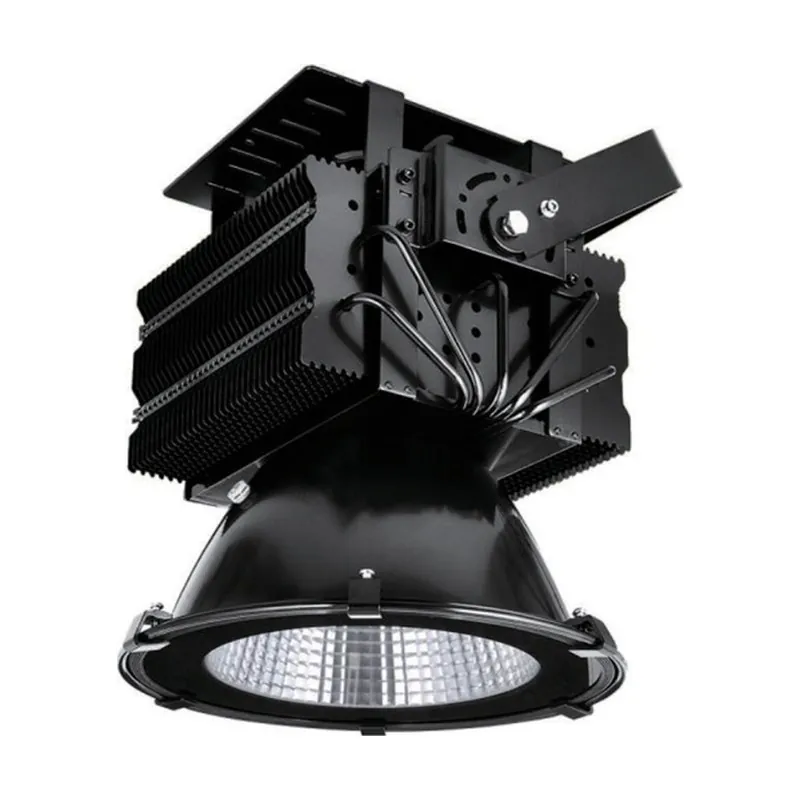
- Asymmetric and narrow beams keep light on the ramps rather than the infields. Our heat-pipe floodlight is available with 25°, 40°, 60° and 90° reflectors and a 216° adjustable bracket.
- Partial rings: a three-quarter or half ring at the edge of an interchange avoids lighting land beyond it, as on our 32 m steel pipe plant project, where one mast carries 8 floodlights on a three-quarter ring.
- Dimming after midnight, when traffic falls, cuts the energy gap considerably.
- Combined schemes: masts over the core, conventional poles on outer ramps and approaches.
Safety details
- Place masts outside the clear zone, or behind barriers, and protect bases from vehicle impact.
- Aim floodlights well below the horizontal and fit visors where they face oncoming traffic.
- Make the transition from the lit interchange to the unlit or lower-lit highway gradual, so drivers’ eyes adapt.
- On conventional poles in the clear zone, use passively safe or breakaway bases; our article on breakaway light pole bases explains the options.
Maintenance
A mast is maintained by lowering its ring to the ground at the base, with no traffic management on the carriageway. Our article on high mast light maintenance covers the lowering system, ropes and inspection schedule. With LED floodlights rated for 50,000 hours, the ring comes down mainly for annual inspections rather than lamp changes.
Light levels and classes
Interchange ramps are typically lit one class higher than the connecting roads, because drivers are changing lanes and speeds. Our guide to road lighting classes in EN 13201 lists the classes and their luminance and illuminance values, and highway light poles covers conventional pole choices for main carriageways.
For highway authorities and consultants
Send us the interchange layout, ramp widths, required lighting class and any constraints on mast positions. We will run both options, poles and masts, with our calculators, give the counts, loads and floodlight weights, and help decide where a combined scheme gives the best balance of energy, safety and maintenance.
Sources
Frequently asked questions
Why are high masts used on highways?
At interchanges and large junctions, one mast can light many lanes and ramps at once. That removes dozens of poles from beside fast traffic, reduces the number of crash hazards, and lets maintenance happen from outside the road.
How tall are highway high masts?
Usually 20–40 m, most often 25–35 m at interchanges. Taller masts cover more area per mast but need larger floodlights and foundations.
How far apart are high masts on a highway?
At 20 lux, a mast lights a radius of roughly twice its height with suitably sized floodlights, so 30 m masts are often 100–140 m apart. The exact spacing comes from a photometric design.
Do high masts cause glare for drivers?
They can if floodlights are aimed too high. Modern LED floodlights with tight optics and visors, aimed well below the horizontal, keep glare low; drivers see the light on the road rather than the source.
