
High Mast Lighting Survey Form: What to Record on Site Before a Quotation
A copyable high mast lighting site survey form: area, light level, mast positions, obstacles, soil, wind, power and maintenance access, with a first sizing from the survey data.
Key points
- A good site survey answers four questions: what area must be lit and how well, where masts can stand, what the ground and wind will demand of them, and how power and maintenance will reach them.
- With the area and target from the form, a first sizing takes one line: a 150 × 100 m yard at 20 lux needs about 750,000 lumens, roughly twelve 600 W floodlights at 110 lm/W.
- For a steel pipe plant yard, we supplied two 32 m masts carrying 10 and 8 floodlights of 600 W, about 10.8 kW in total, installed in September 2025.
- Soil data and the design wind speed decide the foundation and mast wall thickness; without them any mast price is a guess.
High mast projects go wrong most often before any steel is cut: the mast is placed where a crane swings, the foundation is designed without a soil report, or the floodlights are sized for the wrong area. A structured site survey prevents this. Below is the form we ask clients and contractors to complete, section by section, with a note on why each item matters and how the data turns into a first design.
Section 1: Project and contacts
- Project name, location and GPS coordinates
- Client, consultant and contractor contacts
- Applicable standards or client specification (for example EN 12464-2, IES RP-8, a port authority or highway standard)
- Required completion date
GPS coordinates also give us the climate data for wind and, for solar masts, the sunshine.
Section 2: Area to be lit
| Item | Record |
|---|---|
| Area type | Yard, port, highway interchange, sports ground, airport apron, parking |
| Overall dimensions | Length × width, or a dimensioned plan |
| Sub-areas with different needs | Loading zones, walkways, storage, roads |
| Target light level | Average lux (horizontal), plus vertical lux if required |
| Uniformity | Minimum ÷ average, for example 0.25 or 0.4 |
| Colour temperature and CRI | For example 4000 K, Ra 70 |
| Areas to keep dark | Neighbours, runways, sea lanes, roads |
Light level and area together set the total lumens. Our article on high mast lighting coverage area shows how height and spacing interact.
Section 3: Mast positions and height
- Candidate positions marked on the plan, with distances to edges
- Preferred mast height (for example 20, 25, 30 or 35 m)
- Ring type: full ring, three-quarter or half ring, depending on whether the mast lights in all directions or stands at an edge
- Clearances: overhead lines, crane paths, rail tracks, vehicle routes
- Airport or aviation height restrictions and obstruction lighting needs
At the steel pipe plant below, one mast stood in the open with a full ring and the other near an edge with a three-quarter ring, so the floodlights did not waste light outside the yard.
Section 4: Obstacles and the working environment
- Stacked goods and their maximum height (containers, pipes, steel coils)
- Moving equipment: gantry cranes, reach stackers, forklifts
- Dust, salt spray, chemical fumes or heat
- Vibration sources nearby
Stacks cast long shadows; two or more masts lighting each area from different directions reduce them. Coastal or chemical sites need a higher corrosion grade on floodlights and a heavier galvanising or paint system on the mast.
Section 5: Ground and foundation
- Soil report or at least the soil type (rock, clay, sand, fill)
- Groundwater level
- Underground services at each candidate position
- Access for a piling rig or excavator
The foundation must resist the overturning moment of the mast under wind. Without soil data the foundation is either oversized (costly) or unsafe. Our high mast installation guide covers the foundation and erection steps.
Section 6: Wind and climate
- Design basic wind speed from the national code (m/s, with its return period)
- Terrain category (open coast, open country, suburban)
- Temperature range, snow and ice
- Lightning frequency
Wind speed decides the mast’s wall thickness, base diameter and anchor bolts. The floodlights’ projected area and weight are part of that calculation; heavy or numerous floods on a tall mast need a stronger section. Our high mast pole specification lists what a mast tender must fix.
Section 7: Power and control
- Supply voltage and phases, and the distance to the nearest supply point
- Available capacity
- Switching: photocell, timer, central control system
- Dimming or part-night operation wanted
- Earthing and lightning protection requirements
A 10 kW mast at the end of a long cable run may need a larger cable or a higher voltage to stay within voltage drop limits.
Section 8: Maintenance access
- Vehicle access to each mast base
- Space for the lowering ring to descend and for workers around the base
- Who will maintain the system, and how often
Masts of 25 m and above normally have a winch and lowering ring. See high mast light maintenance.
Section 9: Photos and drawings
Ask for photos of each candidate position in four directions, the existing lighting, and any nearby obstructions, plus a dimensioned site plan in CAD or PDF.
From the form to a first design
With the area and target, a first estimate uses the lumen method:
lumens needed = target lux × area ÷ (utilisation factor × maintenance factor)
For a 150 × 100 m yard (15,000 m²) at 20 lux, with a utilisation factor of 0.5 and a maintenance factor of 0.8:
20 × 15,000 ÷ 0.4 = 750,000 lm
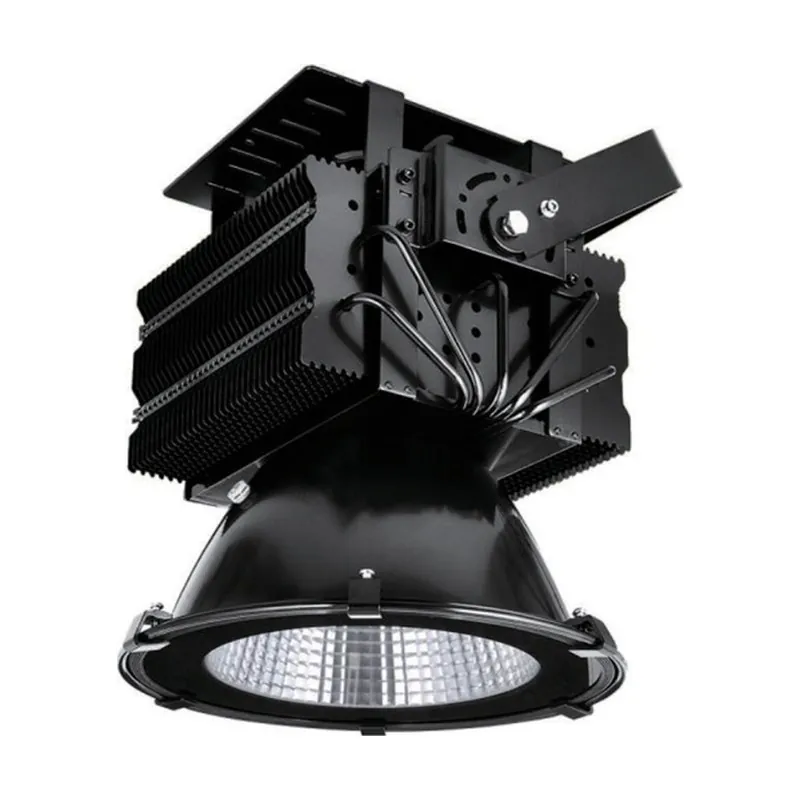
At 110 lm/W, a 600 W floodlight gives about 66,000 lm, so the yard needs roughly twelve 600 W floodlights, about 7.2 kW, split across two or three masts. The photometric design then sets aiming angles and checks uniformity and spill. Floodlights such as our heat-pipe stadium and port floodlight offer 25° to 90° optics, so each mast can mix narrow beams for distant areas with wider ones nearby.
A real project
For Hunan Shengli Xianggang Steel Pipe, we supplied lighting for an outdoor pipe yard with two 32 m masts: a full-ring mast with 10 × 600 W LED floodlights and a three-quarter-ring mast with 8 × 600 W, about 10.8 kW in total. They were installed on 15 September 2025. Tall masts were chosen so that cranes and trucks could move freely; many short poles would have obstructed them. Details are on our steel pipe plant high mast project page.
Common survey gaps
- No wind speed or soil data, so the mast cannot be designed.
- Mast positions chosen without checking crane paths or underground services.
- Target light level missing, so floodlights are sized by guesswork.
- No record of areas to keep dark, leading to complaints after commissioning.
Ordering
Send the completed form, the site plan and photos. We will return a mast layout, floodlight quantities and aiming, and a quotation for the high mast lighting package. Our high mast lighting guide explains the system as a whole.
Sources
Frequently asked questions
What is a high mast lighting survey?
A site visit that records everything needed to design and quote high mast lighting: the area and light level, possible mast positions, obstacles, soil and wind conditions, power supply and maintenance access.
What information do I need for a high mast quotation?
At minimum: a site plan with dimensions, the target light level, preferred mast height, possible mast positions, the design wind speed, soil information for the foundation, and the supply voltage.
How many floodlights does a high mast need?
It depends on the area and target. A 150 × 100 m yard at 20 lux needs about 750,000 lumens, roughly twelve 600 W floodlights at 110 lm/W, split across the masts.
Who should fill in the survey form?
Usually the client's engineer or the installing contractor, with photos. We then check the data and ask for anything missing before designing.
