Simple Solar Garden Light Circuit Diagram: How the Four Parts Work, With the Energy Sums
The circuit inside a solar garden light explained block by block: panel, Ni-MH cell, boost driver and dusk sensing, plus why it fades in winter, worked out with our battery calculator.
Key points
- A basic solar garden light has four parts: a small panel, one 1.2 V Ni-MH cell, a boost driver that raises 1.2 V to the 3 V a white LED needs, and the LED.
- There is no separate light sensor: the driver chip watches the panel voltage and turns the LED on when it falls at dusk.
- The boost driver is often a small four-pin chip with an inductor, a modern version of the 'joule thief' circuit.
- In our battery calculator, an example light drawing 0.06 W for 8 hours uses about 0.53 Wh a night; a 0.3 W panel brings in about 0.81 Wh on a 4.5-sun-hour day but only 0.43 Wh at 2.4 sun hours, so the cell drains in winter.
- Larger solar lights use lithium cells of 3.2–3.7 V, which can drive the LED directly through a current-limiting driver, with a dedicated charge and protection chip.
Open a solar garden light and you find surprisingly little inside: a small panel, one battery, a tiny circuit board with a coil and a chip, and an LED. Yet it charges by day, switches on by itself at dusk, and runs a white LED from a single 1.2 V cell. This guide explains how the circuit does it, block by block, and then works out the energy sums that decide how long the light runs, in summer and in winter.
The simple circuit as a diagram
Solar panel (about 2 V)

     |

     +----> [charging path] ----> Ni-MH cell (1.2 V)

     |                                  |

     +----> [panel voltage sense]       |

                    |                   |

             Driver chip  <-------------+

                    |

              Inductor (coil)

                    |

                White LED (about 3 V)
Four parts do all the work: the panel, the cell, the driver with its inductor, and the LED. Many lights add an on/off switch in the battery line.
Block 1: the solar panel
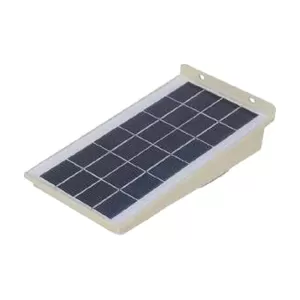
A small stake light has a panel made of a few silicon cells in series, giving roughly 2 V in sun: enough to push charge into a 1.2 V cell. Its output is small, typically a fraction of a watt, which is why the light runs for hours only after a full sunny day.
The panel has a second job: it is the light sensor. In daylight its voltage is clearly above the cell voltage; after sunset it drops close to zero.
Block 2: the Ni-MH cell
Most small garden lights use one 1.2 V Ni-MH cell, AA or AAA, of a few hundred to over a thousand mAh. Ni-MH tolerates the simple, unregulated trickle charge that a small panel gives, which is why it is used instead of lithium in the cheapest lights.
The charging path prevents the cell from discharging back through the panel at night. In very simple circuits that is a diode; in most modern lights the driver chip handles it.
Block 3: the boost driver and inductor
Here is the clever part. A white LED needs about 3 V before it lights, but the cell gives only 1.2 V. The driver chip solves this with a boost converter:
- The chip connects the inductor across the cell for a very short time, and current builds up in the coil.
- The chip disconnects it. An inductor resists a sudden change in current, so its voltage jumps up, above the 3 V the LED needs.
- The stored energy flows through the LED as a short pulse.
- This repeats tens of thousands of times a second, too fast to see.
This is a refined version of the hobbyist “joule thief” circuit, which does the same with a transistor and a hand-wound coil. Garden lights use small four-pin chips built for the job (often marked YX8018 or similar), with the inductor as the only other part. The inductor’s value sets the LED current, which is why the same chip appears in lights of different brightness.
Block 4: dusk switching
The driver chip has a pin connected to the panel. While the panel voltage is high, the chip keeps the boost converter off and lets the panel charge the cell. When the panel voltage falls at dusk, the chip starts the converter and the LED lights. At dawn the reverse happens. There is no LDR and no separate sensor: covering the panel with your hand switches the light on, which is the standard quick test.
The energy sums
Whether a light runs all night depends on two numbers: what the LED uses each night and what the panel brings in each day. We entered an example light into our battery autonomy calculator:
- LED drawing 0.06 W for 8 hours a night.
- 0.3 W panel, simple charging.
- One 600 mAh Ni-MH cell, 80% usable.
These are example inputs; measure or read your own light’s figures where you can.
| Season | Peak sun hours | Panel brings in | LED uses | Result |
|---|---|---|---|---|
| Sunny season | 4.5 | about 0.81 Wh | about 0.53 Wh | Cell refills each day |
| Dark winter month | 2.4 | about 0.43 Wh | about 0.53 Wh | Cell slowly drains; about 1.2 cloudy nights covered |
The 2.4 sun hours is the June figure for Cape Town from PVGIS, a typical mid-latitude winter. Open the example and enter your own figures.
To break even at 2.4 sun hours the panel would need to be about 0.37 W instead of 0.3 W, or the LED would need to run fewer hours. This is why the same garden light that glows all night in July is dim by 10 pm in December. Our guide to solar lights that work in winter covers the fixes.
Bigger lights: lithium circuits
Wall, security and flood lights use lithium cells: 3.7 V lithium-ion or 3.2 V LiFePO4. Their circuits differ:
- The cell voltage is already close to what a white LED needs, so a current-limiting driver or a buck/boost driver controls the LED instead of a 1.2 V boost circuit.
- A dedicated solar charge chip controls the charging current and stops at full charge.
- A protection circuit cuts off on over-charge, over-discharge and short circuit.
- A microcontroller often adds modes, motion sensing and a remote.
Our solar wall light SL3530J005 is this type: 5 W, a 6.8 Wp panel and a 3.7 V 8 Ah lithium battery, many times the energy of a stake light. Our street light circuit diagram shows the mains equivalent, and our automatic solar street light project shows how the same blocks scale up to a 30 W street light.
Fault-finding with the diagram
The diagram makes faults easy to trace:
- Never lights: switch off, dead cell, corroded contacts, or failed chip or LED. Cover the panel to test.
- Lights only briefly: the cell has lost capacity, or the panel is dirty or shaded. Our guide to changing the battery in a solar garden light walks through replacement.
- Stays on in daylight: the panel connection is broken, so the chip never sees daylight.
- Very dim: weak cell, or a damaged inductor.
Building your own
For a school or hobby project, the parts are easy to find: a small panel, a Ni-MH cell and holder, a four-pin solar LED driver chip with its inductor, and a white LED. A joule thief built from discrete parts teaches more about how the boost works, but the chip version is far more efficient.
For retailers and product developers
We supply solar wall and garden lights with the panel watts, battery chemistry and capacity stated on the specification. Tell us the market and the runtime your customers expect in winter, and we will work through the energy sums for each model with our calculators and confirm the certificates with the quotation.
Sources
Frequently asked questions
How does a solar garden light circuit work?
In daylight the panel charges a 1.2 V Ni-MH cell. At dusk the panel voltage falls, and a small driver chip switches on a boost converter that raises the cell's 1.2 V to about 3 V to light a white LED. At dawn the panel voltage rises and the chip turns the LED off.
Why does a solar garden light need an inductor?
A white LED needs about 3 V to light, more than a single 1.2 V cell gives. The driver chip switches current through the inductor rapidly; each time it switches off, the inductor's stored energy pushes the voltage high enough to drive the LED.
Does a solar garden light have a light sensor?
Usually not a separate one. The solar panel itself acts as the sensor: the driver chip measures its voltage and turns the LED on when it falls below a threshold.
Can I make a solar garden light circuit without a chip?
Yes, with a joule thief built from a transistor, a resistor and a hand-wound coil, plus a transistor that uses the panel voltage to disable it in daylight. The dedicated chips are smaller, cheaper and more efficient.