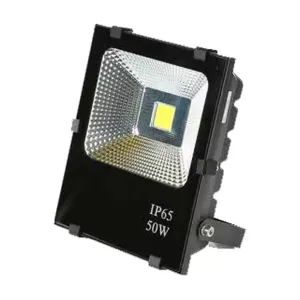
150 W and 200 W LED Flood Lights with Photocell: Hours, kWh and Area Lit
What a 150 W or 200 W LED flood light on a photocell uses: about 4,300 dusk-to-dawn hours a year anywhere, the kWh and cost, the area lit and the wiring.
Key points
- From sunset to sunrise there are about 4,300–4,340 hours a year almost everywhere between the equator and 50° latitude; only the split between winter and summer changes.
- On a photocell, a 150 W flood light uses about 645 kWh a year and a 200 W about 860 kWh; a timer or part-night dimming cuts that by a third or more.
- At 100 lm/W and 100 lux, one 150 W light covers about 60 m² and one 200 W about 80 m²; at 20 lux for a car park, 300 m² and 400 m².
- Fit the photocell where it sees the sky but not the floodlight's own beam, or the light will cycle on and off.
A floodlight on a photocell is one of the simplest pieces of outdoor lighting: it switches on when it gets dark and off when it gets light, with nobody touching a switch. That simplicity hides a question buyers rarely ask until the first electricity bill: how many hours does it actually run? The answer turns out to be almost the same everywhere, and with it you can work out the yearly energy and cost of a 150 W or 200 W LED flood light before buying. This guide does the arithmetic and adds the area each size can light.
Dusk to dawn: about 4,300 hours a year
We calculated the time from sunset to sunrise for every day of the year at different latitudes, using the standard solar position equations with the usual allowance for refraction:
| Latitude | Example | Night hours per year | Night on 21 December | Night on 21 June |
|---|---|---|---|---|
| 0° | Quito, Nairobi | 4,338 | 11.9 h | 11.9 h |
| 15° N | Manila, Dakar | 4,336 | 12.8 h | 11.0 h |
| 25° N | Riyadh, Miami | 4,333 | 13.4 h | 10.3 h |
| 34° N | Los Angeles, Lahore | 4,328 | 14.1 h | 9.6 h |
| 40.7° N | New York, Madrid | 4,322 | 14.7 h | 8.9 h |
| 51.5° N | London | 4,306 | 16.2 h | 7.4 h |
The yearly total hardly changes: long winter nights are paid back by short summer ones. Only the distribution moves. A photocell switches on a few minutes after sunset and off a few minutes before sunrise, depending on its switching level and on cloud, so a real dusk-to-dawn floodlight runs a little under these figures, typically about 4,100–4,300 hours.
Yearly energy and cost
With 4,300 hours a year:
| Flood light | Energy per year | At 0.10 per kWh | At 0.15 per kWh | At 0.25 per kWh |
|---|---|---|---|---|
| 100 W | 430 kWh | 43 | 65 | 108 |
| 150 W | 645 kWh | 65 | 97 | 161 |
| 200 W | 860 kWh | 86 | 129 | 215 |
| 400 W metal halide + ballast (about 460 W) | 1,978 kWh | 198 | 297 | 495 |
Replacing a 400 W metal halide floodlight with a 150 W LED on the same photocell saves about 1,330 kWh a year per light. Our LED retrofit savings calculator works out the payback for a group of lights; enter 11.8 hours a day for dusk to dawn. The fitting and installation costs in it are inputs for you to replace with your own quotation.
What a 150 W or 200 W flood light lights
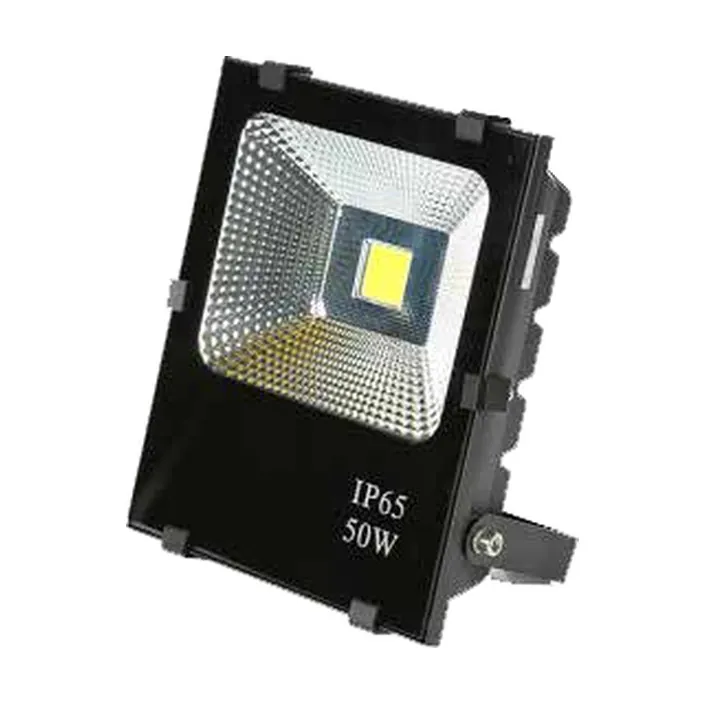
Our TLZ30J slim LED flood light is rated at more than 100 lm/W, so the 150 W size gives at least 15,000 lumens and the 200 W at least 20,000. Using the lumen method with a utilisation factor of 0.5 (wall or pole mounting) and a maintenance factor of 0.8:
| Target | Typical use | 150 W covers | 200 W covers |
|---|---|---|---|
| 20 lux | Car park, storage yard | about 300 m² | about 400 m² |
| 50 lux | Loading area, busy yard | about 120 m² | about 160 m² |
| 100 lux | Loading bay with work | about 60 m² | about 80 m² |
The area is simply lumens × 0.5 × 0.8 ÷ lux: a 20 × 10 m loading bay at 100 lux needs about four 150 W lights. These are averages for budgeting. Uniformity, glare and the shape of the area need a photometric calculation, and EN 12464-2 gives the light level for each outdoor task. Our LED flood light distance chart shows how mounting height and distance change the result.
Part-night operation: the cheaper photocell
A plain photocell runs the light all night. In many yards nobody works after midnight, but a dark yard invites theft, so the light stays on. Two options keep security and cut energy:
- Photocell plus timer. On at dusk, off at a set time, for example midnight, and optionally on again before dawn. A light switched off from midnight to 5:00 runs about 2,500–2,800 hours a year instead of 4,300.
- Dimming after midnight. A driver with a dimming schedule, or a controller, runs 100% until midnight and 50% after. That saves about a quarter of the energy and the yard stays lit. Combined with a motion sensor, the light returns to full brightness when someone enters.
Our guide to motion sensor flood lights explains the sensor options.
Wiring a photocell to an LED flood light
The usual arrangement is a photocell switch wired in series with the flood light’s live supply:
- Supply live to the photocell’s input, live out from the photocell to the flood light’s driver.
- Neutral and earth go straight to the flood light; the photocell takes neutral for its own electronics.
- Use a photocell rated for LED loads. LED drivers draw a short inrush current at switch-on, and several drivers on one photocell can weld its contacts. For more than two or three lights, let the photocell switch a contactor.
- Keep the junction boxes and the photocell sealed to at least IP65 outdoors.
Our photocell guide explains switching levels, fail-on and fail-off types and troubleshooting, and our flood light mounting guide covers brackets and aiming.
Placement mistakes that waste energy
- Photocell in the floodlight’s beam. The light switches on, the photocell sees its own light, the light switches off, and the cycle repeats every few seconds. Fit the sensor facing the sky, away from the beam, ideally facing north in the northern hemisphere.
- Photocell under an eave or in shade. It thinks dusk comes early and switches on in the afternoon.
- Dirty sensor. A dusty or painted-over window makes the light run longer, sometimes all day.
- One photocell per light on a large site. Lights switch at different times and the site looks untidy. Group them on one sensor and a contactor.
Which size to choose
- 100 W: gates, shop fronts and small yards, about 200 m² at 20 lux.
- 150 W: yards and car parks of about 300 m² per light at 20 lux, or a loading door at 100 lux.
- 200 W: larger yards and building facades, or higher poles where the light must travel further.
For large areas, several smaller lights on poles give better uniformity than one big light on the building. For facades and billboards, the narrow and wide beams are matched to the distance.
Ordering
Our TLZ30J is available from 50 W to 200 W with 90° or 120° beams, 3000–6000 K and IP65. Send us the area, the mounting height and the hours you want it on, and we will recommend the size, the beam and the control option, and quote with a photocell or dimming driver as required.
Sources
Frequently asked questions
How many hours a year does a dusk-to-dawn flood light run?
About 4,300 hours. We calculated sunset to sunrise for latitudes from the equator to 51.5° and found 4,306–4,338 hours a year. A photocell switches a few minutes after sunset and before sunrise, so the real figure is slightly lower.
How much electricity does a 150 W LED flood light use with a photocell?
About 150 W × 4,300 h = 645 kWh a year, plus a small amount for the driver's power factor and standby. At 0.15 per kWh that is about 97 a year.
What area does a 150 W LED flood light cover?
At 100 lm/W it gives about 15,000 lumens. With a utilisation factor of 0.5 and a maintenance factor of 0.8, that is about 60 m² at 100 lux, 120 m² at 50 lux or 300 m² at 20 lux.
Can I add a photocell to any LED flood light?
Yes, as long as the photocell is rated for the load and for LED drivers. Use a separate photocell switch wired in the supply to the flood light, or a fitting with a built-in sensor, and check the inrush current if several floodlights share one photocell.