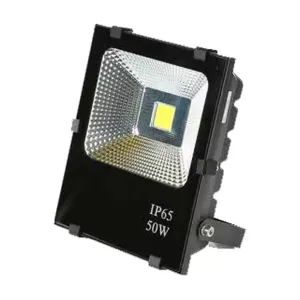
LED Flood Light Distance Chart: How Far 50 W to 1000 W Floodlights Really Reach
A 50 W, 90° flood light gives 20 lux at 7.5 m; a 400 W, 25° light still gives 55 lux at 60 m. Distance chart by wattage and beam angle, with the formula to check it.
Key points
- A flood light's useful distance depends far more on its beam angle than on its wattage. Halving the beam angle roughly quadruples the light at a given distance.
- A 50 W, 90° flood light gives about 20 lux on a surface 7.5 m away and 10 lux at about 10.6 m; at 120° those distances shrink to 4.3 m and 6.1 m.
- For long throws, narrow optics do the work: a 400 W light with a 25° beam still gives about 55 lux at 60 m, while a 60° beam gives about 8 lux.
- Beam diameter = 2 × distance × tan(beam angle ÷ 2). Average lux ≈ lumens in the beam ÷ beam area.
“How far will this flood light reach?” is one of the first questions buyers ask, and the answer on most product pages is a single number with no basis. The honest answer depends on three things: lumens, beam angle and how much light you need at the far end. This guide gives the formula, a distance chart for our own floodlights’ published lumens and beam angles, and the rules for choosing between wattage and beam.
The method
For a flood light aimed straight at a surface:
Beam diameter (m) = 2 × distance × tan(beam angle ÷ 2)
Average lux in the beam ≈ lumens in the beam ÷ beam area (π × radius²)
Not all of a floodlight’s lumens fall inside the quoted beam angle, because the beam angle is measured where intensity drops to half of the peak. For the charts below we assumed 70% of the lumens fall inside the beam, a reasonable figure for faceted-reflector and lensed floodlights. The real figure is in the photometric file; ask for it when the distance matters.
On the ground, a flood light mounted on a pole and aimed downwards gives an elongated pool instead of a circle, and the far end gets less light than the chart because the light strikes at a glancing angle. Treat the chart as the best case for a surface facing the light, such as a facade, a sign or a stack in a yard.
Distance chart: 50–200 W at 90° and 120°
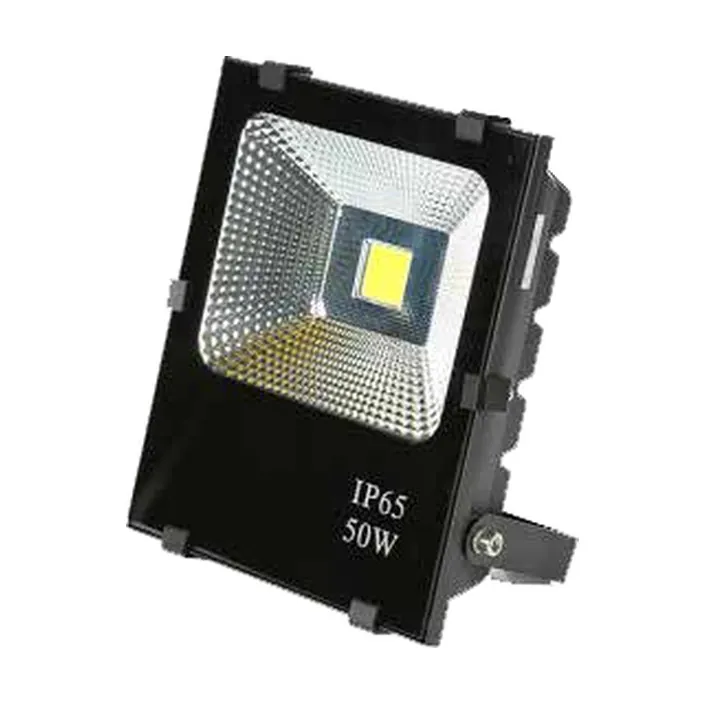
Our TLZ30J slim flood light is rated above 100 lm/W with a 90° or 120° reflector. Using 100 lm/W:
90° beam
| Power (lumens) | Beam width / lux at 5 m | at 10 m | at 15 m | at 20 m | Distance for 20 lux | Distance for 10 lux |
|---|---|---|---|---|---|---|
| 50 W (5,000 lm) | 10 m / 45 lux | 20 m / 11 lux | 30 m / 5 lux | 40 m / 3 lux | 7.5 m | 10.6 m |
| 100 W (10,000 lm) | 10 m / 89 lux | 20 m / 22 lux | 30 m / 10 lux | 40 m / 6 lux | 10.6 m | 14.9 m |
| 150 W (15,000 lm) | 10 m / 134 lux | 20 m / 33 lux | 30 m / 15 lux | 40 m / 8 lux | 12.9 m | 18.3 m |
| 200 W (20,000 lm) | 10 m / 178 lux | 20 m / 45 lux | 30 m / 20 lux | 40 m / 11 lux | 14.9 m | 21.1 m |
120° beam
| Power | Beam width / lux at 5 m | at 10 m | at 15 m | Distance for 20 lux | Distance for 10 lux |
|---|---|---|---|---|---|
| 50 W | 17 m / 15 lux | 35 m / 4 lux | 52 m / 2 lux | 4.3 m | 6.1 m |
| 100 W | 17 m / 30 lux | 35 m / 7 lux | 52 m / 3 lux | 6.1 m | 8.6 m |
| 150 W | 17 m / 45 lux | 35 m / 11 lux | 52 m / 5 lux | 7.5 m | 10.6 m |
| 200 W | 17 m / 59 lux | 35 m / 15 lux | 52 m / 7 lux | 8.6 m | 12.2 m |
So a common “50 W flood light distance” question has two answers: about 7–11 m with a 90° beam, 4–6 m with 120°, for 10–20 lux. Wide-beam floodlights are area lights for short distances, not searchlights.
Distance chart: 400–1000 W narrow-beam floodlights
For long distances, such as port yards, sports fields and high masts, floodlights use narrow reflectors. Our heat-pipe stadium and port floodlight is available with 25°, 40°, 60° and 90° reflectors. Using 110 lm/W:
| Power and beam | Beam width / lux at 20 m | at 40 m | at 60 m | at 80 m | Distance for 100 lux | Distance for 50 lux |
|---|---|---|---|---|---|---|
| 400 W, 25° | 9 m / 499 lux | 18 m / 125 lux | 27 m / 55 lux | 36 m / 31 lux | 45 m | 63 m |
| 400 W, 40° | 15 m / 185 lux | 29 m / 46 lux | 44 m / 21 lux | 58 m / 12 lux | 27 m | 38 m |
| 400 W, 60° | 23 m / 74 lux | 46 m / 18 lux | 69 m / 8 lux | 92 m / 5 lux | 17 m | 24 m |
| 1000 W, 25° | 9 m / 1,247 lux | 18 m / 312 lux | 27 m / 139 lux | 36 m / 78 lux | 71 m | 100 m |
| 1000 W, 40° | 15 m / 463 lux | 29 m / 116 lux | 44 m / 51 lux | 58 m / 29 lux | 43 m | 61 m |
| 1000 W, 60° | 23 m / 184 lux | 46 m / 46 lux | 69 m / 20 lux | 92 m / 11 lux | 27 m | 38 m |
The 400 W light with a 25° beam reaches 100 lux further than the 1000 W light with a 60° beam. That is the whole argument for choosing optics before wattage.
Wattage or beam: what changes the reach
Because illuminance falls with the square of distance:
- Doubling the wattage doubles the lux everywhere and extends the distance for a given lux by √2, about 40%.
- Narrowing the beam from 60° to 25° concentrates the same lumens on an area almost seven times smaller, extending the reach by about 2.6 times.
But a narrow beam lights a small patch. To cover an area evenly, you need more narrow beams aimed at different points, which is how sports and high mast floodlighting works. Our article on what stadium lights are called describes the main floodlight types and where each is used.
How much light do you need at the far end?
Typical maintained values on the lit surface or ground:
| Application | Typical target |
|---|---|
| Security and perimeter | 5–20 lux |
| Car parks and yards with vehicle movement | 10–30 lux |
| Loading bays, active storage yards | 50–100 lux |
| Building facades (depending on surroundings) | 20–150 lux |
| Recreational sports | 75–200 lux |
| Televised sports | 1,000 lux and more, vertical |
Our foot-candles to lux guide converts these if your specification is in foot-candles.
Worked example: a 30 m deep yard
A storage yard 30 m deep, lit from a building wall at 8 m height, needs about 20 lux at the far edge.
- A 200 W, 120° flood light reaches 20 lux at only 8.6 m. It lights the area near the wall brightly and leaves the far side dark.
- A 200 W, 90° flood light reaches 20 lux at about 15 m, still short.
- Two choices work: narrow optics aimed at the far half (for example 400 W, 60°, reaching 50 lux at 24 m and 20 lux at roughly 38 m), or a second row of lights on poles in the middle of the yard.
The second option usually gives more even light and less glare for drivers. Our LED flood light wattage guide works through more examples by application.
Aiming and glare
Longer throws need more careful aiming:
- Aim the beam centre about two thirds of the way to the far edge, so the upper half of the beam does not spill above the area.
- Keep the aiming angle below about 70° from vertical for pole-mounted lights, or use visors, to limit glare.
- Narrow beams magnify aiming errors; a 5° mistake at 60 m moves the spot by about 5 m.
Our flood light mounting guide covers brackets, heights and aiming, and our flood light lens guide explains how reflectors and lenses shape the beam.
Using the chart
- Measure the distance from the light to the farthest point that must be lit.
- Choose the lux needed there.
- Find the smallest wattage and beam combination in the charts that reaches it.
- Check the beam width at that distance covers the area, or plan several lights.
- For a final design, ask for a point-by-point calculation with the photometric file.
Send us a sketch of the area with mounting positions and heights, and we will choose wattage and beam angles from our floodlight range and return a lux plot.
Sources
Frequently asked questions
How far does a 50 W LED flood light reach?
With a 90° beam and about 5,000 lumens, a 50 W flood light gives roughly 45 lux at 5 m, 20 lux at 7.5 m and 10 lux at about 10.6 m on a surface facing it. With a 120° beam the same lumens spread wider, so 10 lux is reached at only about 6 m.
What is the beam spread of a flood light at a given distance?
Beam diameter equals 2 × distance × tan(half the beam angle). A 90° beam is twice as wide as the distance (20 m wide at 10 m); a 120° beam is about 3.5 times the distance; a 25° beam is about 0.44 times the distance.
Is a higher wattage or a narrower beam better for distance?
For distance, a narrower beam. Doubling the wattage doubles the lux at every distance and increases the reach by only about 40%. Going from 60° to 25° increases the lux on target almost seven times and the reach about 2.6 times.
Why does my flood light look bright but not light the far end of the yard?
Most general-purpose floodlights have 90–120° beams. They light a wide area close by and very little far away. To reach the far end, use a narrower optic aimed at it, or add a second light closer to the area.