
LED Parking Lot Lights: Pole Height, Wattage, Layout and Retrofit Payback
How to light a parking lot with LED: light levels, pole heights of 20–40 ft, wattage and optics, a layout from our spacing calculator, and savings from replacing 400 W metal halide with 150 W LED.
Key points
- Most parking lots use 6–12 m (20–40 ft) poles with 100–250 W LED area lights, placed along the driving aisles.
- A 400 W metal halide shoebox is usually replaced by 150 W of LED; in our 30-light example that saves about 39,000 kWh and US$6,800 a year, a payback of about 12 months.
- Type III, IV and V optics put the light on the parking area instead of the neighbours.
- Where no cable exists, compare with solar parking lot lighting before trenching.
Parking lots are where many businesses first meet LED lighting: the old metal halide “shoebox” lights burn every night of the year, their lamps fade to an orange glow within a few years, and relamping them needs a bucket truck. Replacing them with LED usually pays back in about a year. This guide covers the light levels, pole heights, layout and fixture choice, with a worked retrofit example. For new car parks without power, see our separate guide to solar parking lot lighting.
How much light
Recommendations differ by country and by how busy the parking is. As a guide:
| Parking area | Typical average illuminance |
|---|---|
| Low activity: residential, small offices | 5–10 lx (about 0.5–1 fc) |
| Medium activity: offices, schools, hospitals | 10–15 lx (about 1–1.5 fc) |
| High activity: retail, stations, sports venues | 20 lx or more (about 2 fc or more) |
| Entrances, pay stations, pedestrian crossings | Higher than the surrounding area |
In North America, IES RP-20 gives guidance for parking facilities, often expressed as minimum foot-candles for security, with limits on the ratio of maximum to minimum. In Europe, EN 12464-2 and the P classes of EN 13201 are common references. Uniformity matters as much as the average: dark patches between poles are what make a car park feel unsafe.
Pole height and wattage
| Lot size | Pole height | Typical LED per head | Typical spacing |
|---|---|---|---|
| Small (shops, offices) | 6–7.5 m (20–25 ft) | 60–100 W | 20–26 m (65–85 ft) |
| Medium (supermarkets, schools) | 8–9 m (26–30 ft) | 100–150 W | 26–32 m (85–105 ft) |
| Large (malls, stadiums, logistics) | 10–12 m (35–40 ft) | 150–250 W | 32–42 m (105–140 ft) |
Poles inside the lot usually carry two heads back to back (lighting two parking modules) or four heads in the middle of large areas; poles at the boundary carry one head aimed inwards.
Layout: a worked example
A standard parking module is a 7 m driving aisle with a 5 m row of bays on each side, 17 m in all. Treating it as a 17 m “road” in our pole height and spacing calculator, with 9 m (30 ft) poles and 150 W LED area lights at 130 lm/W:
- Lights on both edges of the module, 31 m apart
- About 29 lx average, well above a busy retail target of 20 lx
- About 78 W per head would reach 15 lx; about 104 W would reach 20 lx
So for a medium-activity lot, 100 W heads at the same spacing would do the job, saving a third of the power. For a busy retail lot, 120–150 W gives margin for ageing and dirt. With 7.5 m (25 ft) poles and 100 W heads, the spacing drops to about 26 m.
The optics matter
LED area lights come with several standard distributions:
- Type III: throws light forwards and to the sides; for poles at the edge of the lot.
- Type IV: a stronger forward throw with little light behind; for boundaries next to houses or roads.
- Type V: a round or square pattern; for poles in the middle of the lot.
- House-side shields cut the light behind the pole even further.
Choosing the right optic for each pole position often does more for uniformity and neighbour complaints than adding wattage. Flat-glass, full cut-off fixtures send no light above the horizontal, which reduces sky glow and is required by many dark-sky ordinances.
Retrofit example: 30 shoebox lights
A shopping centre car park has 30 × 400 W metal halide shoebox fixtures (about 448 W with magnetic ballasts) on existing poles, burning 12 hours a night. Relamping and repairs cost about US$35 per fixture a year. They are replaced one for one with 150 W LED area lights at US$180 each plus US$50 installation, keeping the poles and cables. At US$0.15/kWh, our LED retrofit savings calculator gives:
- About 58,900 kWh a year before, 19,700 kWh after: 39,200 kWh saved (67%)
- About US$5,900 in energy plus US$960 in maintenance: US$6,800 a year
- Investment US$6,900, payback about 12 months
- About 20 tonnes of CO₂ avoided a year
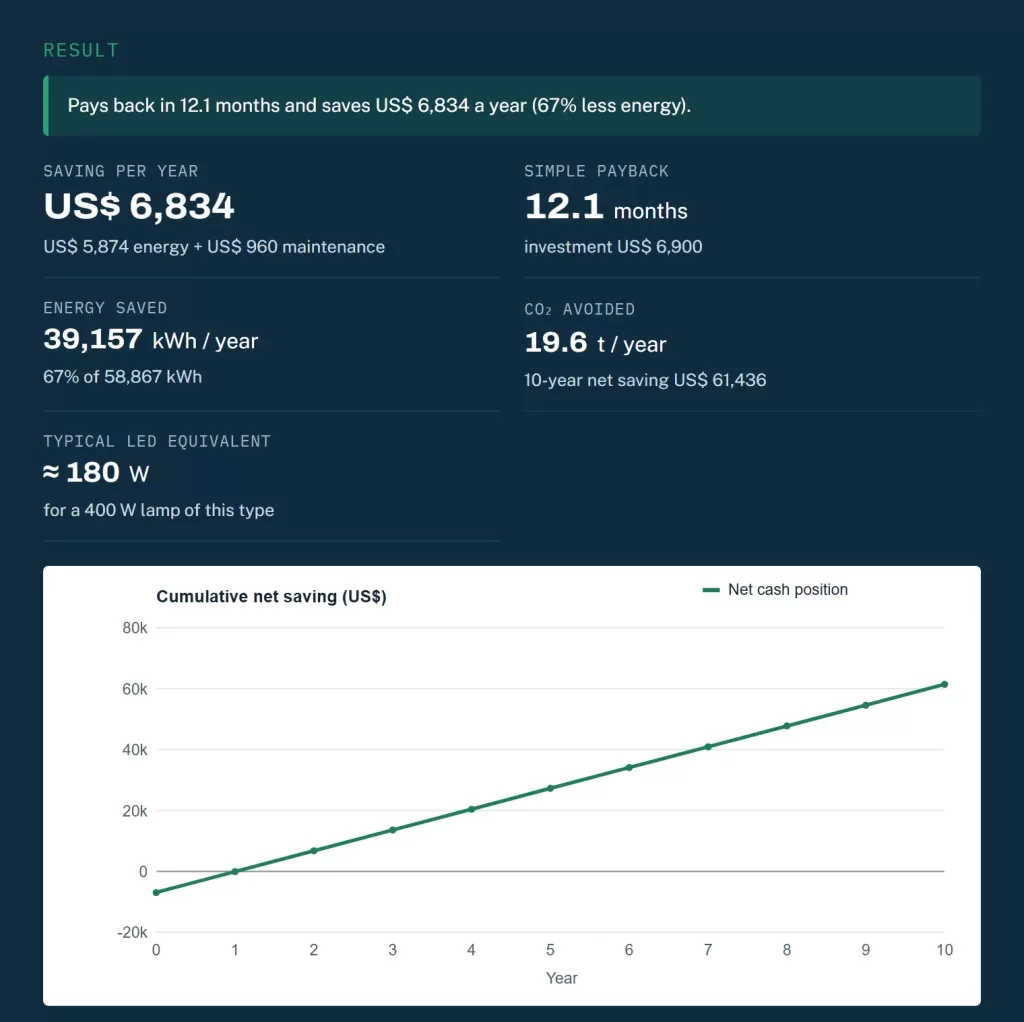
Open this example and enter your own numbers. Adding dimming after closing time, for example to 30–50% from midnight to dawn with motion sensors to bring the light back up, reduces the LED energy by roughly another third.
Retrofit kit or new fixture?
- Retrofit kits (LED modules fitted inside the old shoebox housing) cost less but depend on the condition of the old housing and seals, and the result keeps the old optics.
- New fixtures cost more but come with optics designed for LED, a sealed housing and a new warranty. On housings that are 15–20 years old, new fixtures are usually the better investment.
- Check the pole top fitting (slip fitter, arm mount or direct mount) and the pole condition before ordering; a corroded pole base is a safety issue that a new light does not fix.
Specification checklist
- Luminaire lumens and efficacy from a test report, not just watts
- Optic type for each pole position (III, IV, V) and photometric files for a layout
- Colour temperature: 3000–4000 K is common; warmer light reduces glare and sky glow
- IP65 or better, surge protection of 10 kV or more
- Dimming driver and a photocell or controller socket (NEMA or Zhaga) if controls are planned
- Mounting type to match the existing poles
Our modular LED street and area lights cover 30–350 W in one housing family, so one fitting can serve the whole car park and the access road. Send us a site plan with the pole positions, and we will return a photometric layout and a savings estimate.
Sources
Frequently asked questions
What wattage LED replaces a 400 W metal halide parking lot light?
Usually 130–150 W of LED at 130–140 lm/W. The metal halide fixture draws about 450 W with its ballast and loses much of its light in the reflector, so a well-aimed LED area light of about a third of the power gives the same or better light on the ground.
How tall should parking lot light poles be?
Typically 6–9 m (20–30 ft) for small and medium lots and 10–12 m (35–40 ft) for large lots. Taller poles can be spaced further apart but need brighter luminaires and stronger foundations.
How far apart should parking lot lights be?
Roughly 3–4 times the mounting height: about 25–35 m (80–115 ft) for 9 m (30 ft) poles. The exact spacing depends on the light level, the optics and whether poles carry one, two or four heads.
What does LED parking lot lighting cost to run?
A 150 W LED area light running 12 hours a night uses about 660 kWh a year, roughly US$100 at US$0.15/kWh, against about US$290 for the 400 W metal halide fixture it typically replaces.