
Solar Parking Lot Lighting: Layout, Sizing and a 10-Year Cost Comparison
How to light a car park with solar street lights: light levels, pole height and spacing, sizing the panel and battery, and a 40-light cost comparison with grid-powered LED including trenching, cable and electricity.

Key points
- Car parks typically need 5–20 lx depending on use; busy commercial car parks and entrances need more.
- Use 6–8 m poles with 40–60 W solar lights in rows along the driving aisles, spaced about 3–4 × the pole height.
- A 60 W solar light running 5 h at 100% and 7 h at 30% needs about 1,578 Wh of battery for 3 nights and a 150 Wp panel at 4.5 sun hours.
- In our 40-light example, solar costs about US$42k over 10 years against about US$81k for grid lighting, mainly because there is no trench or cable.
Car parks are one of the best places for solar lighting. They are open to the sky, their lights stand in rows that would otherwise need trenches across the tarmac, and most of them are nearly empty for much of the night. This guide covers the light levels, layout and sizing, and compares the 10-year cost with grid-powered lighting.
How much light
| Car park | Typical average illuminance |
|---|---|
| Light traffic: residential, small offices | 5 lx |
| Medium traffic: offices, schools, hospitals | 10 lx |
| Heavy traffic: shopping centres, stations, sports venues | 20 lx |
Entrances, pedestrian crossings and pay stations deserve extra light. In Europe, EN 12464-2 and the P classes of EN 13201 give reference values; elsewhere, check local codes and the client’s standard.
Layout
- Poles along the driving aisles, not over the parking bays, so cars do not block the light and drivers do not hit the poles.
- Pole height 6–8 m for most car parks; 10–12 m for very large ones.
- Spacing about 3–4 × the pole height: 18–24 m for 6 m poles, 24–32 m for 8 m poles.
- Asymmetric or Type III optics at the edges, aimed into the car park and away from neighbours.
The pole height and spacing calculator can treat a driving aisle as a road: enter the aisle plus the bays on each side as the “road width” and use a P class (P2 = 10 lx, P1 = 15 lx).
Example: one parking module
A typical parking module is a 7 m driving aisle with a 5 m row of bays on each side: 17 m wide. Entered in the pole height and spacing calculator as a 17 m “road” with 8 m poles and 60 W lights:
- The calculator chooses lights on both edges, facing each other, 28 m apart
- Average about 14 lx, comfortably above class P2 (10 lx); about 44 W would just reach it
- For a brighter commercial car park (P1, 15 lx), 80 W lights at the same spacing give about 18 lx
Where modules sit side by side, the poles on the line between two modules can carry two heads back to back, so one pole lights the edge of both modules. That roughly halves the number of poles compared with treating each module separately. With 6 m poles and 40 W lights (class P3), the spacing drops to about 21 m.
Light where it matters: entrances, crossings and charging bays
- Entrances and exits: drivers move from a bright road into the car park; raise the level near the entrance and use the brightest light at the barrier or pay station.
- Pedestrian routes and crossings: vertical light on people’s faces matters as much as light on the ground, both for drivers and for security cameras.
- EV charging bays: users handle cables and read screens; plan extra light at each charger, and remember that chargers need grid power anyway, so lights in that area may share the supply.
- CCTV: cameras need even light without strong shadows or glare into the lens; agree the camera positions before finalising the lighting layout.
Sizing the solar lights
A typical car park light: 60 W LED, 5 hours at 100% from dusk, then 7 hours at 30% (the car park is quiet after the evening), LiFePO4 battery, MPPT controller, 3 nights of autonomy, 4.5 worst-month sun hours. The solar street light calculator gives:
- 473 Wh used per night
- Battery 1,578 Wh (about 123 Ah at 12.8 V)
- Panel 146 Wp, so a 150 W standard panel
With motion dimming, the night energy falls further, because a quiet car park keeps the lights at standby most of the night. For example, 4 hours at 100% followed by a 20% standby level for 8 hours uses about 373 Wh a night instead of 473 Wh. The same light then needs about 1,244 Wh of battery (97 Ah) and a 120 W panel instead of 150 W: about a fifth smaller, for every light in the car park.
Opening hours change the design
A car park that closes at 22:00 does not need full light until dawn. Common patterns:
| Car park | Suggested schedule |
|---|---|
| Office or school, closed at night | 100% until closing, then 20–30% with motion boost |
| Shopping centre, open late | 100% until closing plus an hour, then motion-dimmed standby |
| Station, hospital, 24-hour site | Steady level all night, 50–70% after midnight with motion boost |
Agree the schedule with the operator before sizing, because it changes the battery more than any other input.
Cost comparison: 40 lights over 10 years
We compared 40 lights in the solar vs grid cost calculator, with these example assumptions (replace them with local quotes):
| Grid-powered | Solar | |
|---|---|---|
| Light + pole, installed | US$600 each | US$800 each |
| Trench + cable | US$30/m, 25 m between poles (1,000 m) | — |
| Grid connection | US$3,000 | — |
| Power and hours | 60 W, 12 h a night, US$0.15/kWh, +3% a year | — |
| Battery replacement | — | US$150 every 6 years |
| Maintenance | US$15 per light per year | US$10 per light per year |
Results:
- Grid: US$57,000 upfront, of which US$30,000 is trenching and cable; about US$81,000 over 10 years
- Solar: US$32,000 upfront; about US$42,000 over 10 years, including one battery change
- Solar saves about US$39,000 and is cheaper from day one; it also avoids about 105 MWh of grid electricity and 53 tonnes of CO₂
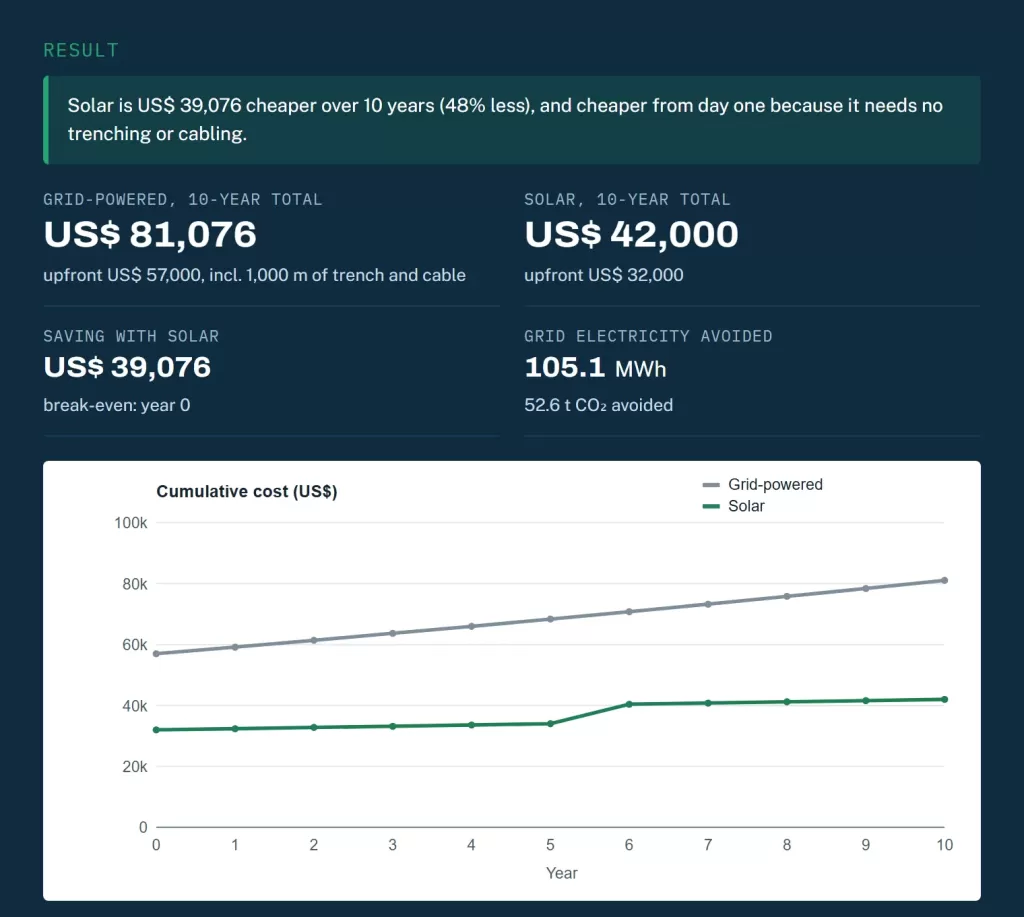
Open this example and enter your own prices. Where the car park already has powered poles, set the trench cost to zero: grid LED will then usually win.
Practical points
- Shade from trees and buildings: check every pole position; a shaded panel ruins the sizing.
- Vehicle impact: protect poles with kerbs or bollards in tight aisles.
- Theft and vandalism: anti-theft fixings for panels and batteries.
- Security cameras: if CCTV shares the pole, add its consumption to the nightly energy, or power it separately.
For the full cost reasoning, see solar vs grid street lights. Send us your car park plan and location; we will propose the layout, size the lights and quote. See our solar street lights.
Sources
Frequently asked questions
How many lux does a parking lot need?
As a guide, about 5 lx for light-traffic car parks such as residential areas, 10 lx for medium traffic such as offices and schools, and 20 lx for heavy-traffic car parks at shopping centres, stations and sports venues. Local codes and client standards may set different values.
How far apart should parking lot lights be?
About 3–4 times the mounting height: 18–24 m for 6 m poles and 24–32 m for 8 m poles, placed along the driving aisles rather than over the parking bays.
Are solar parking lot lights worth it?
Usually yes for new car parks without existing cabling, because trenching, cable and connection to the grid often cost more than the extra price of the solar lights. Where powered poles already exist, grid LED is normally cheaper.