Solar High Mast Lights: When They Work and How They Are Sized
How solar high mast lighting works: why high masts need large energy, panel and battery sizing, typical heights and wattages, where solar or hybrid masts make sense, wind loads, and alternatives.
Key points
- High masts of 15–30 m carry several floodlights totalling hundreds or thousands of watts, so their nightly energy need is far larger than a street light's.
- Solar high masts are practical for moderate outputs, typically up to a few hundred watts of LED with dimming, at sites without grid power.
- The panel area and battery bank needed for large masts are big; they are often placed on a ground frame near the mast rather than on top.
- For large junctions, ports and stadiums with grid access, grid-powered LED high masts are usually more economical.
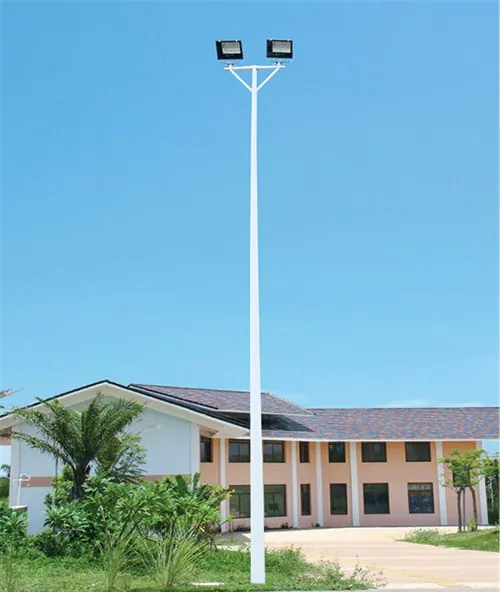
High masts light large areas from one point: junctions, interchanges, ports, markets, mining camps and sports fields. Making them solar powered is appealing where there is no grid, but the energy numbers are much larger than for street lights. Understanding those numbers is the first step.
Why high masts need so much energy
A street light might use 30–60 W. A high mast carries several floodlights: six 200 W floods is 1,200 W. Running that for 12 hours needs over 14 kWh a night. Even with dimming, the energy need is many times that of a street light.
The same design rules apply as for any solar light, just at a larger scale:
- Nightly energy = total LED power × hours, adjusted for dimming
- Panel energy per day = panel kWp × peak sun hours × about 0.7–0.75 for a larger system
- Battery = nightly energy × days of autonomy ÷ usable depth of discharge
A worked example
Take a 15 m mast with four 150 W LED floods (600 W). Profile: full power for 5 hours, 40% for 7 hours.
- Nightly energy: 600 × 5 + 240 × 7 ≈ 4.7 kWh
- At 4.5 peak sun hours and about 0.72 system efficiency, the panel must be about 1.5 kWp
- For 2 nights of autonomy with LiFePO4 at 80% usable capacity, the battery is about 12 kWh
That is a significant installation: several square metres of panels and a large battery bank, usually in a ground-mounted cabinet beside the mast. For a mast with 1,200 W or more of floods, the system grows accordingly.
Where solar or hybrid masts make sense
- Remote road junctions and border crossings without grid supply
- Rural markets, bus parks and town squares in regions with unreliable power
- Mining camps and construction sites
- Community sports fields in off-grid areas
- Temporary sites where grid connection is not worth it
In windy coastal or upland sites, a wind turbine can supplement the panels; see wind-solar hybrid street lights for the principles.
Where grid power is better
For large interchanges, ports, stadiums and logistics yards with grid access, grid-powered LED high masts are usually far cheaper per lumen. LED floodlights already cut energy by 50–70% compared with old sodium and metal halide floods, which makes grid operation affordable. See the high mast lighting guide.
Panel placement
Panels on top of a high mast add large wind loads and are hard to maintain. Common options:
- Ground-mounted array next to the mast, fenced and with the battery cabinet
- Panels on a lower bracket of the mast for smaller systems
- Separate array serving several masts on one site
Ground arrays are easier to clean and secure, and they keep wind load on the mast manageable.
Batteries and controllers
Large solar masts use battery banks of LiFePO4 modules in ventilated cabinets, with a battery management system and MPPT charge controllers. The controller handles dusk switching, dimming profiles and protection. Remote monitoring is strongly recommended for remote sites so problems are found before the area goes dark.
Floodlights for solar masts
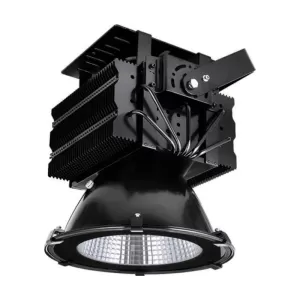
Efficiency matters even more than usual: every watt saved reduces panel and battery size. Choose floodlights with high efficacy and optics that put light where it is needed, so fewer watts achieve the target. Our heat-pipe stadium and port floodlights offer 25° to 90° reflectors for aiming from height.
Mast structure and wind load
High masts must be designed for the site’s design wind speed, with the floodlights, ring and any panels included. Masts above about 20 m usually have a lowering system for maintenance. Foundations are large reinforced concrete blocks designed by an engineer for the soil. Adding panels to an existing mast changes its loads and requires a structural check.
Maintenance
- Clean panels regularly, especially in dusty regions
- Inspect battery cabinets for heat and ventilation
- Check floodlight aiming and the lowering system
- Replace battery modules on schedule, typically every 5–8 years
- Keep spare controllers and fuses on site
Alternatives
For moderate areas, several solar street lights on 8–12 m poles may be simpler than one solar high mast: the energy is spread over more, smaller systems, and one failure does not darken the whole area. For areas with grid access, a grid high mast is usually the cheapest long-term solution.
Security and theft
Large battery banks and panel arrays are valuable. Remote masts need secure, locked cabinets, fencing around ground arrays, anti-theft fixings and, ideally, monitoring that raises an alarm if a cabinet is opened. Community involvement helps on village and market sites, where local people benefit directly from the light.
Phased approach for remote sites
Where budgets are limited, start with a mast designed for the full number of floodlights but install fewer at first, with a panel array and battery sized to match. Add floodlights and panels later as funds allow. Designing the mast and cabinet for the final size from the start avoids replacing them later.
Monitoring and fault response
On remote solar masts, a monitoring unit that reports battery state, charging and floodlight status by mobile network lets operators plan visits and spot failing batteries early.
Ordering
Send us the site layout, area to be lit, required light level, hours of operation and whether grid power is available. We will compare solar high mast, multiple solar poles and grid options, and propose the configuration that fits.
Sources
Frequently asked questions
Can high mast lights be solar powered?
Yes, for moderate outputs. A solar high mast with, for example, 200–400 W of LED dimmed late at night needs a few kilowatt-hours a night, which requires a large panel array and battery bank. For very high outputs, grid power is usually more practical.
How tall are solar high mast lights?
Typically 12–20 m for solar or hybrid designs. Taller masts carry more floodlights and need much more energy and stronger structures.
Where are solar high mast lights used?
Remote junctions, rural markets and town squares, mining camps, construction sites, border posts and community spaces where the grid is unavailable or unreliable.