Shielded Street Lights: Full Cutoff, BUG Ratings and Dark-Sky Road Lighting
Shielded street lights explained: full cutoff vs semi-cutoff, how to read a BUG rating, why tilt adds uplight, and worked spacing showing a level-mounted LED head still meets the target.
Key points
- A shielded (full cutoff) street light emits no light above the horizontal; in IES TM-15 terms that is an uplight rating of U0.
- Most LED street lights with a flat lens are close to full cutoff when mounted level; tilting the head upwards to reach farther adds uplight and glare.
- In our calculation, a 40 W head on 6 m poles along a 6 m residential road gives about 14 lux at 21 m spacing, and 80 W on 8 m poles along a 7 m road about 17 lux at 28 m, without tilt.
- Ask for the IES or LDT photometric file and the BUG rating at the installed tilt; a catalogue picture of a flat lens is not proof of full cutoff.
Residents complain about glare in their bedrooms; astronomers complain about the orange or white dome over every town; ecologists worry about insects and bats. Much of this comes from light that leaves a street light sideways or upwards instead of going onto the road. Shielded street lights are the answer. This guide explains the terms (full cutoff, BUG rating, uplight), what makes an LED head shielded or not, and whether shielding costs extra poles.
Terms you will meet
| Term | Meaning |
|---|---|
| Full cutoff | No light above 90° (the horizontal) and limited light between 80° and 90° |
| Cutoff | Small amount allowed above 90°, more allowed near the horizontal |
| Semi-cutoff / non-cutoff | Significant light at and above the horizontal; typical of old globe and drop-lens fittings |
| Fully shielded | Common planning term: no light emitted above the horizontal |
| BUG rating | Backlight, Uplight and Glare classes from IES TM-15, each 0–5 |
| ULR / ULOR | Upward light ratio: the share of the fitting’s flux emitted above the horizontal |
The older full cutoff / cutoff classes are still widely used in specifications, but the BUG system has largely replaced them because it also describes glare and light behind the fitting.
Reading a BUG rating
A BUG rating such as B1 U0 G1 says:
- B (backlight) 1: little light falls behind the pole, onto house fronts and gardens.
- U (uplight) 0: no light above the horizontal. This is the dark-sky requirement in most ordinances.
- G (glare) 1: limited light at high angles where it would dazzle drivers and residents.
The rating depends on the fitting and how it is mounted. The same head can be U0 when level and U1 or U2 when tilted up by 10°. Ask for the BUG rating at the installed tilt, or the photometric file so your designer can check it.
What makes an LED street light shielded
Four features matter:
- Flat lens or flat glass. LEDs facing straight down behind a flat optic cannot emit above the horizontal when the head is level.
- Mounting level. Zero tilt keeps the flat lens horizontal. Many old fittings were tilted 5–15° to throw light across wide roads.
- Road optic. An asymmetric lens that spreads light along and across the road removes the reason to tilt.
- No reflective skirts or domed covers. Domed or dropped diffusers spread light sideways and up.
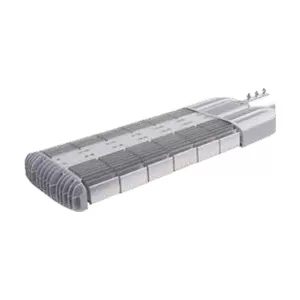
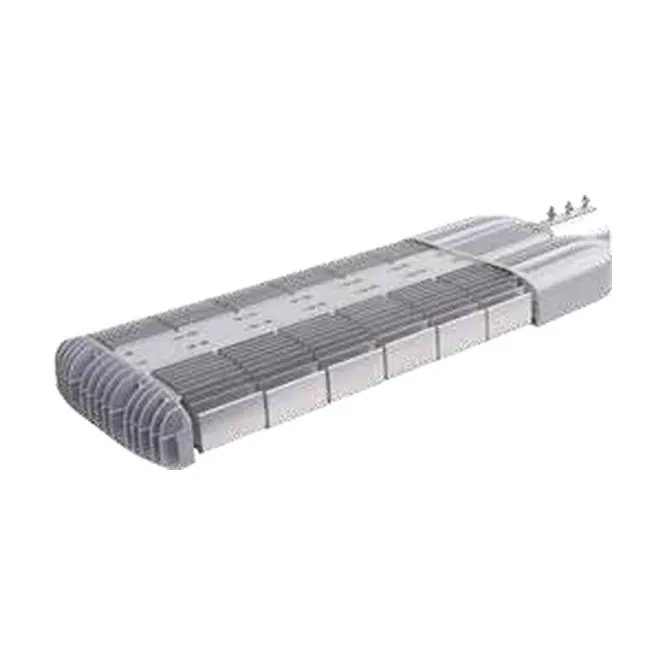
Our LDM30C modular street light uses PMMA road lenses on a flat module face (140° × 80° distribution), designed to be mounted level. For the BUG rating of a specific wattage and optic, ask us for the photometric file; we do not quote a rating without one. For spill onto house fronts, our guide to street light house-side shields covers backlight control in detail.
Does shielding cost extra poles?
The usual worry: if the head is not tilted, will it reach far enough? We checked typical roads with level-mounted heads in our pole height and spacing calculator, at 110 lm/W and a maintenance factor of 0.8:
| Road | Pole height | Head | Target class | Spacing | Average |
|---|---|---|---|---|---|
| 6 m residential street | 6 m | 30 W | P4 (5 lux) | 21 m | about 10.6 lux |
| 6 m residential street | 6 m | 40 W | P3 (7.5 lux) | 21 m | about 14.2 lux |
| 7 m collector road | 8 m | 60 W | M5 | 28 m | about 12.9 lux |
| 7 m collector road | 8 m | 80 W | M4 | 28 m | about 17.2 lux |
(Open the 6 m street example.)
In each case the spacing reached the usual limit of about 3.5 times the pole height, and the average comfortably exceeded the class. The calculator even says a 30 W head would be more than enough for P4 at 21 m (it estimates about 14 W would meet 5 lux). In other words, on ordinary residential and collector roads, there is no need to tilt for reach; tilt mainly adds glare and uplight. The calculator gives averages; uniformity must be checked with the real photometric file. Our guide to road lighting classes explains P and M classes.
Colour and intensity also matter
Shielding controls direction. Two more choices reduce sky glow and disturbance:
- Warmer colour temperature. 3000 K or lower emits less blue light, which scatters more in the atmosphere and affects wildlife more. Many dark-sky ordinances set 3000 K as a maximum. See LED street light colour temperature.
- Not over-lighting. The examples above show how easy it is to exceed the target. A 40 W head where 20 W would do doubles the light reflected from the road into the sky.
- Dimming after midnight. Part-night dimming halves the light when roads are empty.
Retrofitting old fittings
Replacing globe lanterns and drop-lens cobra heads with level-mounted flat-lens LED heads is the single biggest step a town can take. Points to check:
- Arm angle. Old arms may be angled upwards. Use an adjustable bracket or a level-mount adapter so the new head sits flat.
- Spacing. Old poles at 40–50 m spacing on 8 m poles may need a higher-power head or a different optic. Check the result with a calculation before ordering.
- Lumens, not watts. Do not copy the old wattage. LED heads often need half or less for the same road.
Our HPS to LED conversion chart gives starting points for the wattage.
Common mistakes
- Assuming every LED head is full cutoff. Tilt and optic decide it.
- Accepting “dark-sky friendly” without data. Ask for the BUG rating or the photometric file.
- Shielding the head but over-lighting the road. Reflected light still reaches the sky.
- Forgetting the arm angle in retrofits. A flat lens tilted 15° is no longer shielded.
If your project must meet a dark-sky ordinance or a planning condition, send us the road widths, pole positions and the requirement. We will propose a head and optic, and supply the photometric file so the BUG rating can be checked at the installed tilt.
Sources
- IES TM-15-20 — Luminaire Classification System for Outdoor Luminaires (BUG ratings)
- DarkSky International — Fixture Seal of Approval and lighting principles
- CIE 150:2017 — Guide on the limitation of the effects of obtrusive light from outdoor lighting installations
- BlueGreen OE — Pole height and spacing calculator
Frequently asked questions
What is a shielded street light?
A street light designed so that no light, or very little, goes above the horizontal plane through the fitting. Full cutoff fittings emit no light above 90° and limit light just below it; they reduce sky glow and glare.
What does BUG rating mean?
Backlight, Uplight and Glare: three ratings from IES TM-15, each from 0 (lowest) to 5, describing how much light goes behind the fitting, above the horizontal and into high glare angles. A dark-sky street light is typically U0.
Are LED street lights full cutoff?
Many are when mounted level, because the LEDs face down behind a flat lens. A head tilted upwards by 10–15°, or one with a dropped or domed lens, can emit light above the horizontal. Check the BUG rating at the installed tilt.
Do shielded street lights need more poles?
Not necessarily. A good road optic spreads light along the road without tilt. In our examples, level-mounted heads reached the usual 3.5 × height spacing on residential roads.