LED Street Light Colour Temperature: 3000K vs 4000K vs 5000K
Which colour temperature for LED street lights: 4000K for main roads and car parks, 3000K for residential streets, 2200K near observatories. Efficacy, glare and sky glow.
Key points
- Colour temperature (CCT, in kelvin) describes how warm or cool white light looks: 3000K warm white, 4000K neutral white, 5000K cool white.
- Cooler light is a little more efficient: 3000K LEDs typically give about 5–10% fewer lumens per watt than 4000K, so a road may need slightly more watts for the same lux.
- Warmer light emits less blue, which reduces sky glow and disturbance to people and wildlife; many cities and dark-sky guidelines now ask for 3000K or lower in residential areas.
- 4000K is the common choice for main roads and car parks; 3000K for residential streets, town centres and parks; amber or 2200K and below near observatories and nesting beaches.
Choosing an LED street light used to be about watts and lumens. Colour temperature has become just as important: it changes how the street looks, how residents react and, in more and more places, whether the project meets the local lighting rules. This guide explains the trade-offs and the typical choices.
What colour temperature means
Correlated colour temperature (CCT) describes the colour of white light, in kelvin (K):
| CCT | Appearance | Typical use in outdoor lighting |
|---|---|---|
| 1800–2200K | Amber to very warm (like sodium) | Near observatories, turtle-nesting beaches, sensitive habitats |
| 2700K | Warm white | Historic centres, quiet residential streets |
| 3000K | Warm white | Residential streets, town centres, parks, paths |
| 4000K | Neutral white | Main roads, highways, car parks, industrial areas |
| 5000K | Cool white | Security areas, some industrial yards, sports (by choice) |
| 6000K+ | Cold, bluish | Rarely recommended for roads today |
CCT is not the same as colour rendering. CRI (or Ra) measures how naturally colours appear; most street lights are about Ra 70, and Ra 80 is available at some cost in efficacy.
Efficacy: cooler light gives a little more lumen per watt
Warm-white LEDs use more phosphor to convert blue light into longer wavelengths, which loses some energy. With modern chips the penalty is small: 3000K typically gives about 5–10% fewer lumens per watt than 4000K, and 5000K is about the same as 4000K or a few percent higher.
In practice, that means a slightly higher wattage for the same result. For a 7 m wide road with 10 m poles and lighting class M3, our pole height and spacing calculator finds:
- 140 lm/W (typical 4000K): about 76 W is enough at 35 m spacing
- 130 lm/W (typical 3000K): about 82 W at the same spacing
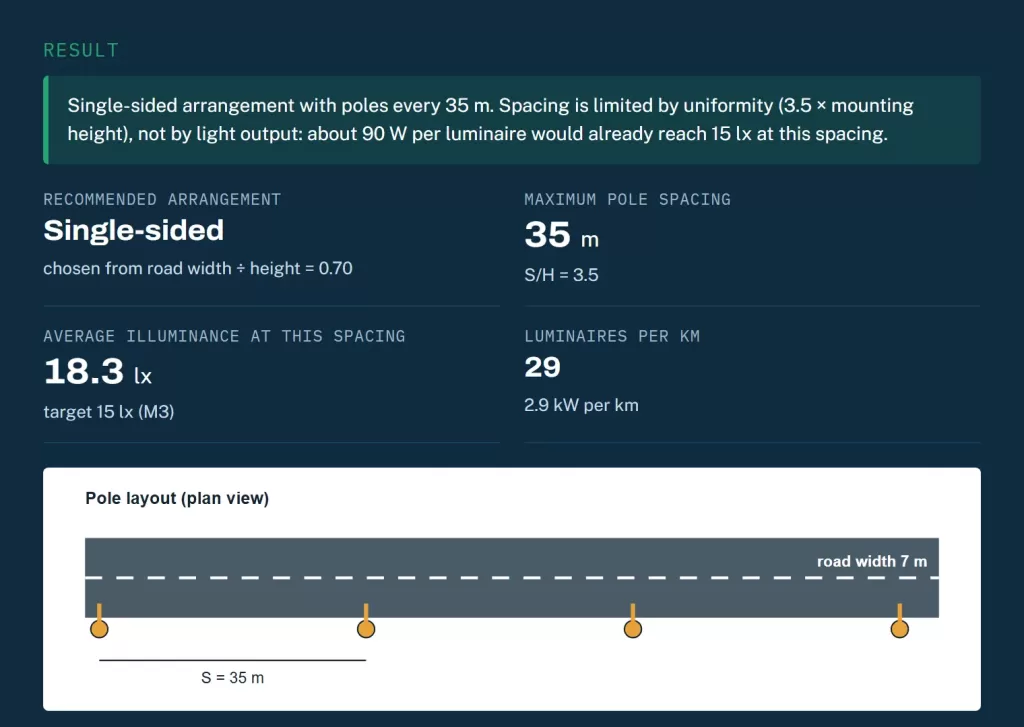
Open the example and change the efficacy to 140 to compare.
Over a whole road, that is about 8% more energy for 3000K: real, but small compared with the saving against sodium or metal halide (see the HPS to LED conversion chart).
How people see the road
At night, the eye works in mesopic conditions, between daylight and night vision. In these conditions, cooler light can make peripheral objects slightly easier to see at the same photopic lux, which is why some standards allow a lower lighting class for light with a high S/P ratio. The effect matters most at low light levels and is not a reason to choose very cold light on its own.
What drivers and pedestrians notice more is glare and contrast. Cooler light at the same brightness is often perceived as harsher, especially from low poles or unshielded fittings. Good optics with no light above the horizontal, and a sensible mounting height, matter more than a few hundred kelvin.
Sky glow, health and wildlife
Blue light scatters more in the atmosphere, so cooler lighting adds more to sky glow per lumen. Blue light at night also has the greatest effect on the body clock. In 2016 the American Medical Association recommended that outdoor lighting should be 3000K or lower and fully shielded, and dark-sky guidelines recommend warm light (3000K or lower) used only where and when it is needed.
Many animals are sensitive to blue and white light: insects are drawn to it, and sea-turtle hatchlings are disoriented by bright, short-wavelength light near beaches. This is why amber or very warm LEDs are often required near nesting beaches, wetlands and observatories.
Typical choices by application
| Application | Typical CCT | Why |
|---|---|---|
| Highways and main roads | 4000K | Efficiency, good visibility, few residents nearby |
| Urban streets with homes | 3000K | Comfort, less complaint, less blue light |
| Historic centres and squares | 2700–3000K | Appearance, matches older lighting |
| Parks, paths, waterways | 2700–3000K | Comfort, wildlife |
| Car parks and logistics yards | 4000K (5000K if specified) | Colour recognition, security cameras |
| Ports and industrial areas | 4000–5000K | Task visibility; see our port and stadium floodlights |
| Near observatories, beaches, sensitive habitats | Amber / 2200K or below | Local rules |
| Solar street lights in villages | 3000–4000K | Efficiency matters with a limited battery; warmer for homes |
For solar street lights, the efficacy penalty matters a little more, because every watt comes from the panel and battery. Use the efficacy of the chosen CCT when sizing the system in the solar street light calculator.
What to write in a specification
- CCT with tolerance, for example “3000K ±200K” or “within the ANSI C78.377 quadrangle for 3000K”, so all lights in a street match
- Minimum efficacy at that CCT, for the complete luminaire, not the LED chip
- Colour rendering: Ra ≥ 70 for roads, Ra ≥ 80 where colour recognition matters
- Light distribution and upward light: no light above the horizontal for dark-sky compliance
- Colour consistency over time: lumen maintenance and colour shift, backed by LM-80 test data for the LED package
- Any local rule: some cities, regions and countries set a maximum CCT for public lighting
Changing CCT on existing projects
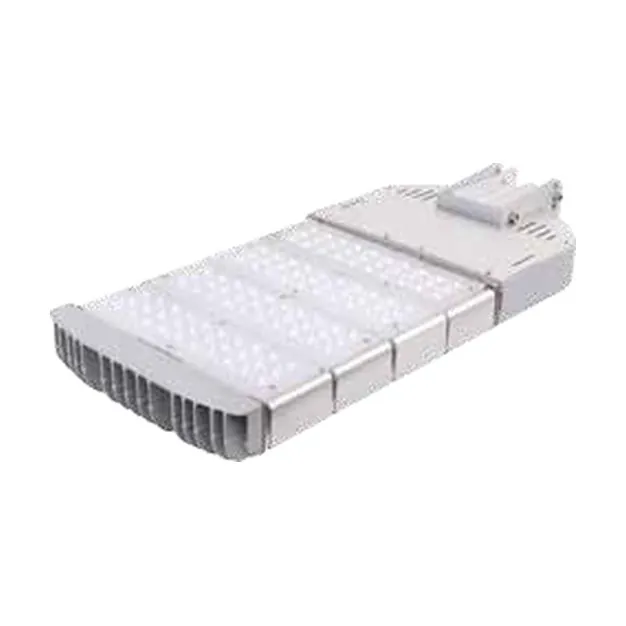
If residents complain about an existing installation, the options are new LED modules at a warmer CCT, new fittings, or dimming. Dimming reduces brightness but not the colour. Our modular LED street lights use replaceable modules, so the CCT can be changed during maintenance without replacing the housing.
All our LED street lights, including the modular LED street light and the compact LED street light, are available at 3000K, 4000K, 5000K and 6000K. Tell us the road type and any local rule, and we will quote the efficacy and photometric file for the CCT you need.
Sources
Frequently asked questions
Is 3000K or 4000K better for street lights?
Both are widely used. 4000K is slightly more efficient and common on main roads, highways and car parks. 3000K looks warmer, produces less blue light and is often preferred, or required, in residential streets, historic centres and near parks and waterways.
Why are some cities replacing 5000K street lights?
Early LED street lights were often 5000K or cooler because they were the most efficient at the time. Residents complained about harsh, bluish light and glare, and health and dark-sky organisations raised concerns about blue light at night. As warm-white LEDs became nearly as efficient, many cities switched to 3000K or 2700K.
Does colour temperature affect how far apart street lights can be?
Not directly. Spacing is set by the lighting class, the optic and the lumen output. Because warmer LEDs give slightly fewer lumens per watt, a 3000K light may need a few more watts to reach the same lux at the same spacing.