Lumens per Square Foot for a Shop: How Much Light a Workshop Needs, with Worked Layouts
How many lumens per square foot a shop or workshop needs: foot-candle targets by task, the conversion to fixture lumens, and three worked shop layouts from our calculator.
Key points
- Fixture lumens per square foot = target foot-candles ÷ (utilisation × maintenance). With typical values of 0.55 and 0.8, 30 foot-candles needs about 68 lm/ft² and 50 foot-candles about 114 lm/ft².
- A general woodworking or assembly shop works well at 30–50 foot-candles (about 300–500 lux); detailed bench work at 50–75 foot-candles.
- In our worked example, a 12 × 9 m (about 39 × 30 ft) shop with a 4.5 m ceiling reaches about 540 lux (50 fc) with 12 fittings of 100 W at 110 lm/W, about 113 fixture lumens per square foot.
- In small, low shops the spacing rule sets the count, so the real lumens per square foot often end up above the minimum.
Ask a shop owner how much light they want and the answer is usually “more”. Ask a lighting designer and you will get a number in foot-candles or lux. In between sits the figure most people actually shop with: lumens per square foot. This guide links the three, gives a table for typical shop tasks, and checks it against three real layouts from our calculator.
Foot-candles, lux and lumens per square foot
- Foot-candle (fc): one lumen falling on one square foot. It describes the light arriving on the floor or bench.
- Lux: one lumen per square metre. 1 fc = 10.764 lux, so 500 lux is about 46 fc.
- Fixture lumens per square foot: the total lumens the fixtures emit, divided by the floor area.
The difference between the first and the last is light that never reaches the work: absorbed by walls and ceiling, blocked by machines, lost to dust on the lens and to the slow fall in LED output. Two factors capture it:
Fixture lm/ft² = target fc ÷ (UF × MF)
where UF is the utilisation factor (typically 0.45–0.65 in a shop) and MF the maintenance factor (0.8 for LED in a reasonably clean space). Our foot-candles to lumens guide covers the formula in more depth.
Targets for typical shop tasks
With UF 0.55 and MF 0.8:
| Shop task | Foot-candles | Lux (approx.) | Fixture lumens per ft² |
|---|---|---|---|
| Storage, parts shelves | 10–20 | 100–200 | 23–45 |
| General shop, woodworking, assembly | 30 | 300 | 68 |
| Machining, mechanics bench, welding prep | 50 | 500 | 114 |
| Fine bench work, painting, inspection | 75 | 750 | 170 |
| Very fine work, colour matching | 100 | 1,000 | 227 |
For a mixed shop, the usual approach is 30–50 fc overall and task lights on benches that need more.
Three worked shops
The table gives the minimum. Real layouts add one more constraint: fixtures must be close enough together for even light. We ran three shops through our high bay and warehouse lighting calculator, with medium reflectances, a 0.8 m (2.6 ft) working plane, MF 0.8 and wide or medium beams.
| Shop | Ceiling | Target | Fitting | Fixtures (grid) | Average | Fixture lm/ft² |
|---|---|---|---|---|---|---|
| 9 × 6 m (about 30 × 20 ft) | 3.5 m (11.5 ft) | 500 lux | 60 W at 110 lm/W | 12 (4 × 3) | about 638 lux (59 fc) | 136 |
| 12 × 9 m (about 39 × 30 ft) | 4.5 m (15 ft) | 300 lux | 100 W at 110 lm/W | 9 (3 × 3) | about 405 lux (38 fc) | 85 |
| 12 × 9 m (about 39 × 30 ft) | 4.5 m (15 ft) | 500 lux | 100 W at 110 lm/W | 12 (4 × 3) | about 540 lux (50 fc) | 113 |
| 24 × 15 m (about 79 × 49 ft) | 6 m (20 ft) | 500 lux | 150 W at 130 lm/W | 24 (6 × 4) | about 658 lux (61 fc) | 121 |
(Open the 12 × 9 m, 500 lux example.)
The 12 × 9 m shop at 500 lux lands almost exactly on the table: 113 lm/ft² for a 114 lm/ft² target. The other three overshoot, and for the same reason: the ceiling is low, so the spacing rule needs more fixtures than the lumens alone would ask for. In the small 9 × 6 m shop, a fixture is needed every 2–2.2 m. If that seems like a lot of fixtures, use lower-wattage units at the same spacing rather than fewer, brighter ones.
Choosing the fixture for a shop
| Ceiling height | Suitable type | Typical power |
|---|---|---|
| Under 3.5 m (11 ft) | Linear LED shop lights or batten fittings | 40–60 W |
| 3.5–5 m (11–16 ft) | Small UFO high bays with wide beams, or linear fittings | 60–100 W |
| 5–8 m (16–26 ft) | UFO high bays, 90° beam | 100–150 W |
| Over 8 m (26 ft) | High bays, 60°–90° beam | 150–250 W |
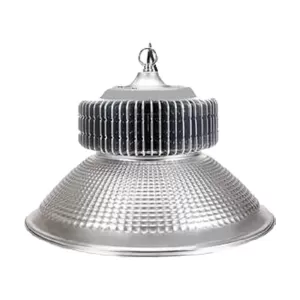
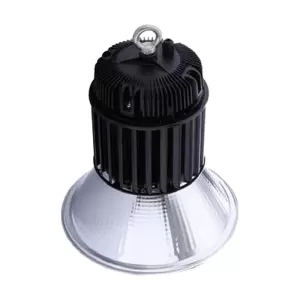
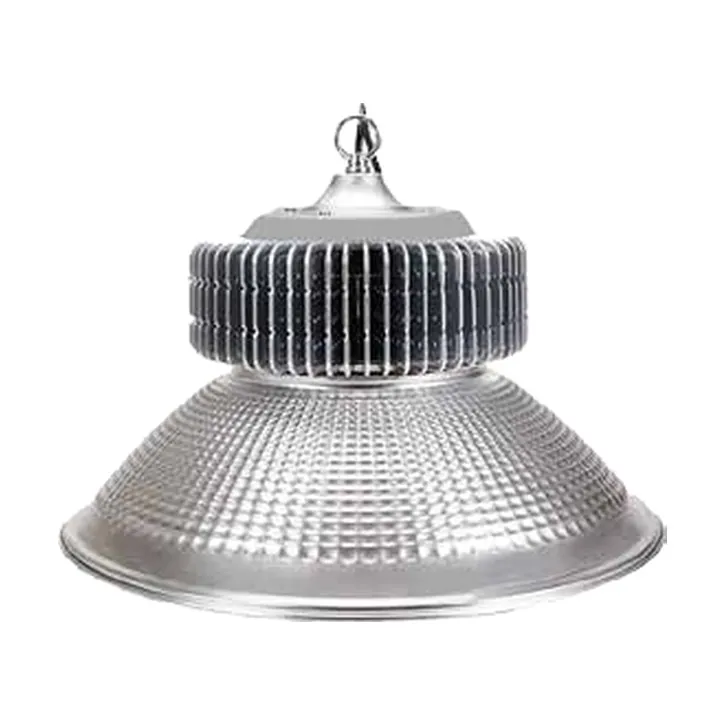
For a dry, clean shop, a light fin high bay such as our GKP40J (60–250 W, under 2.2 kg, IP44) is enough. Where there is sawdust, metal dust, oil mist or welding fume, choose an IP65 fitting such as the GKP40G, which also runs cooler under its heat pipes. Our shop lights vs high bay lights guide compares the two families with two examples.
Placing the fixtures in a shop
Lumens per square foot gives the total. Placement decides whether the light helps:
- Light the benches from the front or side, not from behind. A fixture behind the worker casts their shadow on the task.
- Put a row over each machine line. Lathes, saws and mills need light on the cutting point, and the machine itself blocks light from the far side.
- Avoid fixtures directly over glossy surfaces such as polished steel tables if they reflect into the eyes.
- Keep walls light. White or light-grey walls raise the utilisation factor by several points, which is equivalent to adding a fixture or two.
Colour temperature and CRI
4000–5000 K is the common choice for shops: it renders metals and wood clearly without the harsh blue of 6000 K. For painting, finishing or colour matching, choose CRI 90. Our GKP40 range is available at Ra 70, 80 or 90.
Running cost
The 12 × 9 m shop at 500 lux uses 12 × 100 W = 1.2 kW. At 10 hours a day, 300 days a year and $0.15 per kWh, that is 3,600 kWh and about $540 a year. A small shop rarely needs more than 1–1.5 W per square foot (about 11–16 W/m²) for good light with modern LED.
Common mistakes
- Using foot-candles as fixture lumens. It leaves the shop at about half the intended level.
- One bright fixture in the middle. A single 200 W fixture in a 30 × 20 ft shop gives glare in the middle and dim corners.
- Ignoring the ceiling height. The same lumens behave very differently at 10 ft and 20 ft.
- Daylight-only thinking. Skylights help in the day, but the design must work after dark.
If you send us the shop size, ceiling height and the work done in each area, we will run the calculation with the actual fixtures and return a layout.
Sources
Frequently asked questions
How many lumens per square foot does a shop need?
For general shop work at 30–50 foot-candles, plan for about 70–115 fixture lumens per square foot of floor. For detailed bench work at 75 foot-candles, about 170. These figures assume typical wall colours and allow for lumen loss over time.
How many lumens for a 20 × 30 ft workshop?
600 ft² at 50 foot-candles needs about 600 × 114 ≈ 68,000 fixture lumens. In our calculation a 9 × 6 m shop with a 3.5 m ceiling ended up with 12 fittings of 60 W (about 79,000 lm) because the low ceiling needs closer spacing.
Are foot-candles and lumens per square foot the same?
One foot-candle is one lumen arriving on each square foot. But fixtures must emit more than that, because some light is absorbed by walls and lost to dirt and ageing. That is why fixture lumens per square foot are roughly twice the foot-candle target.
What lux is a workshop?
Typically 300 lux (about 28 foot-candles) for general work, 500 lux (about 46 foot-candles) for machining and assembly, and 750 lux or more for fine inspection.