Candlepower to Lumens: The Formula, Beam Angle and Worked Floodlight Examples
How many lumens is 1 million candlepower? About 3,800 lm at a 4° beam, 8,600 at 6° and 24,000 at 10°. The candlepower to lumens formula, a table, and worked floodlight examples.
Key points
- 1 million candlepower is about 3,800 lm at a 4° beam, 8,600 lm at 6° and 23,900 lm at 10°, assuming an even beam; quoted peak values mean fewer real lumens.
- Candlepower is intensity in one direction (candela); lumens are the total light. You cannot convert one to the other without the beam angle.
- For a cone of light: lumens ≈ 2π × candela × (1 − cos(beam ÷ 2)). For a bare source shining equally in all directions, 1 cd equals about 12.57 lm.
- Our 500 W heat-pipe floodlight gives about 55,000 lm; squeezed into a 25° beam that is up to about 369,000 cd, against about 65,000 cd with a 60° lens.
- Lux on axis = candela ÷ distance² in metres; foot-candles = candela ÷ distance² in feet. A '1 million candlepower' spotlight with a 10° beam holds at most about 24,000 lm.
Spotlights, searchlights and marine lamps are often sold by “candlepower”, while LED floodlights are sold by lumens. The two numbers measure different things, and converting between them needs one extra piece of information: the beam angle. This guide gives the formula, a quick reference table and worked examples with our own floodlights.
How many lumens is 1 million candlepower?
Short answer: between about 1,000 and 54,000 lumens, depending on the beam angle. Candlepower measures intensity along the beam, so the same 1 million candela can come from a few thousand lumens squeezed into a pencil beam, or from tens of thousands spread over a wider one. Using the cone formula below with an even beam:
| Beam angle | Lumens for 1,000,000 cd | Typical product |
|---|---|---|
| 2° | about 960 lm | Long-range searchlight, laser-like throw |
| 4° | about 3,800 lm | Handheld “million candlepower” spotlight |
| 6° | about 8,600 lm | Marine and hunting spotlight |
| 8° | about 15,300 lm | Large handheld or boat searchlight |
| 10° | about 23,900 lm | Narrow LED spot or searchlight |
| 15° | about 53,800 lm | Narrow-beam floodlight, 500 W class |
Two points change the answer in practice:
- Peak versus average. Spotlight makers usually quote the peak intensity at the centre of the beam. The edge of the beam is much dimmer, so the lumens are lower than the table, often well below half for a sharply peaked handheld spotlight.
- What the throw means. At 1 million cd the beam gives 100 lux at 100 m and 1 lux at 1 km on axis. The ANSI/NEMA FL 1 “beam distance” for torches is where the light falls to 0.25 lux; for 1,000,000 cd that is √(1,000,000 ÷ 0.25) = 2,000 m.
For comparison, one of our 500 W heat-pipe floodlights with a 25° lens gives about 55,000 lm and an average of about 369,000 cd; see worked example 2 below. A floodlight wins on total light; a narrow spotlight wins on candela.
Two different quantities
- Candela (cd), or candlepower, is luminous intensity: how much light goes in one direction. It describes how bright a beam looks along its axis and how far it throws.
- Lumen (lm) is luminous flux: the total light leaving the source in all directions. It describes how much light there is to spread over an area.
The link between them is the solid angle of the beam, measured in steradians (sr). One candela is one lumen per steradian. A full sphere has 4π, or about 12.57, steradians. Our article on what a lumen is covers the units in more depth.
The formula
For a source shining equally in all directions:
lumens = 4π × candela ≈ 12.57 × candela
For a cone-shaped beam with full angle θ:
lumens ≈ 2π × candela × (1 − cos(θ ÷ 2))
and the reverse:
candela ≈ lumens ÷ (2π × (1 − cos(θ ÷ 2)))
This treats the beam as uniform, which real optics are not: intensity is highest at the centre and falls toward the edge, and some light spills outside the nominal beam. Use the result as an average or an upper estimate. For accurate figures, use the measured intensity distribution in the IES photometric file.
Quick reference: lumens per candela
| Beam angle | Solid angle (sr) | Lumens per 1,000 cd |
|---|---|---|
| 6° | 0.0086 | 9 |
| 10° | 0.024 | 24 |
| 25° | 0.149 | 149 |
| 30° | 0.214 | 214 |
| 60° | 0.842 | 842 |
| 90° | 1.84 | 1,840 |
| 120° | 3.14 | 3,142 |
| All directions | 12.57 | 12,566 |
Read across: a light with a 30° beam and 1,000 cd average intensity emits about 214 lumens inside the beam.
Worked example 1: a 100 W floodlight
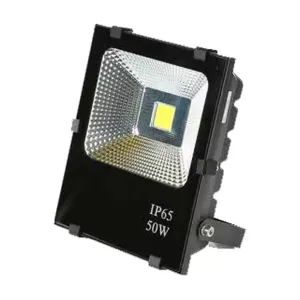
Our slim LED flood light TLZ30J in the 100 W size gives more than 100 lm/W, so about 10,000 lm.
- With the 90° lens: 10,000 ÷ 1.84 ≈ 5,400 cd average.
- With the 120° lens: 10,000 ÷ 3.14 ≈ 3,200 cd average.
The narrower lens throws further: at 6 m, the 90° version gives about 5,400 ÷ 36 = 150 lux on axis, the 120° version about 88 lux, but over a wider patch. Our LED flood light beam angle guide explains the trade-off.
Worked example 2: a 500 W stadium floodlight
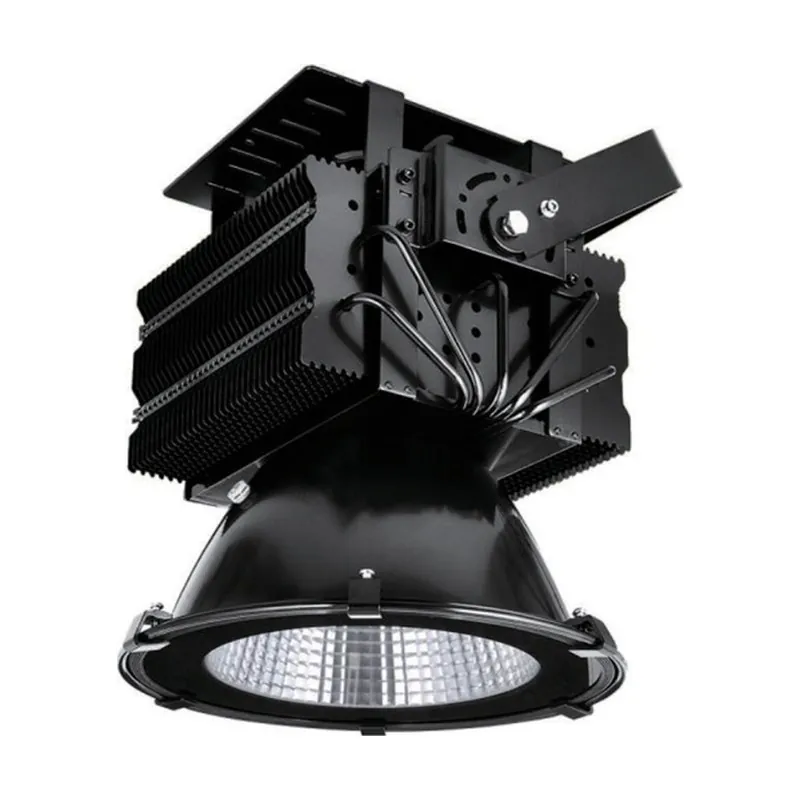
Our heat-pipe stadium and port floodlight in the 500 W size gives more than 110 lm/W, about 55,000 lm, with 25°, 40°, 60° or 90° optics.
| Lens | Average intensity | Lux at 30 m on axis | Beam diameter at 30 m |
|---|---|---|---|
| 25° | about 369,000 cd | about 410 | about 13 m |
| 60° | about 65,000 cd | about 73 | about 35 m |
The lumens are the same; the lens decides whether they land as a small, intense patch far away or a broad, softer one nearby. On a sports field, tall poles use narrow beams aimed at the far side and wide beams for the near side, which is why one mast often carries several optics. See our LED stadium lights guide.
From candela to lux and foot-candles
On the beam axis, illuminance falls with the square of distance:
- lux = candela ÷ (distance in metres)²
- foot-candles = candela ÷ (distance in feet)²
So 5,400 cd at 20 ft gives 5,400 ÷ 400 = 13.5 fc. If the surface is tilted to the beam, multiply by the cosine of the angle of incidence.
Going the other way, the intensity you need is:
candela = target × distance²
To put 10 fc on a sign 50 ft away you need 10 × 2,500 = 25,000 cd toward it. For conversions between lux, foot-candles and lumens over an area, see foot-candles to lux and foot-candles to lumens.
Decoding “million candlepower” claims
Handheld spotlights often claim “1 million candlepower” or more. With the formula:
- at a 10° beam, 1,000,000 cd needs at most about 24,000 lm;
- at a 6° beam, about 8,600 lm.
A narrow reflector turns modest lumens into a huge intensity number. That is a fair measure of throw, but not of how much area the light can cover. Some sellers also quote peak rather than average intensity, which inflates the figure further. Ask for both lumens and peak candela, measured to a stated standard such as ANSI/NEMA FL 1 for torches.
When to think in candela, and when in lumens
| Task | Use |
|---|---|
| Lighting a field, yard or hall evenly | Lumens and the lumen method |
| Aiming at a distant target (façade top, far touchline) | Candela and distance |
| Checking glare toward drivers or neighbours | Candela in that direction |
| Comparing searchlights and torches | Peak candela and lumens together |
For area lighting, we usually start from lumens; our LED flood light distance chart gives quick coverage figures by wattage and height.
Common mistakes
- Dividing lumens by 12.57 for a floodlight. That assumes light in all directions and understates the beam intensity many times over.
- Comparing candela across different beam angles. A 25° and a 90° light of equal lumens differ by more than ten times in candela.
- Using on-axis lux as the average. The edge of the beam receives far less light than the centre.
Ordering
If your specification gives candela at a distance, or a target lux at a far point, send it with the mounting positions. We will choose the wattage and optic and send the IES files for the floodlights we propose.
Sources
Frequently asked questions
How many lumens is 1 million candlepower?
It depends on the beam angle. With an even beam, 1,000,000 cd is about 960 lm at 2°, 3,800 lm at 4°, 8,600 lm at 6°, 15,300 lm at 8°, 23,900 lm at 10° and 53,800 lm at 15°. Real beams are brighter in the centre, so if 1 million is the peak value the true lumens are lower.
How many lumens is a candle?
An ordinary wax candle is roughly 1 candela, and because it shines in all directions that is about 12.6 lumens. That is the origin of the candlepower unit.
How many lumens is 1 candlepower?
It depends on the beam. A source shining equally in all directions gives about 12.57 lumens per candela. A narrow beam concentrates light, so the same lumens produce far more candela.
Is candlepower the same as candela?
Practically yes. Candlepower is the older name; the modern SI unit is the candela, and the old candle unit differed from it by only about 2%.
How do I convert lumens to candela?
Divide lumens by the solid angle of the beam: candela ≈ lumens ÷ (2π × (1 − cos(beam ÷ 2))). A 10,000 lm light with a 90° beam averages about 5,400 cd.