
Hazardous Area Light Fixtures: Which Type Goes Where, With Fitting Counts
Hazardous area light fixtures by space: pump rooms, compressor houses, paint stores, corridors, tank farms, plant roads and escape routes, with fitting counts worked out in our calculator.
Key points
- Choose the fixture type by the space first (room, walkway, open area, road, escape route), then confirm its Ex marking against the zone, gas group and temperature class.
- In our calculator, a 12 × 8 m pump room at 4 m needs 12 round 40 W fittings for 200 lux; a 24 × 12 m compressor house at 7 m needs 15 fittings of 100 W.
- Small fittings in large numbers give better uniformity and fewer shadows behind pipework than a few large floodlights.
- Escape routes need their own emergency fittings: our BG-FBYJ10A twin-head light runs 2 hours on battery and is marked Ex d IIC T4.
A plant with hazardous areas rarely needs just one kind of light. Pump rooms, compressor houses, pipe racks, tank farms, plant roads and escape routes each call for a different fixture. This guide matches fixture type to space and gives fitting counts from our calculator, so you can build a first bill of materials before the photometric design.
Two decisions, in this order
- What kind of space is it? Room, walkway, open area, road or escape route. That decides the fixture form: ceiling light, round light, high bay, floodlight, street light head or emergency light.
- What does the area drawing say? Zone, gas group, temperature class, and any dust zone. That decides which certified models are allowed.
The second step is a pass-or-fail filter on the first. Our explosion-proof light ratings guide explains how to read both the drawing and the marking.
Small rooms and corridors
Fixture: compact ceiling light, 15–30 W.
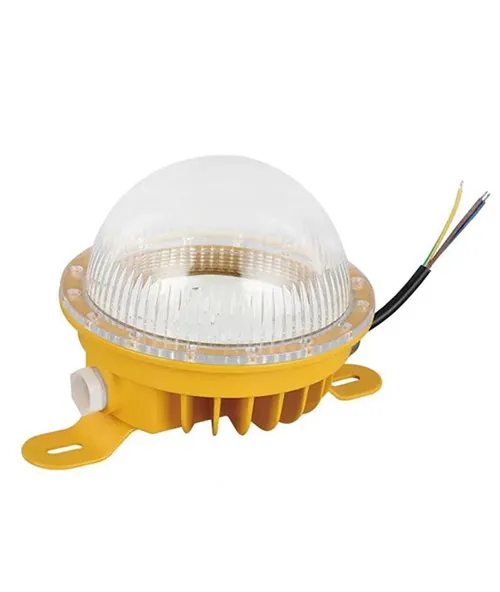
Control rooms, battery rooms, small stores and corridors inside a hazardous area need low, even light without glare. Our BAD8501B ceiling light (Ex d IIC T6 Gb; Ex tD A21 IP66 T80 °C) weighs 1.1 kg at Ø150 mm. For 100 lux in a 2.4 m wide corridor with a 3 m ceiling, one 15 W fitting every 2.5 m is enough by the lumen method.
Pump rooms
Fixture: round flameproof light, 30–70 W, wide beam.
Pump rooms are low, cluttered and often Zone 1. We ran a 12 × 8 m room with a 4 m mounting height and a 200 lux target through our high bay and warehouse lighting calculator using the 40 W BDE507 at 110 lm/W (open the example):
- 12 fittings, 4 × 3, about 3 m apart;
- about 251 lux average;
- 5 W per m².
The extra margin over 200 lux is useful: pumps, motors and pipe runs cast shadows the calculation does not see. Place fittings over walkways and service points, not over the pumps themselves, so maintenance is possible without shutting down.
Compressor houses and process halls
Fixture: higher-power fittings at 6–10 m, medium beam.
A 24 × 12 m compressor house with fittings at 7 m and a 200 lux target, using 100 W BED series fittings at 110 lm/W (open the example):
- 15 fittings, 5 × 3, about 4.8 × 4 m;
- about 260 lux average.
The BED is covered by our own certificate, ZJEx23.0914 (Ex db eb mb IIC T4 Gb; Ex tb IIIC T130 °C Db). Compressor houses are hot; check the ambient against the certified range and allow for vibration with a safety wire.
Paint stores and mixing rooms
Fixture: higher light level for colour work, wide beam.
Colour matching needs more light and a higher CRI. A 10 × 6 m mixing room at 4.5 m, 300 lux target, with 60 W BED fittings (open the example):
- 8 fittings, 4 × 2;
- about 340 lux average.
Solvent vapours in paint areas may require a different gas group or temperature class from the rest of the plant. Check the drawing for each room; our article on explosion-proof lighting for paint booths covers spray areas.
Pipe racks, tank farms and loading areas
Fixture: explosion-proof floodlight, aimed from structures or poles.
Open areas are lit from the edges: floodlights on platforms, pipe-rack columns or poles, aimed to light both the ground and vertical surfaces such as valves and ladders. The BAD8599 floodlight (50–600 W, Ex d IIC T6 Gb) covers group IIC, and its U-bracket allows any aiming angle. For a loading bay worked example, see our Zone 1 IIB T3 guide.
Plant roads
Fixture: explosion-proof street light head on poles.
Roads crossing hazardous areas can use the street-light version of the ExF (Ex d IIB T6 Gb). On a 7 m road with 8 m poles, 80 W heads at 28 m spacing give about 17 lux in our pole height and spacing calculator. Outside the classified zones, ordinary LED street lights are usually acceptable and cheaper.
Escape routes
Fixture: certified emergency light.
When the mains fails, people must find their way out of a plant that may also be filling with gas. Our BG-FBYJ10A has twin adjustable 30° heads, 10 W, Ex d IIC T4, and runs 2 hours on its battery. Place emergency lights at exits, changes of direction, stairs and fire-fighting points. See explosion-proof emergency exit lights.
A summary table
| Space | Typical height | Fixture | Example count |
|---|---|---|---|
| Corridor 2.4 m wide | 3 m | Ceiling light 15 W | 1 per 2.5 m (100 lux) |
| Pump room 12 × 8 m | 4 m | Round light 40 W | 12 (251 lux) |
| Mixing room 10 × 6 m | 4.5 m | 60 W fitting | 8 (340 lux) |
| Compressor house 24 × 12 m | 7 m | 100 W fitting | 15 (260 lux) |
| Plant road 7 m wide | 8 m pole | 80 W street head | 1 per 28 m (17 lux) |
| Escape route | 2–3 m | Twin-head emergency 10 W | Exits, turns, stairs |
Except for the BED series, the certificate for each model is supplied with the quotation.
A real site
We supplied the forecourt lighting for a Sinopec petrol station in Xiangtan. On fuel forecourts only parts of the area, mainly around dispensers, fill points and vents, are classified; the area drawing decides where certified fittings are required and where standard canopy lights are acceptable.
Ordering
Send the area classification drawing, the room and road dimensions, mounting heights and target light levels. We will return fitting counts for each space and the data sheets and certificates for the series we propose.
Sources
Frequently asked questions
What is a hazardous area light fixture?
A luminaire certified for use where flammable gas, vapour or combustible dust may be present. It carries an Ex marking that states the zones, gas or dust groups and temperature class it is approved for.
How many explosion-proof lights does a pump room need?
By our calculation, a 12 × 8 m pump room with fittings at 4 m needs 12 round 40 W lights at 110 lm/W for an average above 200 lux. Pipework and equipment may require extra fittings to fill shadows.
Should I use floodlights or round fittings indoors?
Round or ceiling fittings below about 6–8 m, because they spread light evenly with low glare. Floodlights suit high bays, open structures, tank farms and loading areas where light must be aimed.
Do hazardous area lights need emergency backup?
Escape routes, control rooms and areas with dangerous processes usually need emergency lighting under the local code. Use certified emergency fittings or fittings with a certified battery option.
Products in this guide
-
 Explosion-Proof LED Ceiling Light 15–30 W
BAD8501B Specifications and quote →
-
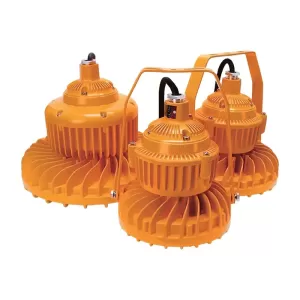 Explosion-Proof Round LED Light 20–70 W, BDE507
BDE507 Specifications and quote →
-
 Explosion-Proof LED Light 30–600 W, BED Series
BED Specifications and quote →
-
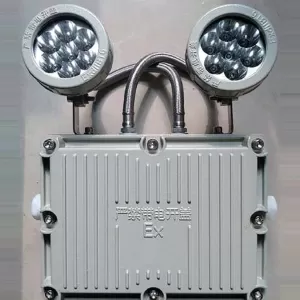 Explosion-Proof LED Emergency Light 10 W
BG-FBYJ10A Specifications and quote →