Zone 1 IIB T3: What the Classification Means and Which Lights Qualify
Zone 1 IIB T3 decoded part by part, the rule for which explosion-proof lights may be used there, and two worked layouts for a loading bay and a plant road from our calculators.
Key points
- Zone 1 IIB T3 means gas is likely in normal operation, the gas belongs to group IIB, and no surface may exceed 200 °C.
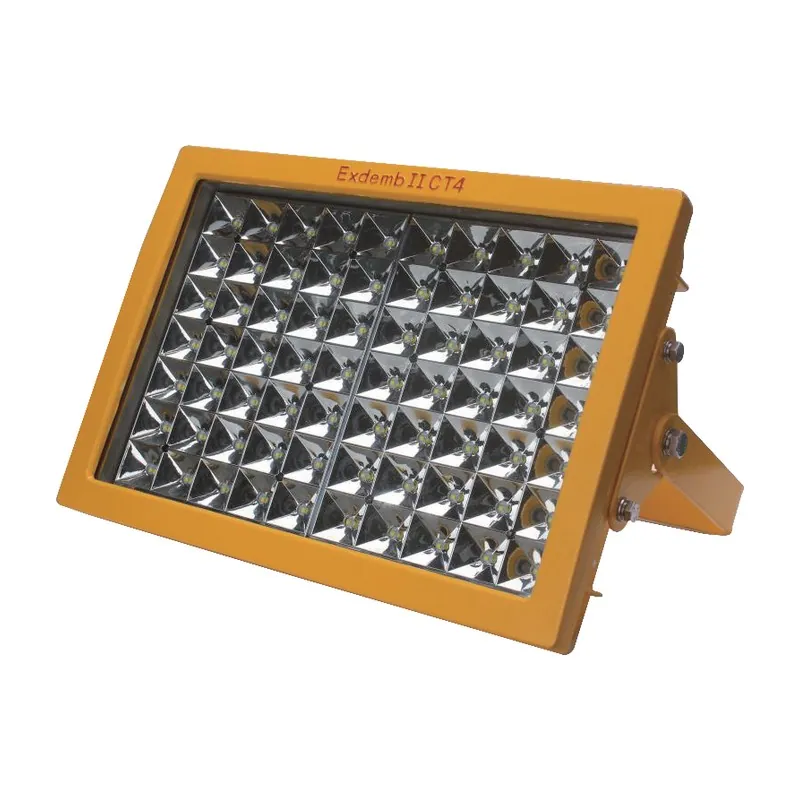
- A light qualifies if its marking is Gb (or Ga), its gas group is IIB or IIC, and its temperature class is T3 or cooler (T4, T5, T6). All of our Ex d series meet this.
- In our calculator, a 20 × 10 m loading bay with fittings at 6 m reaches about 188 lux with eight 100 W ExF lights; a 7 m plant road gets about 17 lux from 80 W heads on 8 m poles at 28 m spacing.
- Specifying IIC or T6 where IIB T3 is enough is allowed, but it may limit choice and raise cost; the reverse is never allowed.
“Zone 1 IIB T3” appears on area classification drawings at refineries, gas processing plants and chemical sites. It is a compact instruction for anyone buying lights or other electrical equipment. This guide decodes each of the three parts, gives the rule for which lights qualify, and works through two layouts with our own explosion-proof fittings.
The three parts
Zone 1: how often gas is present
The zone states how likely an explosive gas atmosphere is:
| Zone | Meaning | Equipment protection level |
|---|---|---|
| Zone 0 | Present continuously or for long periods | Ga |
| Zone 1 | Likely in normal operation | Ga or Gb |
| Zone 2 | Not likely, and only briefly if it occurs | Ga, Gb or Gc |
Zone 1 typically surrounds pump seals, sample points, open drains, loading arms and vents. Our Zone 1 vs Zone 2 guide shows where each typically applies.
IIB: how easily the gas ignites
Group II gases are divided by how easily a flame passes through a narrow gap and how little energy ignites them. IIA (propane, petrol vapour) is hardest to ignite; IIC (hydrogen, acetylene) is easiest; IIB sits in the middle, with ethylene and hydrogen sulphide as typical members. Our IIB vs IIC article covers the test basis.
T3: how hot surfaces may get
T3 caps every equipment surface at 200 °C. It is chosen when the lowest ignition temperature of the gases present is above 200 °C but below 300 °C. Hydrogen sulphide, at about 260 °C, is an example. See T3 vs T4.
The selection rule
A light may be used in a Zone 1 IIB T3 area when all three of the following hold:
- Protection level Gb or Ga (for Zone 1).
- Gas group IIB or IIC (a IIC light covers IIB; a IIA light does not).
- Temperature class T3, T4, T5 or T6 (cooler classes are acceptable).
The light must also be certified under a scheme your jurisdiction accepts, and installed to IEC 60079-14 or the local equivalent. If you are new to the term, our explainer on what explosion proof means covers the principle behind these markings.
How our series compare
| Series | Marking | Fits Zone 1 IIB T3? | Notes |
|---|---|---|---|
| ExF, 50–150 W | Ex d IIB T6 Gb | Yes | Exactly matches the gas group; T6 gives a large margin |
| BED, 30–600 W | Ex db eb mb IIC T4 Gb | Yes | Our own certificate ZJEx23.0914; also for IIC and dust zones |
| BDE507, 20–70 W | Ex d IIC T6 Gb | Yes | Compact round light for rooms and walkways |
| BAD8599 floodlight, 50–600 W | Ex d IIC T6 Gb | Yes | High-power floodlighting |
| BAD8501B ceiling light, 15–30 W | Ex d IIC T6 Gb | Yes | Small rooms and corridors |
For every model except the BED, the certificate that applies is supplied with the quotation. Check it against the drawing before ordering.
The ExF is the natural fit here: it is rated exactly for IIB and its T6 class leaves wide headroom. If the same plant also has a hydrogen unit, standardising on a IIC model such as the BED simplifies spares, at the cost of a heavier or pricier fitting in some sizes.
Worked example 1: a loading bay
A covered tanker loading bay of 20 × 10 m, classified Zone 1 IIB T3 around the loading arms, with fittings at 6 m. Loading work needs good vertical and horizontal light; we aim for 150 lux average.
With 100 W ExF lights at 110 lm/W and a wide beam, our high bay and warehouse lighting calculator gives (open the example):
- 8 fittings in a 4 × 2 grid, about 5 m apart;
- about 188 lux average;
- 4 W per m².
At a 100 lux target the count drops to six. Aim some fittings at the sides of the tanker so the operators see the hatches and couplings, not only the floor.
Worked example 2: a plant road
A 7 m wide road through the same hazardous area, using the ExF in its street-light version on 8 m poles. In our pole height and spacing calculator (open the example):
- single-sided poles at 28 m, the limit set by 3.5 times the height;
- about 17 lux average, above the 11 lux of class M4;
- 36 poles per kilometre, 2.9 kW per kilometre.
The calculator suggests about 51 W would reach M4 at that spacing, so a smaller head is possible if the plant accepts the lower level. Many sites prefer the 80 W head for safety around vehicles and pedestrians.
Common mistakes
- Reading T3 as “T3 only”. A T6 light is fine in a T3 area. The class is a maximum, not a target.
- Ignoring the dust zones. A drawing may also show Zone 21 or 22 near powder handling. The ExF has no dust marking; the BED does (Ex tb IIIC T130 °C Db).
- Forgetting the accessories. Glands, junction boxes and emergency fittings in the same zone need the same assessment. Our explosion-proof emergency exit lights guide covers escape routes.
- Mixing systems. In North America the same area might be called Class I Division 1 Group C or D; see Class 1 Division 1 lighting. Equipment must carry the marking your inspector accepts.
What to send us
The area classification drawing (or the zone, gas group and temperature class for each area), the room or road dimensions, mounting height, target light level and ambient temperature range. We will return a fitting count from our calculators and the data sheet and certificate for the series we propose.
Sources
Frequently asked questions
What does Zone 1 IIB T3 mean?
Zone 1: an explosive gas atmosphere is likely to occur in normal operation. IIB: the gas belongs to the middle group, more easily ignited than propane but less than hydrogen. T3: equipment surfaces must stay at or below 200 °C.
Can I use a IIC T4 light in a Zone 1 IIB T3 area?
Yes. IIC covers IIB and IIA, and T4 (135 °C) is cooler than T3 (200 °C). A light rated for a more severe condition may always be used in a less severe one.
Can I use a IIA light in a IIB area?
No. A IIA enclosure is tested for gases that are harder to ignite. Its flame paths are not proven for IIB gases.
Is a Zone 2 light acceptable in Zone 1?
No. Zone 1 needs equipment protection level Gb or Ga. Gc equipment is for Zone 2 only.
Which gases are typically IIB T3?
Hydrogen sulphide is a common example: group IIB, with an ignition temperature of about 260 °C, which falls in T3. Mixed process areas are also often classified IIB T3 to cover the most demanding gas present.