Grain Elevator Lighting: Dust Zones, Surface Temperature and Gallery Layouts
How to light grain elevators, silos and feed mills: Class II Group G and Zone 21/22 areas, the surface temperature rule for grain dust, housekeeping, and gallery and headhouse layouts.
Key points
- Grain dust is a combustible dust: NEC calls it Class II, Group G, and IEC classifies the areas as Zone 20, 21 or 22 with dust group IIIB.
- For a 5 mm dust layer, a light's maximum surface temperature must be at least 75 K below the layer ignition temperature and no more than two-thirds of the cloud ignition temperature.
- A light marked T80 °C passes those rules for any dust whose layer ignites above 155 °C and cloud above 120 °C; a T130 °C light needs 205 °C and 195 °C.
- A 60 m conveyor gallery 3 m wide needs 16 fittings of 30 W for about 126 lux by our lighting calculator.
Grain dust explosions are among the most destructive industrial accidents, because a small first explosion shakes settled dust into the air and a much larger second one follows. Lighting in grain elevators, silos and feed mills must not be the source of either. This guide explains the dust zones, the temperature rule that decides whether a light is safe, and how many fittings a gallery and a headhouse need.
How grain dust areas are classified
| System | Classification for grain dust |
|---|---|
| NEC (US) | Class II, Group G (non-conductive combustible dust), Division 1 or 2 |
| IEC / ATEX | Dust group IIIB (non-conductive), Zone 20, 21 or 22 |
Where the zones typically fall in a grain facility:
| Area | Typical zone |
|---|---|
| Inside bucket elevator legs, bins, silos and dust collectors | Zone 20 |
| Around spouts, transfer points, scales and the headhouse floor near openings | Zone 21 |
| Galleries, tunnels and rooms where dust escapes only occasionally and is cleaned up | Zone 22 |
Lights are almost never installed in Zone 20. Most lighting work is in Zone 21 and 22. Our Class 2 Division 1 lighting guide explains the NEC side in more detail.
The temperature rule that decides
For gases, the temperature class (T1 to T6) is compared with the gas ignition temperature. Dust is different: a layer of dust on top of a light insulates it and gets hotter, and the layer can smoulder at a lower temperature than a cloud ignites. IEC 60079-14 sets two limits for the light’s maximum surface temperature:
- Cloud limit: no more than two-thirds of the dust cloud ignition temperature.
- Layer limit (up to 5 mm): at least 75 K below the ignition temperature of a 5 mm layer.
Thicker layers need a larger margin, and the standard gives a reduction for those. The practical answer is housekeeping: keep layers thin.
What that means for real fittings
| Light marking | Minimum cloud ignition temperature it allows | Minimum 5 mm layer ignition temperature it allows |
|---|---|---|
| T80 °C (BAD8501B, BAD8599) | 120 °C | 155 °C |
| T130 °C (BED series) | 195 °C | 205 °C |
These limits come straight from the two rules above: 80 × 3/2 = 120 and 80 + 75 = 155; 130 × 3/2 = 195 and 130 + 75 = 205. Compare them with the test data for your own dust, from the facility’s dust hazard analysis or a laboratory test. Grain dust values vary with the crop, moisture and particle size, so do not rely on a general figure. Our combustible dust lighting guide shows a worked example of this check.
Worked example 1: a 60 m conveyor gallery
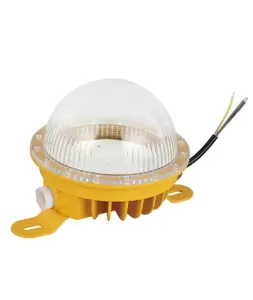
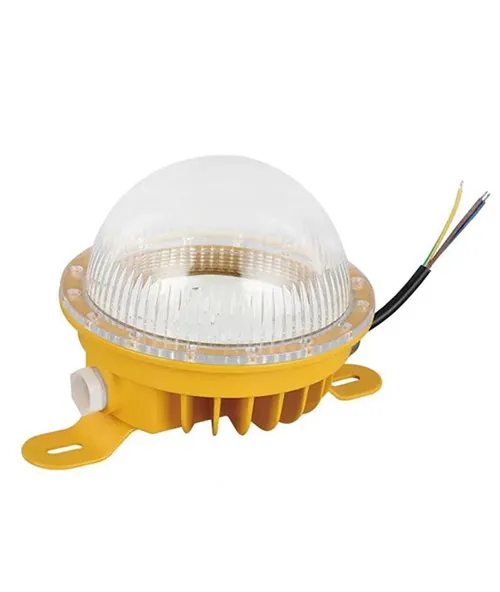
A gallery above the bins, 60 m long and 3 m wide, ceiling at 3.5 m, carries a belt conveyor. It is classified Zone 22 and needs 100 lux on the walkway for inspection. With our BAD8501B ceiling light at 30 W and 120 lm/W, our lighting calculator gives:
| Result | Value |
|---|---|
| Fittings | 16 in one row |
| Spacing | 3.75 m |
| Average illuminance | about 126 lux |
| Power density | 2.67 W/m² |
The spacing rule (no more than 1.5 times the mounting height for a wide beam) decides the count here, not the lumens: the lumen method alone needs 13. In a narrow gallery, mount the row above the walkway side, not above the belt, so cleaning and relamping do not need the conveyor stopped.
Worked example 2: a 12 × 10 m headhouse floor
The headhouse holds the elevator heads, distributors and spouts. Take a floor 12 × 10 m, ceiling at 4 m, a target of 150 lux and Zone 21 near the equipment. With the same 30 W BAD8501B, the calculator gives 12 fittings (4 × 3) at 3.0 × 3.3 m spacing and about 171 lux. The calculator shows that about 26 W per fitting would reach 150 lux on that grid, so 30 W leaves a margin for dust on the lens between cleanings.
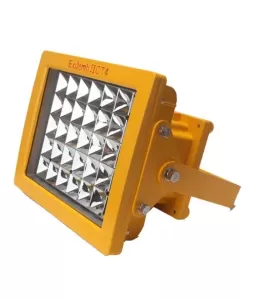
For taller spaces, such as a truck dump shed or a flat storage warehouse, the BAD8599 floodlight carries the same Ex tD A21 IP66 T80 °C dust marking from 50 W upward.
Housekeeping is part of the lighting design
OSHA’s grain handling standard requires dust to be kept below set limits in priority areas, and NFPA 61 treats housekeeping as a primary safeguard. For lighting this means:
- Choose shapes that shed dust. Domed or sloping tops collect less than flat housings.
- Mount where cleaners can reach. A fitting nobody can reach becomes the thickest dust layer in the room.
- Include lights in the cleaning schedule. Dust on the lens cuts light output and raises the surface temperature.
Cable and glands
- Use cable glands certified for dust (Ex t) or for both gas and dust.
- Seal unused entries with certified plugs.
- Keep cable trays clear; dust on trays above lights falls onto them.
Our explosion-proof junction box guide covers the boxes used for loop-in wiring along a gallery.
Outdoor areas
Truck receiving pits, rail loading spouts and the outside of the headhouse often have their own zones near openings. Floodlights on poles or the building face, placed outside the zones and aimed in, keep most fittings non-hazardous. Check the zone drawing for every fitting position.
Emergency lighting
Galleries and tunnels are long and narrow, and a blackout during an incident leaves workers with no sense of direction. Fit emergency lighting rated for the dust zone at each exit, stair and change of direction.
What to send us
- Dust hazard analysis or zone drawing
- Dust cloud and layer ignition temperatures, if tested
- Room sizes, ceiling heights and target lux levels
- Supply voltage
- Any washdown or outdoor exposure
With these we will check each light’s surface temperature against your dust data and return a fitting list with spacings like the examples above.
Sources
Frequently asked questions
Do grain elevators need explosion-proof lights?
Areas where grain dust can form clouds or layers are classified as combustible dust locations. Lights there must be dust-ignition-proof (Class II, Group G) or rated for the dust zone (Ex t, Zone 21 or 22). Gas-only flameproof fittings are not automatically acceptable for dust.
What surface temperature is safe for grain dust?
Under IEC 60079-14, for a dust layer up to 5 mm the light's maximum surface temperature must be at least 75 K below the layer ignition temperature, and no more than two-thirds of the dust cloud ignition temperature. Use the test values for your actual dust.
Where are the most dangerous areas in a grain elevator?
Inside bucket elevator legs, bins and dust collectors (often Zone 20), and around transfer points, spouts and the headhouse (Zone 21 or 22). Galleries and tunnels with conveyors are commonly Zone 22 if housekeeping is good.
Which of your lights suit grain dust areas?
The BAD8501B (15–30 W, Ex tD A21 IP66 T80 °C) for galleries, tunnels and small rooms, the BAD8599 floodlight (Ex tD A21 IP66 T80 °C) for larger spaces, and our BED series (Ex tb IIIC T130 °C Db, certificate ZJEx23.0914).