Fuel Loading Rack Lighting: Zones Around the Hatch and a Two-Bay Gantry Layout
Lighting a road tanker loading gantry: how the zones form around top and bottom loading, which explosion-proof floodlights suit the canopy, and a 24 × 10 m two-bay example.
Key points
- The worst zone at a loading rack is around the open hatch during top loading; bottom loading with vapour recovery keeps most of the gantry in Zone 2.
- Petrol vapour is group IIA with an ignition temperature that needs at least T3; diesel can still form a flammable atmosphere when it is loaded into a tank that last held petrol.
- A 24 × 10 m two-bay canopy at 7 m needs 10 BAD8599 floodlights of 100 W for about 165 lux at ground level, by our lighting calculator.
- Mount fittings on the canopy structure outside the zone around the hatch where possible, aim them at the truck sides and the platform, and keep switching outside the classified area.
A road tanker loading rack is where a fuel terminal’s hazardous area meets its busiest workplace. Drivers connect arms, open hatches, read meters and walk on top of tankers at night, often in rain. The lighting has to be certified for the vapour, bright enough to see a spill, and placed so that maintenance does not need a permit every time a fitting is touched.
How the zones form
The Energy Institute’s Model Code Part 15 and API RP 505 both classify loading racks by the release sources: the hatch or vent, the arm couplings, and the drip tray or drain. How the product is loaded matters most.
| Loading method | Main release | Typical result |
|---|---|---|
| Top loading, open hatch | Vapour pushed out of the hatch while the tank fills | Zone 1 around the hatch, Zone 2 beyond; zones reach the top platform |
| Top loading, sealed arm with vapour return | Leaks at seals, residual vapour when the arm is lifted | Smaller Zone 1, more of the gantry in Zone 2 |
| Bottom loading with vapour recovery | Couplings during connection and disconnection | Mainly Zone 2 around the couplings and drip tray |
Petrol vapour is heavier than air, so it also collects in the drip tray, drains and any pit, which are often Zone 1. The exact distances come from the site study; use the drawing, not a rule of thumb. Our Zone 1 vs Zone 2 article explains what each zone allows.
Gas group and temperature class
Petrol vapour is classed as group IIA. Its auto-ignition temperature is lower than most light hydrocarbons, so a T3 fitting is the minimum; T4 or better gives margin. Terminals that also handle ethanol blends, jet fuel or solvents should check every product’s data sheet. Our article on T3 vs T4 temperature classes covers the reasoning.
Diesel is often treated as non-hazardous because its flash point is above normal ambient temperatures. The catch is switch loading: when diesel goes into a compartment that last carried petrol, the incoming liquid displaces petrol vapour. For that reason most terminals rate diesel bays like petrol bays.
Choosing the fitting
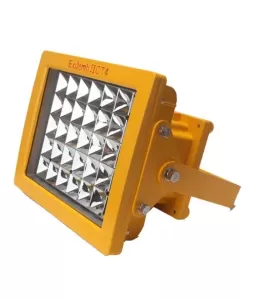
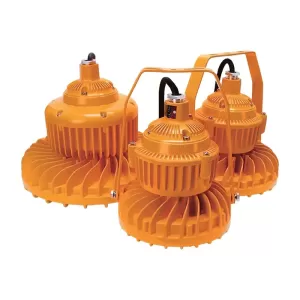
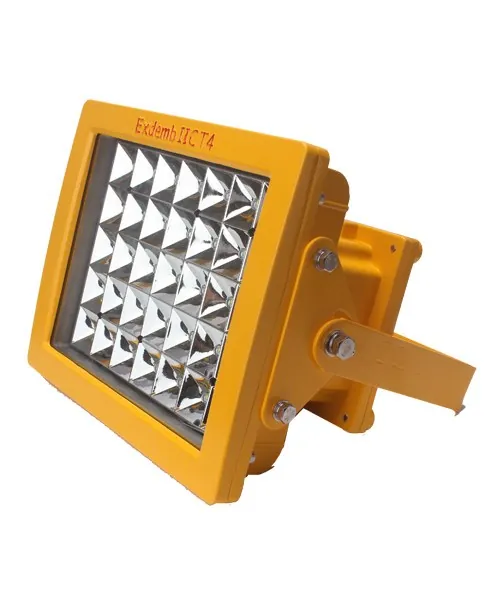
For canopy lighting we usually propose the BAD8599 explosion-proof floodlight: 50–600 W, Ex d IIC T6 Gb, IP66, at least 120 lm/W, with a U-bracket that lets each head be aimed. IIC T6 is more than a IIA, T3 loading rack needs, so the same fitting can be used across a terminal that also has other products. Where a canopy is low and fittings need to sit near the platform, the 20–70 W BDE507 is a compact alternative. For both models we supply the applicable certificate with the quotation.
Worked example: a two-bay gantry
A two-bay canopy measures 24 × 10 m with the underside of the roof at 7 m. The structure is dark painted steel, the ground is concrete with oil staining, and the target is 150 lux at ground level. Using the BAD8599 at 100 W and 120 lm/W with a wide beam, our lighting calculator gives:
| Result | Value |
|---|---|
| Room index | 1.01 |
| Utilisation factor | 0.41 (dark surroundings, open sides) |
| Fittings | 10 (5 × 2) |
| Spacing | 4.8 m × 5.0 m |
| Average illuminance at ground level | about 165 lux |
| Wattage that would just reach 150 lux | about 91 W |
The calculator treats the canopy as a room, which flatters an open-sided structure; the low reflectance setting allows for that. The top platform, about 4 m above the ground, will be brighter than the ground figure because it is closer to the fittings.
In practice we would place the two rows along the outer edges of each bay, not on the centre line over the hatches. This keeps the fittings away from the strongest release, lights the side of the tanker where valves and the meter are, and still reaches the platform. Aim one or two heads at the arm parking positions, where drivers handle couplings.
Things that go wrong at loading racks
- Shadow behind the tanker. Lights only on one side leave the far side dark, where a driver checks bottom valves. Light both sides of each bay.
- Glare for drivers. Floodlights aimed too flat shine into cab mirrors. Keep aiming angles steep, within about 60° of vertical.
- Water ingress. Canopy gutters leak onto fittings. IP66 housings and glands sealed to the same rating matter more here than in a dry plant.
- Switching inside the zone. Put switches and photocells in the control building or outside the classified area. See our guide to hazardous area light switches.
Emergency lighting and escape routes
Drivers on top of a tanker need to find the stairs if power fails. Fit self-contained explosion-proof emergency fittings at stair heads and platform exits, rated for the same zone as the gantry. Our explosion-proof emergency light article covers duration and placement.
Approach lanes and the wider terminal
Outside the classified area, approach lanes and parking need only ordinary floodlights, typically at lower levels. Tank areas, pump stations and bund walls have their own requirements; our tank farm lighting guide covers those, and the explosion-proof cable glands article explains how to keep the IP and Ex rating at each entry.
Maintenance on a live terminal
LED floodlights remove routine relamping, which was the main reason electricians climbed into loading canopies. What remains is periodic inspection to IEC 60079-17: checking glass, glands, fixings and earthing. Fittings placed outside the inner zone can often be inspected under a lighter permit, which is one more reason to keep them away from the hatches.
What to send us
- Canopy drawings with bay sizes and roof height
- The area classification drawing for the loading rack
- Products loaded and the loading method (top or bottom, vapour recovery)
- Supply voltage and any requirement for emergency lighting
We return a fitting list, aiming plan and calculated levels, with the certificate for each model.
Sources
Frequently asked questions
Do fuel loading racks need explosion-proof lights?
Yes, within the classified area. The space around the loading arm, hatch and drip tray is normally Zone 1 or Zone 2 depending on how the product is loaded. Fittings must be certified for that zone, group IIA or higher, and T3 or stricter for petrol.
How much light does a loading bay need?
Terminals commonly design for about 100–150 lux at the loading position so drivers can read meters, check couplings and see spills, with lower levels on approach lanes. Check your company standard; EN 12464-2 lists values for petrochemical outdoor areas.
Is diesel loading a hazardous area?
Diesel's flash point is above normal ambient temperatures, so on its own it rarely forms a flammable atmosphere. The exception is switch loading: putting diesel into a compartment that last carried petrol pushes out petrol vapour. Most terminals classify all bays the same for that reason.
Floodlights or linear fittings for a loading gantry?
Floodlights on the canopy steel are easier to keep out of the inner zone and light both the truck side and the top platform. Linear fittings under a low canopy give softer light but sit closer to the hatch.