Replacing Zone 2 Fluorescent Fittings with LED: Rules, Lumens and Savings
Why LED tubes cannot go into a certified Zone 2 fluorescent fitting, how to match lumens, and our calculation for replacing 60 twin 36 W Ex fittings in a 24-hour plant.
Key points
- Putting LED tubes into a certified Zone 2 fluorescent fitting changes the certified design and voids its Ex certificate; the whole fitting must be replaced.
- A twin 36 W T8 fitting draws about 79 W with its ballast; a 40 W LED Ex fitting at 110 lm/W gives 4,400 lm, more than the old fitting typically delivers.
- In our calculator, replacing 60 twin 36 W fittings running 24 hours with 40 W LED saves about 20,600 kWh a year, 49 %.
- Zone 2 allows Gc equipment, but a Gb fitting meant for Zone 1 can be used, which keeps one spare-part list across the site.
Many refineries, chemical plants and offshore modules still run on linear fluorescent Ex fittings installed fifteen or twenty years ago. Tubes and ballasts are getting harder to buy, and every tube change in a hazardous area needs a permit. LED is the obvious replacement, but the way it is done matters more in Zone 2 than anywhere else in the plant. This guide covers what the rules allow, how to match the light output, and what the change saves.
Why you cannot just fit LED tubes
In an ordinary building, a ballast-bypass LED tube is a quick retrofit; see how to wire LED tubes without a ballast. In a hazardous area, the same job breaks the certification.
An Ex certificate covers the equipment as tested: the enclosure, the ballast, the lamp type and wattage, the internal wiring and the temperatures that result. IEC 60079-14 and 60079-17 require equipment to be installed and maintained in line with its certificate. Fitting LED tubes, rewiring the lamp holders or removing the ballast is a modification the certificate does not cover. The fitting is then uncertified, and so is the installation.
The only exception is a retrofit kit certified together with that specific fitting by the original manufacturer. These exist for some product lines, but they are rare and model-specific. In practice, the replacement is a complete certified LED fitting.
Matching the light output
A twin 36 W T8 fitting is the most common Zone 2 linear light. A good 36 W T8 tube such as the MASTER TL-D Super 80 840 is rated at 3,350 lm, so two give about 6,700 lm bare. An Ex fitting then loses part of that in its tube guard, diffuser and reflector, and the tubes lose output as they age and as the fitting gets dirty. Look for the light output ratio or fitting lumens on the old datasheet if you have it.
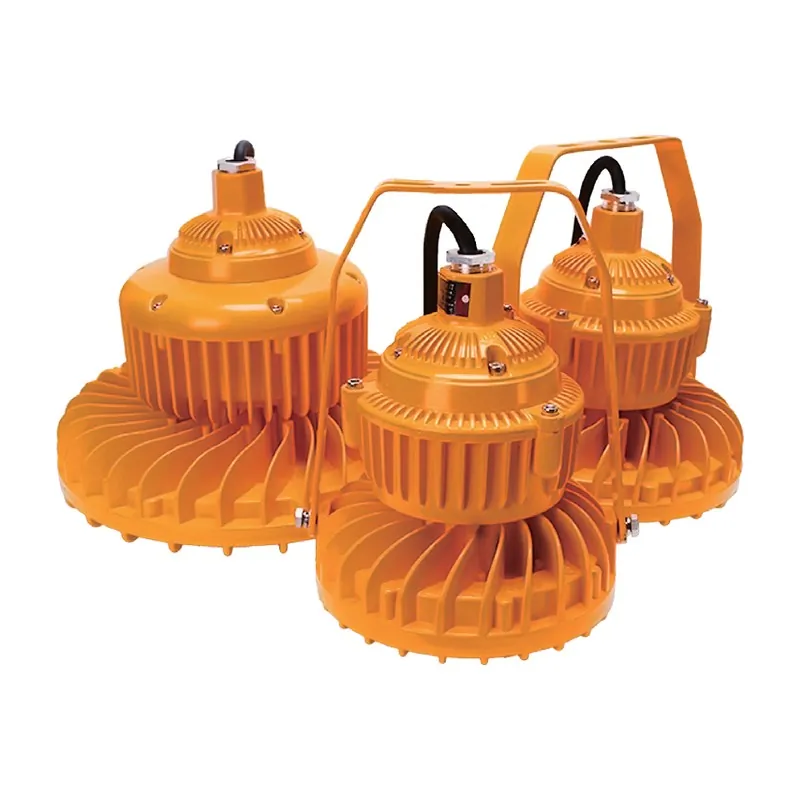
An LED Ex fitting is rated by its own output, with no separate optics loss. Our BDE507 is rated at 110 lm/W:
| Old fitting | Typical system power | LED replacement | LED fitting output |
|---|---|---|---|
| 1 × 36 W T8 | about 40 W | BDE507-20 or -30 | 2,200–3,300 lm |
| 2 × 36 W T8 | about 79 W | BDE507-30 or -40 | 3,300–4,400 lm |
| 2 × 58 W T8 | about 128 W | BDE507-60 or -70 | 6,600–7,700 lm |
System power uses a 10 % ballast loss, the default in our retrofit calculator for fluorescent. Real ballasts vary; electronic ones are often lower.
The BDE507 is a round fitting, so the layout changes from long strips to points. For walkways and long rooms, check spacing with a calculation rather than reusing the old positions one for one.
A worked layout
An 18 × 10 m compressor house, Zone 2 IIA, ceiling at 4 m, currently lit by twin 36 W fluorescent fittings. Target: 150 lux. Our high bay lighting calculator with the BDE507 at 40 W and a wide beam returns (open the example):
- 15 fittings in a 5 × 3 grid, 3.6 × 3.3 m apart;
- about 185 lux;
- 3.3 W per m².
The lumen method alone asks for 13; the grid adds two to keep spacing below 4.8 m at this height. The calculator also shows 32 W would reach 150 lux, so the 30 W size is an option if the client wants the lowest load.
What the change saves
For a plant that keeps its lights on 24 hours a day, we entered 60 twin 36 W fittings into our LED retrofit savings calculator, replaced by 40 W LED fittings, at 0.12 per kWh (open the example):
| Item | Fluorescent | LED |
|---|---|---|
| Power per fitting | 79.2 W | 40 W |
| Energy per year | 41,628 kWh | 21,024 kWh |
| Saving | — | 20,604 kWh (49 %) |
| Energy cost saved | — | about 2,470 per year |
We also entered 15 per fitting per year for tube and starter replacement against 2 for LED, which adds about 780 a year. That figure is our assumption, not a measured cost: in a hazardous area, the permit, isolation and gas test for each tube change usually cost more than the tube itself. Put your own number in. At 0.5 kg CO2 per kWh, the energy saving is about 10.3 tonnes of CO2 a year.
We did not enter a fitting price, so the calculator shows no payback; enter your quoted price to see it.
Zone 2 equipment choices
Zone 2 accepts equipment protection level Gc, such as “ec” or “nA” fittings, which are often lighter and cheaper than flameproof ones. A Gb fitting certified for Zone 1 is also allowed. Many plants standardise on Gb across Zones 1 and 2 so that one spare fits everywhere; our Zone 1 vs Zone 2 guide discusses that trade-off.
| Series | Marking | Best for | Power |
|---|---|---|---|
| BDE507 | Ex d IIC T6 Gb | Rooms, walkways, pump houses | 20–70 W |
| BAD8501B | Ex d IIC T6 Gb / Ex tD A21 IP66 T80 °C | Low ceilings, small rooms | 15–30 W |
| BED | Ex db eb mb IIC T4 Gb | Higher ceilings, process halls | 30–600 W |
The BED series carries our own certificate ZJEx23.0914 (GB 3836, IEC 60079-aligned; not ATEX or IECEx). For the BDE507 and BAD8501B, the certificate for the exact model comes with the quotation.
Practical steps
- List every fitting with tag, location, zone, gas group and T class from the area drawing.
- Check the supply. Our Ex LED fittings take AC 85–265 V (BDE507) or AC 220 V (BED). Emergency fittings need their own replacement; see explosion-proof emergency exit lights.
- Reuse cable entries where the thread and gland suit the new fitting; otherwise plan new certified glands.
- Update the inspection records. IEC 60079-17 asks for an initial detailed inspection of new equipment.
What to send us
Your fitting list with zones and groups, the room sizes and heights, and the target lux. We will return a layout from our calculator, the energy figures, and the models with their certificates.
Sources
Frequently asked questions
Can I put LED tubes in my Zone 2 fluorescent light fittings?
No. The Ex certificate covers the fitting as tested, with its ballast, lamp type and temperatures. Changing the lamp technology or bypassing the ballast is a modification the certificate does not cover. Replace the fitting with a certified LED one.
What LED wattage replaces a twin 36 W fluorescent Ex fitting?
Usually 30–40 W of LED at 110 lm/W. A 40 W fitting gives about 4,400 lm, while a twin 36 W fitting loses part of its tubes' 6,700 lm in its diffuser and guard. Check the old fitting's light output ratio, or run a layout.
How much energy does the change save?
In our example, 60 fittings at 79 W each, running 24 hours, use about 41,600 kWh a year. Sixty 40 W LED fittings use about 21,000 kWh, a saving of about 20,600 kWh or 49 %.
Do I need a Zone 1 fitting in a Zone 2 area?
No, Zone 2 accepts Gc equipment. A Gb fitting certified for Zone 1 is also allowed, and many plants use one type everywhere to simplify spares.
Which of your lights replace Zone 2 fluorescent fittings?
The BDE507 (20–70 W, Ex d IIC T6 Gb) for rooms and walkways, the BAD8501B ceiling light (15–30 W) for low ceilings, and the BED series (30–600 W, Ex db eb mb IIC T4 Gb) under our own certificate.