Commercial Kitchen Lighting Levels: Lux by Area, Food Code Rules and a Layout Example
How much light a commercial kitchen needs: 500 lux for food preparation, FDA Food Code minimums for storage and washing areas, colour rendering, shielding, and a 12 × 8 m layout worked example.
Key points
- EN 12464-1 sets 500 lux, Ra 80 and UGR 22 for commercial kitchens; the US FDA Food Code requires at least 540 lux (50 foot-candles) where staff work with food and knives.
- Storage, walk-in coolers and washing areas need less: the Food Code minimums are 108 lux and 215 lux.
- By our lighting calculator, a 12 × 8 m kitchen with a 3 m ceiling needs 30 panels of 36 W for about 561 lux on the worktops.
- Lamps over open food must be shielded, coated or shatter-resistant, and fittings near wash-down areas need a suitable IP rating.
- A colour rendering index of 80 or more lets cooks judge doneness and freshness by colour.
Kitchen staff cut, cook and plate food at speed, often under steam and heat. The lighting needs to show colour accurately, avoid glare on stainless steel, survive cleaning and meet food safety rules. This guide sets out the light levels that apply in each part of a commercial kitchen, the rules on shielding and colour, and a worked layout with our own panel lights.
Light levels by area
Two references cover most projects: the European workplace standard EN 12464-1 and, in the United States, the FDA Food Code, which most states adopt for food safety inspections.
| Area | EN 12464-1 | FDA Food Code minimum |
|---|---|---|
| Food preparation and cooking | 500 lux, Ra 80, UGR 22 | 540 lux (50 fc) at the work surface |
| Washing up, dishwashing | 300 lux | 215 lux (20 fc) |
| Handwashing stations, toilets | 200 lux | 215 lux (20 fc) |
| Dry storage, walk-in coolers and freezers | 100–200 lux | 108 lux (10 fc) at 75 cm above floor |
| Self-service counters, buffets | Depends on area | 215 lux (20 fc) |
The Food Code figures are minimums an inspector can measure with a meter; they are not design targets. Lighting a prep area to exactly 540 lux on day one leaves no margin for dirt and LED ageing, so designs normally aim higher with a maintenance factor built in. Our foot-candles to lux article converts between the two units.
Shielding and food safety
Section 6-202.11 of the Food Code requires light bulbs over exposed food, clean equipment and utensils to be shielded, coated or otherwise shatter-resistant. The rule exists because broken glass in food is a serious hazard. Practical consequences:
- LED panels and battens with polymer diffusers are preferred over bare tubes;
- heat lamps over pass counters must have shielded or coated bulbs;
- lights inside cooking hoods are a separate case; they must be rated for the heat and grease, and hood makers normally supply them.
Colour rendering and colour temperature
Cooks judge doneness, freshness and plating by colour. A colour rendering index (Ra or CRI) of at least 80 is the usual minimum; 90 helps in pastry and plating areas. For colour temperature, 4,000 K is the common choice: neutral, clean-looking and close enough to daylight that windows and lights do not clash.
Glare on stainless steel
Stainless worktops and splashbacks reflect bright sources straight into the eyes. Fittings with diffusers and a controlled glare rating help. EN 12464-1 sets UGR 22 for kitchens. Our UGR glare rating guide explains the number, and our low-glare office panel is designed for areas where glare is a concern.
Worked example: a 12 × 8 m kitchen
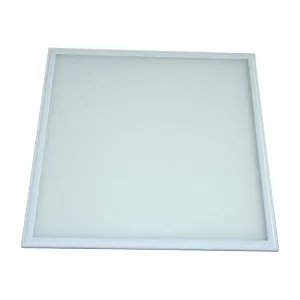
Assume a restaurant kitchen 12 m long and 8 m wide, with a 3 m ceiling, worktops at 0.9 m, light-coloured walls and ceiling, and a target of 500 lux on the worktops. Using our BG-MBC panel light at 36 W and 90 lm/W, wide beam and a maintenance factor of 0.8, our lighting calculator gives:
| Result | Value |
|---|---|
| Room index | 2.29 |
| Utilisation factor | 0.69 |
| Panels by the lumen method | 27 |
| Panels after the grid layout | 30 (6 × 5) |
| Spacing | 2.0 m × 1.6 m |
| Average illuminance | about 561 lux |
| Lighting power density | 11.25 W/m² |
At about 561 lux, the design clears both EN 12464-1’s 500 lux and the Food Code’s 540 lux at the work surface. In a real kitchen, extraction hoods take up ceiling space over the cooking line, so panels shift to the prep benches and aisles. Put the 6 × 5 grid on the ceiling plan first, then move fittings away from hoods and over the worktops. Our LED flat panel light guide covers panel sizes and mounting options.
Moisture, grease and cleaning
Kitchens are humid and greasy, and they are cleaned with water and chemicals. Choose fittings with:
- a sealed diffuser that grease cannot get behind;
- an ingress protection rating suited to the cleaning method (splash-proof for wiping, jet-proof for hose-down);
- smooth surfaces without louvres that trap grease.
Our IP65 vs IP66 vs IP67 article explains the higher IP ratings used near wash-down areas. Before ordering, tell us which areas are hosed down, so that the right fitting and rating can be confirmed for each.
Controls
Kitchens run long hours, so controls save more than in most rooms:
- Zoning: separate circuits for prep, cooking line, washing and storage, so areas can be switched off between services.
- Occupancy sensors in walk-in coolers and dry stores, where lights are often left on.
- Dimming for open kitchens visible from the dining room. Our dimmable LED panel light guide covers the driver options; the standard BG-MBC driver is not dimmable, so ask for a dimmable driver when ordering.
Common mistakes
- Lighting to the minimum. A design that just reaches 540 lux on day one falls below it as panels get dirty.
- Forgetting the hoods. The cooking line needs light from the hood or from fittings at its edge; ceiling lights behind the hood leave cooks in their own shadow.
- Cold or low-CRI light. Ra 70 at 6,000 K makes meat and vegetables look grey.
- Open tubes over food. These fail the shielding rule.
What to send us
Send the kitchen plan with hood positions, the ceiling height, the target lux by area and the cleaning method. We will return a fitting count by zone and a calculator link like the one above.
Sources
Frequently asked questions
What lux level is required in a commercial kitchen?
EN 12464-1 sets 500 lux for kitchens. The US FDA Food Code requires at least 540 lux (50 foot-candles) at surfaces where staff work with food or with utensils such as knives and slicers, and lower minimums for storage and washing areas.
How many lights does a commercial kitchen need?
It depends on size, ceiling height and the fitting's lumen output. For a 12 × 8 m kitchen with a 3 m ceiling and light-coloured surfaces, about 30 panels of 36 W give around 560 lux by the lumen method.
Do kitchen lights need to be shatterproof?
In food preparation and exposed food areas, the FDA Food Code requires light bulbs to be shielded, coated or otherwise shatter-resistant. LED panels with a polymer diffuser meet the intent better than bare tubes.
What colour temperature is best for a commercial kitchen?
Neutral white, about 4,000 K, is the most common choice. It looks clean, renders food colours well with Ra 80 or more, and matches daylight from windows reasonably well.