Recessed High Bay Lighting: When It Works, the Heat Problem and the Alternatives
When recessed high bay lights make sense, why heat in the ceiling void shortens LED life, how to service them, and a 30 × 18 m hall layout comparing two options.
Key points
- Recessed high bays sit flush in a high ceiling (atriums, sports halls, showrooms, airports), giving a clean look with no fittings hanging into the space.
- The main risk is heat: the LED driver and heat sink sit in a closed ceiling void that can run far hotter than the room, shortening LED and driver life.
- Check the ambient rating of the fitting against the void temperature, not the room temperature; our GKP40C, a pendant type, is rated for −30 °C to +50 °C ambient.
- In our calculator example for a 30 × 18 m hall at 7 m with light surfaces, 24 fittings of 100 W give about 313 lux; 20 fittings of 150 W with a wide beam give about 374 lux.
- Plan access first: a recessed fitting at 7–12 m must be serviceable from below or from a walkway in the void.
In a warehouse nobody minds high bays hanging from the roof. In an airport hall, a showroom, a hotel atrium or a sports hall with a finished ceiling, architects often want the light to come from the ceiling plane itself, with nothing hanging into the space. That is what recessed high bay lighting promises. It can work well, but it adds two problems that pendant fittings avoid: heat and access. This guide explains both and compares layouts.
Where recessed high bays are used
| Space | Typical ceiling height | Why recessed |
|---|---|---|
| Atriums and lobbies | 6–15 m | Clean ceiling, architectural look |
| Showrooms (cars, furniture) | 6–10 m | No clutter in photographs and sightlines |
| Sports halls with finished ceiling | 7–12 m | Ball impact protection, clean appearance |
| Airport and rail terminals | 8–20 m | Integration with ceiling panels |
| Large retail | 5–8 m | Ceiling grid with integrated services |
In an industrial building without a finished ceiling, recessed fittings rarely make sense: pendant or surface high bays are simpler and cheaper.
The heat problem
An LED high bay is efficient, but most of its input power still becomes heat that the heat sink must shed. A pendant fitting sheds it into the open room, with cool air moving around the heat sink. A recessed fitting sheds it into the ceiling void, and that void can be:
- Closed and still, with little air movement
- Close to the roof, which can be very hot under summer sun
- Insulated, which traps the heat further
- Shared with other heat sources, such as ducts, cables and equipment
LED chips and especially drivers age faster at higher temperatures. Lumen maintenance projections (IES TM-21, from LM-80 test data) and driver life ratings assume a particular temperature; run hotter, and you get less.
What to check:
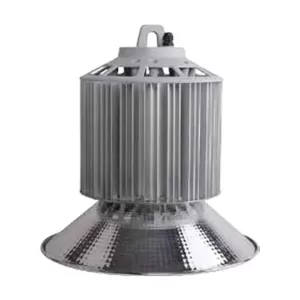
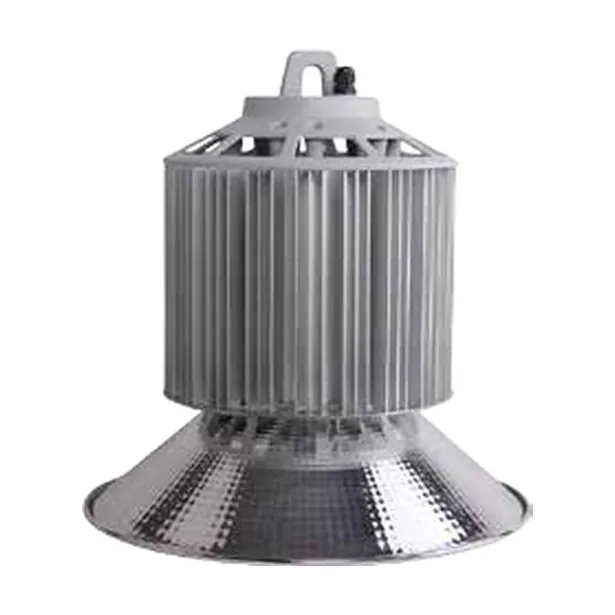
- The fitting’s rated ambient temperature (Ta). Compare it with the expected void temperature in the hottest month, not the room temperature. Our pendant-type GKP40C heat-pipe high bay, for example, is rated for −30 °C to +50 °C ambient; a void under a metal roof in a hot climate can approach or exceed that.
- Whether the fitting is designed and marked for recessed mounting (IEC 60598-2-2 covers recessed luminaires), including any clearance to insulation.
- Whether the driver can be mounted remotely, in a cooler place, which helps a lot.
- Whether the void can be ventilated.
If you cannot answer these, a surface-mounted fitting on the ceiling is often a better compromise: it looks tidy and still sheds heat into the room.
Worked example: a 30 × 18 m hall at 7 m
A showroom hall 30 m × 18 m with fittings at 7 m, light-coloured surfaces and a target of 300 lux. Two options from our high bay lighting calculator, both at 130 lm/W and a maintenance factor of 0.8:
| Option A: 100 W, 90° beam | Option B: 150 W, 120° beam | |
|---|---|---|
| Fittings | 24 (6 × 4) | 20 (5 × 4) |
| Spacing | 5.0 × 4.5 m | 6.0 × 4.5 m |
| Average | about 313 lux | about 374 lux |
| Power density | 4.4 W/m² | 5.6 W/m² |
| Heat into the void (if recessed) | 2.4 kW total, 100 W per opening | 3.0 kW total, 150 W per opening |
Open option A and change the wattage and beam.
For a recessed design, option A is easier: smaller, cooler fittings spread the heat over more openings, the light is more even, and the lower power density gives some headroom. Option B overshoots the target by about a quarter; it would need dimming to 300 lux, which also lowers its heat, but each opening still has a bigger fitting to cool. In a showroom, the extra fittings of option A also give softer shadows on displayed products.
Access for maintenance
A recessed fitting at 7–12 m must be reached somehow:
- From below, with a mobile elevating work platform. Check that the floor can take it and that the space can be cleared.
- From the void, via a catwalk, with a fitting that can be serviced from above. Common in airports and theatres.
- With a remote driver placed at an accessible point, so the most likely failure is easy to fix.
LED reduces how often you need access, but not to zero. Drivers fail more often than LED modules, which is another argument for remote drivers in high recessed installations.
Glare from a flush fitting
A flush fitting in a high ceiling can still glare, especially in sports halls where people look up. Ask for:
- A deep-set or louvred optic, so the light source is not visible at normal viewing angles
- A UGR calculation for offices or showrooms
- Ball-impact protection for sports halls
Our gym lighting guide covers impact protection and glare in sports halls, and high ceiling industrial lighting covers taller spaces generally.
Recessed, surface or pendant?
| Recessed | Surface-mounted | Pendant | |
|---|---|---|---|
| Appearance | Cleanest | Tidy | Visible in the space |
| Heat | Hardest | Moderate | Easiest |
| Ceiling cut-outs | Required | None | None |
| Access | Hardest | Moderate | Easiest, can be lowered on chains |
| Typical cost | Highest | Medium | Lowest |
For many showrooms and halls, surface-mounted or short-drop pendant high bays deliver almost the same look with none of the heat risk. For installation details, see our high bay wattage by ceiling height guide.
What to send us
Send the ceiling height, ceiling type, the room size, target lux and whether the fittings must be recessed. We will run the layout, check the heat and access constraints with you, and suggest the fitting type that fits the space.
Sources
Frequently asked questions
What is a recessed high bay light?
It is a high-output LED fitting designed to be built into a ceiling at high level, so its face sits flush with the ceiling. It is used in tall spaces with a finished ceiling, such as atriums, sports halls, showrooms and terminals.
Are recessed high bays worse for heat than pendant high bays?
Usually yes. A pendant high bay sheds heat into the open room air. A recessed fitting sheds it into the ceiling void, which may be closed, insulated and close to a hot roof. The fitting must be rated for that temperature.
Can I recess a normal high bay into a ceiling?
Not unless the maker says it is suitable. Standard high bays are designed for free air around the heat sink. Enclosing one in a ceiling can overheat the driver and void the warranty.
How high can recessed lights be mounted?
Recessed high-output fittings are used at 6 to 15 m and above. The limit is usually the optics and access for maintenance, not the fitting itself.
What are the alternatives to recessed high bays?
Surface-mounted high bays on the ceiling, pendant high bays on short drops, linear high bays, and track or projector fittings in architectural spaces. Each changes the look, heat behaviour and maintenance access.