What Wattage LED High Bay for a 6, 7, 8, 9 or 10 m Ceiling? Worked Answers for One Hall
What wattage LED high bay do you need for a 6 to 10 metre ceiling? One 40 × 25 m hall calculated at each height, showing count, spacing, lux and why spacing sets the answer.
Key points
- For a 40 × 25 m hall at 200 lux with 130 lm/W fittings, our calculator gives 60–100 W at 6 m, 100 W at 7 m, 150–200 W at 8 m, 150 W at 9 m and 150–200 W at 10 m.
- Below about 8 m the spacing limit, not the lumen requirement, sets the number of fittings, so bigger wattages only add lux and energy without removing fittings.
- A rule of thumb from these runs: aim for roughly 3–4 W/m² for 200 lux at 6–10 m with 130 lm/W fittings; above 5 W/m² usually means the wattage is too high for the height.
- Above about 8–9 m switch to a narrower (60°) beam so the light stays on the floor rather than the upper walls.
“What wattage do I need for my ceiling height?” is the most common high bay question we receive, and the honest answer is that height alone does not decide it. Floor area, the light level and the beam all count. But for a given hall, height has a clear and predictable effect, and seeing that effect for one hall at five heights answers the question better than any rule of thumb. This guide does exactly that.
The hall we used
- Floor: 40 × 25 m (1,000 m²), medium reflectances
- Target: 200 lux maintained, typical for warehouses and general workshops
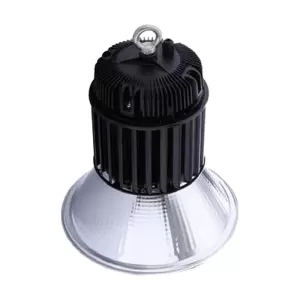
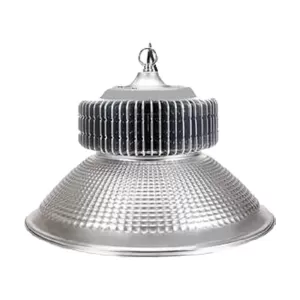
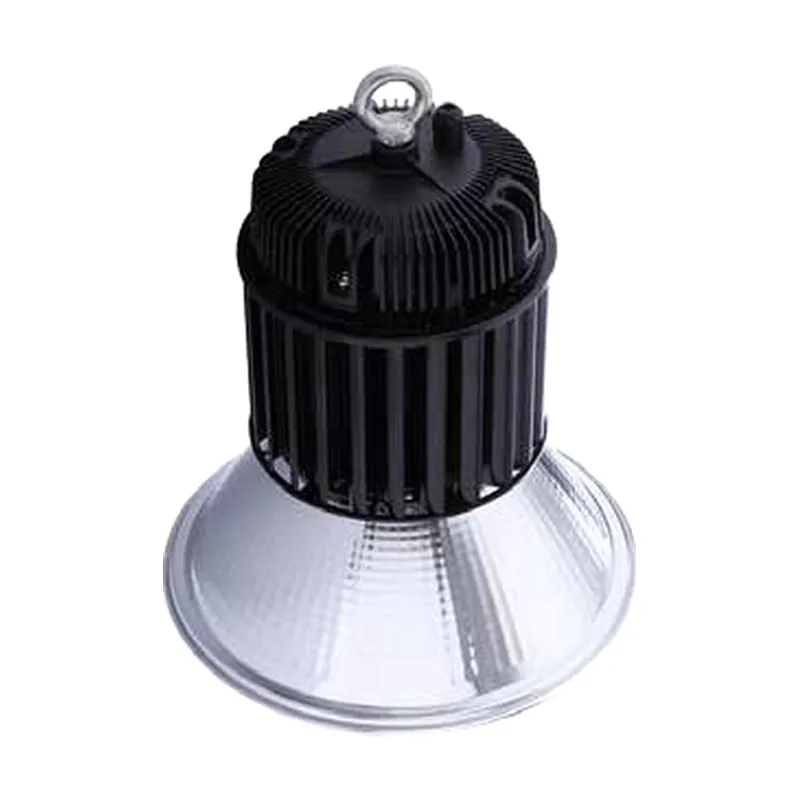
- Fitting: our GKP40G heat-pipe high bay, more than 130 lm/W, IP65, available at 60, 100, 150, 200 and 250 W
- Working plane 0.8 m, maintenance factor 0.8
- Beam: 90° (medium) up to 8 m, 60° (narrow) at 9 and 10 m
Every run below comes from our high bay and warehouse lighting calculator, which applies the lumen method and then caps spacing at about 1.2 times the height above the working plane for a medium beam (0.9 times for a narrow beam).
Results by height
| Ceiling (mounting) height | Wattage | Fittings (grid) | Spacing | Average | W/m² |
|---|---|---|---|---|---|
| 6 m | 60 W | 48 (8 × 6) | 5.0 × 4.2 m | about 218 lux | 2.9 |
| 6 m | 100 W | 35 (7 × 5) | 5.7 × 5.0 m | about 265 lux | 3.5 |
| 7 m | 100 W | 28 (7 × 4) | 5.7 × 6.2 m | about 203 lux | 2.8 |
| 7 m | 150 W | 24 (6 × 4) | 6.7 × 6.2 m | about 262 lux | 3.6 |
| 8 m | 150 W | 24 (6 × 4) | 6.7 × 6.2 m | about 251 lux | 3.6 |
| 8 m | 200 W | 15 (5 × 3) | 8.0 × 8.3 m | about 209 lux | 3.0 |
| 9 m, 60° | 150 W | 24 (6 × 4) | 6.7 × 6.2 m | about 253 lux | 3.6 |
| 10 m, 60° | 150 W | 24 (6 × 4) | 6.7 × 6.2 m | about 244 lux | 3.6 |
| 10 m, 60° | 200 W | 20 (5 × 4) | 8.0 × 6.2 m | about 271 lux | 4.0 |
(Open the 8 m, 200 W example.)
Reading the table
At 6 m the spacing sets the count. With a medium beam, fittings must be no more than about 6.2 m apart, so the hall needs a 7 × 5 grid of 35 fittings whatever their wattage. At 100 W that gives 265 lux; at 150 W it would give about 400 lux and at 250 W more than 650 lux, all for the same number of points. The right answer at 6 m is therefore the smallest wattage that reaches the target on the required grid: 60 W in a slightly denser grid, or 100 W with a comfortable margin.
At 7–8 m the two limits meet. Spacing can open up to about 7.4–8.6 m, so fewer, larger fittings become possible. At 8 m, 15 fittings of 200 W meet the target with the lowest load in the table, 3.0 W/m². Uniformity at 8 × 8.3 m spacing is still within the medium-beam limit, but only just; 24 fittings of 150 W give a more even floor for 20% more energy.
At 9–10 m the beam must narrow. A 90° beam at 10 m puts much of its light on the walls and the upper racking. With a 60° beam, the spacing limit drops back to about 8.3 m at 10 m, and 150–200 W is the practical range.
The pattern behind it
| Ceiling height | Typical wattage for 200 lux (130 lm/W) | Beam |
|---|---|---|
| 5–6 m | 60–100 W | 90°–120° |
| 7 m | 100–150 W | 90° |
| 8 m | 150–200 W | 90° |
| 9–10 m | 150–200 W | 60° |
| 12 m and above | 200–250 W, or higher-power fittings | 45°–60° |
For other light levels, scale the wattage roughly in proportion: 300 lux needs about 1.5 times the power of 200 lux on the same grid; 100 lux about half. For fittings of lower efficacy (for example 110 lm/W), multiply the wattage by about 1.2.
Our how many LED high bay lights do I need guide explains the lumen method step by step, and distance between high bay lights explains the spacing rule.
A sanity check: watts per square metre
Across all heights, a good design for 200 lux with 130 lm/W fittings landed between 2.8 and 4.0 W/m². If a quotation for a similar hall works out much higher than about 5 W/m², the fittings are probably oversized for the height, or the target has crept up. If it is much lower than about 2.5 W/m², check the spacing: the average may be met with dark bands between rows.
When the answer changes
- Racking. In racked warehouses, fittings go over the aisles, one row per aisle, with a narrow or aisle optic. The aisle pitch, not the floor grid, sets the count.
- Dark surfaces. Black floors, unpainted steel and dark racking can cut the utilisation factor by 10–15%. Add that margin.
- Hot or dusty halls. Choose an IP65 heat-pipe fitting; a fin high bay such as the IP44 GKP40J suits only dry, clean spaces.
- Mixed tasks. Zone the hall: 300 lux over assembly lines, 150 lux over bulk storage.
Replacing metal halide at the same height
Old 400 W metal halide high bays were often used at every height from 6 to 12 m. When replacing them one-for-one, the table above suggests 100–150 W at 6–7 m and 150–200 W at 8–10 m. Our metal halide to LED guide shows how to check the lumens and the savings. If the existing points are farther apart than the beam allows, add points rather than increase wattage.
Getting a layout for your hall
Send us the hall length, width, mounting height, the work done in each area and any racking plan. We will run the calculation with the actual fitting and return the count, spacing, average and a point-by-point check.
Sources
Frequently asked questions
What wattage LED high bay do I need for a 6 m ceiling?
For general warehouse work at 200 lux and fittings of 130 lm/W, 60–100 W. At 6 m the beam spacing limit already needs a fitting roughly every 5–6 m, so 150 W or more per point overshoots the target.
What wattage high bay for a 10 m ceiling?
Typically 150–200 W at 130 lm/W for 200 lux, with a 60° beam. In our 40 × 25 m example, 20 fittings of 200 W give about 270 lux; 24 of 150 W give about 245 lux.
Is a higher wattage always better at higher ceilings?
No. Higher mountings allow wider spacing, so fewer, larger fittings become possible. But the right wattage is the one that meets the target at the spacing the beam allows; anything above that is wasted energy.
How do I convert a metal halide high bay to LED by wattage?
A 400 W metal halide high bay is usually replaced by an LED fitting of 150–200 W, depending on height and target level. Check with a lumen calculation rather than a fixed ratio.