2×2 Indirect Troffers: How They Work and How They Compare With Panels
How a 2x2 indirect (volumetric) troffer bounces light off a reflector, where it beats a flat panel or grille troffer on glare and comfort, and a 12 × 8 m office layout comparing the three.
Key points
- An indirect (or volumetric) troffer hides the LEDs and sends their light onto a curved reflector, which spreads it softly into the room; you never look straight at the source.
- Compared with a flat LED panel, an indirect troffer usually gives lower glare and softer, more three-dimensional light, at some cost in efficacy.
- In our calculator example for a 12 × 8 m office at 500 lux, 24 fittings of 36 W are needed either way: our low-glare panel at 115 lm/W gives about 581 lux; an indirect troffer at an assumed 100 lm/W about 505 lux.
- A 2x2 grille troffer at 27 W and 90 lm/W needs 42 fittings for the same room, so efficacy and wattage drive the fitting count.
- Choose by glare (UGR), ceiling grid size (600 × 600 mm or 2 × 2 ft), efficacy and the look the space needs.
Walk into a modern office and look up. Some ceilings have flat, evenly glowing LED panels. Others have fittings with a curved, softly lit centre and dark edges: indirect or volumetric troffers. Both fit the same 2 × 2 grid opening, both run on LEDs, and both can light an office well. They differ in how the light is delivered, which changes glare, appearance and efficiency. This guide explains how an indirect troffer works and runs a layout for an office with three kinds of 2×2 fitting.
How an indirect troffer works
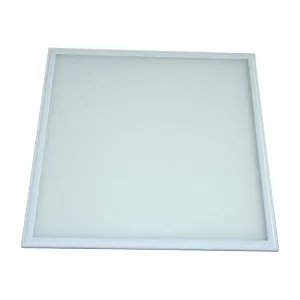
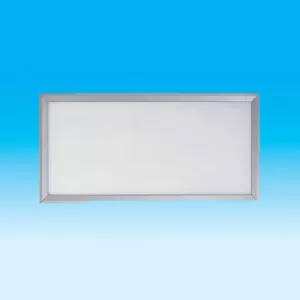
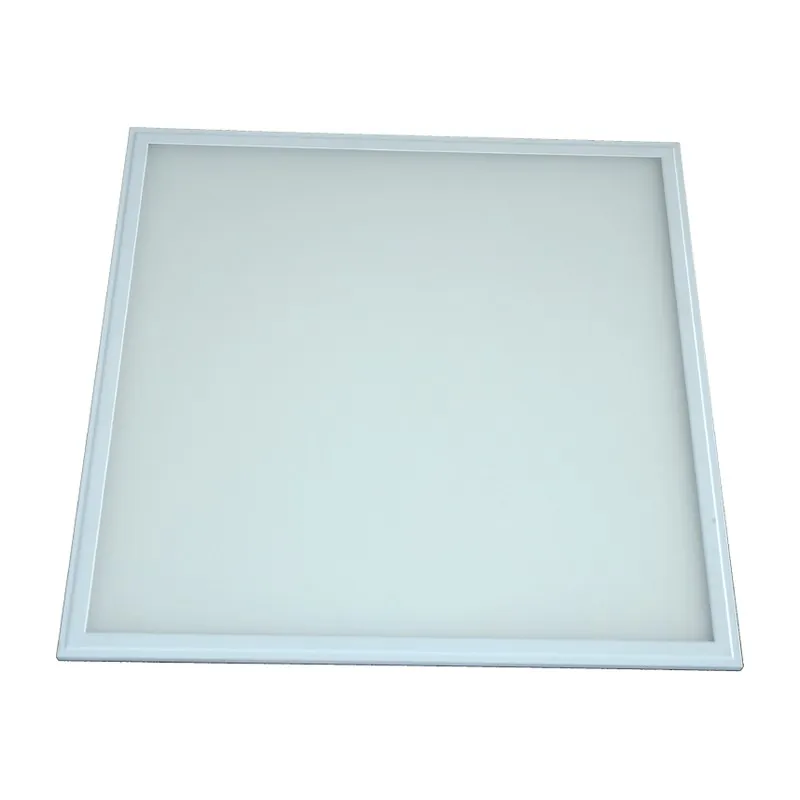
In a flat LED panel, the LEDs shine into the edge of a light guide plate or straight down through a diffuser, so the whole face of the fitting glows.
In an indirect troffer:
- The LEDs are mounted along the edges or in a central spine, facing upwards or sideways, not into the room.
- Their light lands on a curved, white or specular reflector.
- The reflector sends the light down through an open face or a soft diffuser.
You never look directly at an LED. The fitting looks like a softly lit curved surface, and the light comes from a larger, gentler source. That is why indirect troffers are popular in offices, classrooms, clinics and meeting rooms.
Three 2×2 fittings compared
| Flat LED panel (low-glare) | Indirect / volumetric troffer | Grille (louvre) troffer | |
|---|---|---|---|
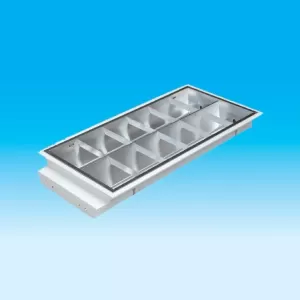
| Light path | Through diffuser or prismatic plate | Off a curved reflector | Down through louvres from LED tubes or modules |
| Appearance | Flat, uniformly bright | Curved, soft centre, darker edges | Bright louvres, dark between |
| Glare | Low with a microprismatic or UGR-rated diffuser | Very low | Low to moderate, depends on louvre |
| Efficacy | High | Medium (reflector losses) | Often lower |
| Light on walls and ceiling | Mostly downwards | Wider, softer spread | Mostly downwards |
| Example from our range | BG-MBC-W36 low-glare panel: 36 W, 4,140–4,320 lm, 115–120 lm/W | Not in our range | BG-DPT8A grille troffer: 27 or 36 W, 90 lm/W |
Worked example: a 12 × 8 m office at 500 lux
An open office 12 m × 8 m with a 2.8 m ceiling, light-coloured surfaces and a 500 lux target at desk height (0.8 m). We ran three options in our lighting layout calculator, with a wide beam and a maintenance factor of 0.8:
| Option | Fittings | Layout | Average | Load |
|---|---|---|---|---|
| Our low-glare panel, 36 W at 115 lm/W | 24 | 6 × 4, 2.0 m apart | about 581 lux | 864 W, 9.0 W/m² |
| Indirect troffer, 36 W at an assumed 100 lm/W | 24 | 6 × 4, 2.0 m apart | about 505 lux | 864 W, 9.0 W/m² |
| Our grille troffer, 27 W at 90 lm/W | 42 | 7 × 6 | about 597 lux | 1,134 W, 11.8 W/m² |
Open the example and put in your room and fitting.
What the numbers say:
- The panel and the indirect troffer need the same count in this room, because the 2 m maximum spacing for even light sets the grid. The panel has about 15 % more light in hand; with dimming it can be turned down to 500 lux and save that energy. The calculator says about 31 W per panel would be enough.
- The indirect troffer just meets the target. Its value is in comfort, not efficiency. If it were less efficient than the 100 lm/W assumed here, you would need more fittings. Check the real lumens of any indirect troffer you consider.
- The grille troffer needs far more fittings at this wattage and efficacy, with about 30 % more connected load.
One caution: the calculator uses a general utilisation model for downward-lighting fittings. Indirect troffers spread more light onto walls, which a full photometric calculation (with the maker’s IES or LDT file) captures better. Use the calculator for a first count and photometric software for the final design.
Glare: the main reason to choose indirect
Discomfort glare is measured as UGR (Unified Glare Rating). EN 12464-1 sets UGR 19 as the limit for offices and computer work. Indirect troffers easily meet it, because the source is hidden. Flat panels can meet it too, but only with the right diffuser: an ordinary opal panel can exceed UGR 19 in large open offices.
Our BG-MBC-W36 panel was designed as a low-glare office panel; ask us for its UGR table for your room size. Our office lighting fixtures guide covers UGR in more detail, and LED troffer lights compares troffer types in general.
Choosing between them
| Priority | Best choice |
|---|---|
| Lowest cost and highest efficacy | Flat low-glare panel |
| Most comfortable light, premium look | Indirect troffer |
| Retrofit into existing grille troffer housings | LED tubes or retrofit kit in the grille |
| Classrooms and clinics with long hours of screen work | Indirect or low-glare panel |
| Corridors and storage | Basic panel or grille troffer |
Check the ceiling grid first
- US grid: 2 × 2 ft (610 × 610 mm) and 2 × 4 ft openings.
- Metric grid: 600 × 600 mm and 1,200 × 600 mm; fittings are about 595 × 595 mm.
- A metric fitting in a US grid (or the other way round) will not sit properly. Confirm the grid before ordering.
Our LED panel light range covers the 595 × 595 mm metric size; tell us if your grid is imperial.
What to send us
Send the room plan, ceiling height, grid size, target lux and any UGR requirement. We will run the layout with our panel and troffer options, report lux, UGR and load, and quote the fittings.
Sources
Frequently asked questions
What is an indirect troffer?
It is a recessed ceiling fitting in which the LEDs face a curved reflector instead of facing the room. Light reflects off that surface and leaves through a diffuser or open face, so the light source is hidden and the fitting looks evenly bright.
Is an indirect troffer better than an LED panel?
It depends on the priority. Indirect troffers give softer light and very low glare, and many people find them more comfortable. Flat panels are usually more efficient and cheaper. A low-glare panel with a UGR below 19 meets office requirements too.
What size is a 2x2 troffer?
Nominally 2 × 2 ft (about 610 × 610 mm) for US ceiling grids. Metric grids use 600 × 600 mm, and fittings for them are typically 595 × 595 mm. Check which grid your building has before ordering.
How many 2x2 troffers do I need for an office?
It depends on room size, target lux and each fitting's lumens. As an example, a 12 × 8 m office at 500 lux needs about 24 fittings of 36 W with an efficacy of 100–115 lm/W. Run a layout for your room.
What UGR should office lighting have?
EN 12464-1 sets a UGR limit of 19 for offices and writing or computer work. Lower values mean less discomfort glare.