Fire-Rated Downlight Covers: When You Need Them and How to Fit LED Downlights Safely
What fire-rated downlight covers (fire hoods) do, when a ceiling needs them, how they differ from fire-rated downlights, and how LED wattage and cut-out size affect the choice.
Key points
- Cutting a downlight hole in a fire-resisting ceiling breaks the fire barrier; a fire-rated cover (hood) or a fire-rated downlight restores it.
- Ceilings that separate flats, a garage from a home, or floors of a building usually need 30 or 60 minutes of fire resistance, and every penetration must keep that rating.
- Hoods are sized by the fitting: check the internal diameter and height against the downlight body and driver, and keep insulation clear unless the hood is rated for contact.
- By our figures, six 9 W LED downlights put 54 W of heat into their hoods, against 300 W for six 50 W halogen lamps, so LEDs suit hoods far better, though drivers still need a little air.
A downlight hole looks harmless, but in some ceilings it is a hole in a fire barrier. Plasterboard ceilings between flats, between storeys, or between a garage and living space are built to hold back fire for a set time, usually 30 or 60 minutes. A 100 mm hole every metre or so lets fire and smoke into the void above long before that. Fire-rated downlight covers, often called fire hoods, are one way to close the gap. This guide explains when they are needed, how they work and what to check when fitting LED downlights.
When a ceiling needs fire protection
Building rules decide where a ceiling must resist fire. In England, Approved Document B is the guidance; other countries have similar codes. Typical cases:
- Separating floors between flats or apartments.
- Floors between storeys in houses of three or more storeys, and in most commercial buildings.
- Integral garages, where the ceiling or wall separates the garage from the home.
- Escape routes such as protected stairways and corridors.
If the ceiling is part of one of these, every penetration (downlights, speakers, extractor fans) must keep its fire resistance. If the ceiling sits under an unheated loft with no fire separation, there is usually no fire requirement, and hoods are used, if at all, to keep insulation off the fittings.
Two ways to keep the rating
Fire-rated downlights. The fitting itself carries an intumescent pad or a steel can that seals the hole when heated. It has been tested, usually to BS 476-21 or an equivalent, in a ceiling for 30, 60 or 90 minutes.
Standard downlight plus fire hood. A cover made of intumescent material, steel or fire-resistant fabric sits over the fitting in the void. In a fire, it expands or holds its shape and closes the opening. The hood carries the fire rating, not the downlight.
Both routes work if the product has been tested for the ceiling type and the time required. What does not work is a standard downlight in a fire-resisting ceiling with nothing above it.
Choosing a hood: size first
Hoods come in sizes and shapes. Before ordering, check:
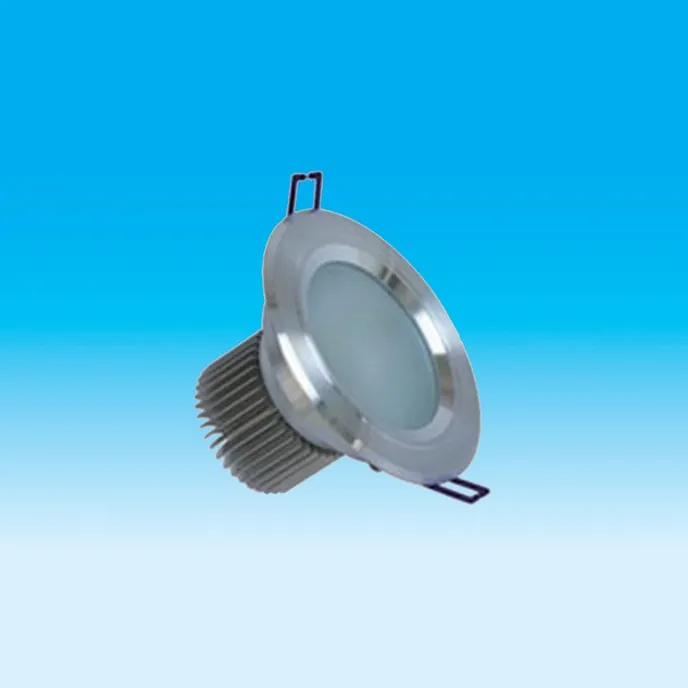
- Internal diameter. It must clear the downlight body, spring clips and any heat sink fins.
- Internal height. The fitting plus its connection box and driver must fit under the hood without being pressed into the top.
- Cut-out range. Many hoods state the hole sizes they cover; the hood must overlap the ceiling around the hole.
- Insulation contact. Some hoods allow loft insulation to be laid straight over them; others need a clearance.
- Acoustic rating, if the ceiling also separates flats for sound.
Our BG-TDT downlights cover cut-outs from 75 mm (5 W) to 170 mm (24 W):
| Model | Power | Outer diameter | Cut-out |
|---|---|---|---|
| BG-TDT05A | 5 W | 98 mm | 75 mm |
| BG-TDT09A | 9 W | 120 mm | 95 mm |
| BG-TDT12A | 12 W | 145 mm | 120 mm |
| BG-TDT18A | 18 W | 180 mm | 145 mm |
| BG-TDT24A | 24 W | 190 mm | 170 mm |
These are standard downlights, not fire-rated fittings. In a fire-resisting ceiling, use them under a tested hood sized for the cut-out, or choose a certified fire-rated downlight.
Heat: why LED and hoods get along
A hood traps the heat that a fitting gives off into the void. With halogen lamps this was a real problem: a 50 W lamp turns almost all of its power into heat, and an enclosed hood could cook the lamp holder and wiring.
LED downlights put out far less heat for the same light. A room lit by six 9 W LED downlights adds about 54 W of heat into the hoods; six 50 W halogen lamps would add about 300 W. At 90 lm/W the 9 W LED gives about 810 lm, more than a typical 50 W halogen lamp.
That does not mean LEDs ignore heat. The LED chip and the driver both last longer when they run cool. Our BG-TDT is rated from −30 °C to +50 °C ambient. Three habits keep a hooded downlight inside that range:
- Use the right size hood, with air space around the heat sink.
- Mount the driver outside the hood when the hood maker allows it, or choose a hood that accommodates the driver.
- Avoid over-powered fittings. A 24 W fitting in a small hood runs much hotter than a 12 W one.
Installation steps
- Confirm whether the ceiling is fire-resisting and for how long, from the drawings or the building control officer.
- Choose fittings and hoods tested for that rating and ceiling type.
- Cut holes to the downlight’s stated cut-out; an oversized hole may fall outside the hood’s tested range.
- Fit the hood over the hole from above if access allows, or through the hole for push-up types.
- Pass the cable through the hood’s entry point and seal it as instructed.
- Connect and fit the downlight, then lay insulation as the hood instructions allow.
Our step-by-step recessed downlight installation guide covers the cutting and wiring. For shallow voids, slimmer fittings help; see our guide to ultra-slim LED downlights.
Common mistakes
- Assuming a hood makes any fitting fire-rated. Only the combination tested together carries the rating.
- Cutting holes too large. It is common when replacing old fittings; the hood or fitting may no longer seal.
- Covering non-rated fittings with insulation. It overheats the driver and can scorch the insulation.
- Forgetting other penetrations. Speakers, cable holes and fans need the same treatment.
For contractors and distributors
On housing and hotel projects, the fire strategy decides which ceilings need rated fittings. Send us the cut-out sizes, ceiling heights and the light levels you need. We can propose standard downlights for unrated areas, confirm the dimensions your hood supplier needs, and suggest fittings that keep heat low in enclosed voids. A lighting layout from our lighting calculator helps fix the count before ordering hoods.
Sources
Frequently asked questions
Do all downlights need fire hoods?
No. They are needed where the ceiling is part of a fire-resisting construction, such as between flats, between floors, or between an integral garage and the house. In a ceiling below a cold loft with no fire rating, hoods are optional, though some are used to keep insulation away from the fitting.
What is the difference between a fire-rated downlight and a downlight with a fire hood?
A fire-rated downlight has its own intumescent seal or steel can and has been tested in a ceiling for 30, 60 or 90 minutes. A standard downlight can be used in a fire-resisting ceiling only if a tested fire hood covers it from above.
Can you cover LED downlights with insulation?
Only if the fitting is marked as suitable for contact with insulation, or if a cover designed for it sits between the fitting and the insulation. Otherwise the driver and LED overheat.
Are your downlights fire-rated?
Our BG-TDT downlights are standard downlights, not fire-rated fittings. In a fire-resisting ceiling they should be installed under a tested fire hood or replaced by a certified fire-rated downlight.