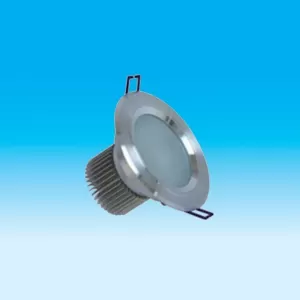
Ultra-Slim Round LED Downlights with 5CCT Switch: How They Work and How Many to Use
How ultra-slim round LED downlights with a 5CCT colour switch work, when a conventional die-cast downlight is better, and a 10 × 8 m room counted with our lighting calculator.
Key points
- An ultra-slim (wafer or canless) downlight is a thin panel a few centimetres deep with its driver in a separate box, so it fits shallow ceilings and needs no can or housing.
- A 5CCT switch lets the installer choose one of five colour temperatures on site, typically from 2700 K to 5000 K, so one stock item covers warm homes and cool offices.
- For a 10 × 8 m room with a 3 m ceiling at 300 lux, our calculator gives 42 downlights of 12 W, 30 of 18 W or 25 of 24 W at 90 lm/W, our BG-TDT efficacy.
- Thin fittings run warmer and have less room for heat sinks; die-cast downlights such as our BG-TDT suit long operating hours and higher wattages better.
Ultra-slim round LED downlights, often sold with a “5CCT” colour switch, have become one of the most common recessed fittings in homes, apartments, small shops and offices. They are thin, light and quick to install, and a single product can be set to five colour temperatures on site. This guide explains how they are built, what the switch does, when a conventional die-cast downlight is the better choice, and how many fittings a typical room needs.
How an ultra-slim downlight is built
A conventional recessed downlight has a body several centimetres to more than ten centimetres deep: a heat sink, a reflector or lens, and often an integrated driver. An ultra-slim downlight, also called a wafer or canless downlight, is different:
- The light head is a thin disc, often under 3 cm deep, with LEDs around the edge or behind a diffuser.
- The driver sits in a separate box connected by a short cable. In North America this box is often a junction box with knockouts, so no separate electrical box is needed.
- Spring clips hold the head in a hole cut in the ceiling. No can or housing is required.
The result fits ceilings with very little depth, such as under joists, in apartment slabs with thin false ceilings, or where insulation fills most of the void. Typical sizes are given by the ceiling hole, for example 4 inch or 6 inch in North America, or 100–200 mm elsewhere.
The 5CCT switch
Colour temperature describes how warm or cool white light looks:
| Setting | Appearance | Typical use |
|---|---|---|
| 2700 K | Warm, like incandescent | Living rooms, bedrooms, restaurants |
| 3000 K | Warm white | Homes, hotels, retail with warm displays |
| 3500 K | Neutral warm | Mixed-use spaces, reception areas |
| 4000 K | Neutral white | Offices, schools, kitchens |
| 5000 K | Cool white | Workshops, garages, task areas |
A 5CCT downlight has a small slide switch, usually on the driver box, that selects one of these. The installer chooses the setting before clipping the fitting into the ceiling. For distributors and contractors this is a stock advantage: one product covers five colour options, so there are fewer items to hold. For buyers it means rooms can be matched on site.
Two points to check: the lumen output at each setting (warmer settings usually give slightly fewer lumens), and that all fittings in one room are set the same, because a mixed ceiling is very obvious. Our colour temperature chart explains the scale in more detail.
Ultra-slim or die-cast: which to choose
| Ultra-slim (wafer) | Die-cast downlight | |
|---|---|---|
| Depth | Very shallow | Deeper body |
| Heat dissipation | Limited by the thin body | Larger metal heat sink |
| Typical wattage | Low to medium | Low to high |
| Colour choice | Often switchable on site | Usually chosen at order |
| Best for | Homes, apartments, light commercial, shallow ceilings | Shops, hotels, malls, offices with long hours |
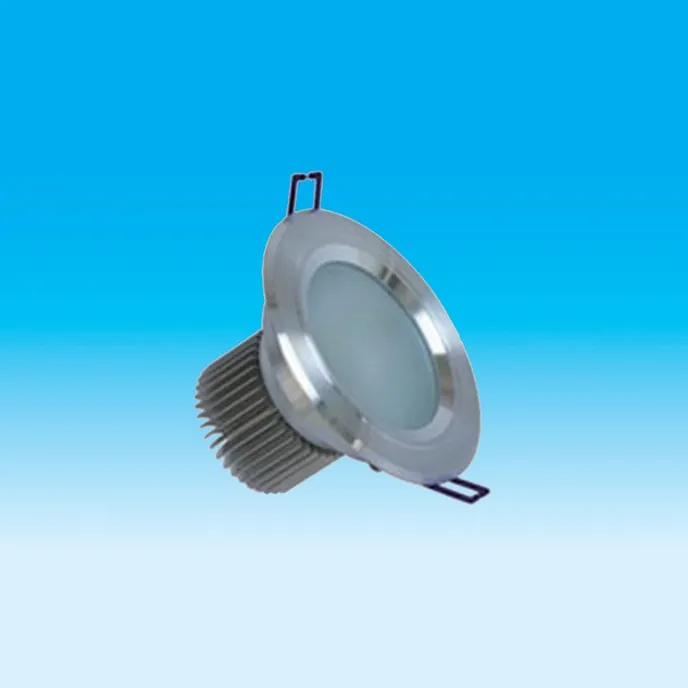
Our own BG-TDT LED downlight is a conventional die-cast design: 5–24 W, ceiling cut-outs from 75 to 170 mm, SMD5730 LEDs, 90 lm/W, a 90° beam, 3000–6000 K chosen at order, Ra 70–90, and an operating range of −30 °C to +50 °C with a rated life of 30,000 hours. It is meant for commercial ceilings where lights burn for many hours a day. For homes and very shallow ceilings, an ultra-slim fitting may be the better fit.
Worked example: how many downlights for a 10 × 8 m room
We used the lumen method of our lighting calculator for a 10 × 8 m office or shop with a 3 m ceiling, a 0.8 m working plane, light-coloured surfaces, a wide beam, maintenance factor 0.8, and 300 lux, a common target for offices and shops under EN 12464-1. Fittings at 90 lm/W, the efficacy of our BG-TDT:
| Downlight wattage | Lumens each | Fittings (grid) | Average | Power density |
|---|---|---|---|---|
| 12 W | about 1,080 lm | 42 (7 × 6) | about 305 lux | 6.3 W/m² |
| 18 W | about 1,620 lm | 30 (6 × 5) | about 326 lux | 6.75 W/m² |
| 24 W | about 2,160 lm | 25 (5 × 5) | about 363 lux | 7.5 W/m² |
Three observations: smaller fittings need many more holes, which adds installation time; larger fittings reach the target with fewer points but slightly overshoot, because the grid is rounded up; and the power density is similar in all three, about 6–7.5 W/m², because efficacy is the same. Choose the wattage that gives a sensible spacing for the ceiling grid and the furniture layout. For a lower target, such as 150–200 lux in corridors or homes, the counts fall roughly in proportion.
Ultra-slim fittings with a lower efficacy would need proportionally more fittings or wattage for the same result; always use the lumens from the datasheet, not the wattage, when counting.
Installation points
- Cut the hole to the stated size; spring clips need the edge to grip.
- Keep the driver box accessible or at least resting free on the ceiling, not buried in insulation unless rated for it.
- Set the CCT switch before fitting, and set every fitting in the room the same.
- Check dimmer compatibility if the fittings will be dimmed; many ultra-slim drivers are designed for phase-cut dimmers, and not every dimmer suits every driver.
- In fire-rated or insulated ceilings, use fittings rated for that use under your local rules.
Our guide to recessed downlight installation covers cutting, wiring and spacing in more detail, and LED downlight beam angle explains how beam choice affects spacing.
Retrofitting old downlights
Ultra-slim fittings are popular for replacing old halogen or CFL downlights, because they fit into existing holes without the old can. Where the old hole is larger than the new fitting, a trim ring or adapter plate covers the gap. See our guide to LED retrofit pot lights and, for small cut-outs, small recessed downlights.
Summary
Ultra-slim 5CCT downlights are thin, flexible and easy to stock, which explains their popularity in homes and light commercial work. For long-hour commercial ceilings, a die-cast downlight like our BG-TDT handles heat and higher wattages better. Either way, count fittings from lumens and the room, not from habit: in our 10 × 8 m example, 30 fittings of 18 W at 90 lm/W reach 300 lux.
Sources
Frequently asked questions
What is an ultra-slim LED downlight?
A recessed downlight built as a thin round or square panel, often under 3 cm deep, with the LED driver in a separate junction box on a short cable. It is clipped into a hole in the ceiling without a can or housing, which suits shallow ceiling voids.
What does 5CCT mean on a downlight?
It means the fitting has a switch, usually on the driver box, that selects one of five colour temperatures, commonly 2700 K, 3000 K, 3500 K, 4000 K and 5000 K. The installer sets it before fitting, so a single product can match different rooms.
How many downlights do I need for a room?
It depends on room size, ceiling height, target lux and the lumens of each light. For a 10 × 8 m office or shop at 300 lux and 3 m ceiling height, our calculation gives about 30 downlights of 18 W at 90 lm/W.
Are ultra-slim downlights as good as standard downlights?
For homes and light commercial use they work well. In long-hour commercial spaces or at higher wattages, deeper die-cast downlights dissipate heat better and usually last longer. Compare rated life and operating temperature, not only thickness.