What Beam Angle LED Downlight Do You Need? Spot Sizes, Spacing and Worked Layouts
Choosing the beam angle for LED downlights: spot diameter on the floor or table for 25°, 36°, 60° and 90°, spacing rules, layouts for a shop and a living room, and narrow spotlights.
Key points
- Beam diameter = 2 × distance × tan(beam angle ÷ 2). From a 3 m ceiling to a 0.75 m table, a 90° downlight lights a circle about 4.5 m across; a 25° spotlight about 1 m.
- For general lighting choose wide beams, 60–120°. Our BG-TDT downlights use a 90° beam; in a calculated 8 × 6 m shop at 300 lux, 25 downlights of 15 W or 30 of 12 W meet the target.
- For accent lighting use 24–36°. A 10 W, 25° spotlight puts about 800 lux on a 1 m circle from 2.25 m, about 17 times the average a 90° downlight of similar output gives over its larger pool.
- Narrow beams in a grid create bright pools and dark gaps; wide beams in a grid give even light. Mix the two by job, not by habit.
Downlight data sheets list a beam angle, but rarely explain what it means for the room. The beam angle decides how big the pool of light is, how far apart the fittings can be, and whether the room looks evenly lit or spotty. This guide turns beam angles into spot sizes, gives spacing rules and runs two rooms through our calculator.
What the beam angle means
The beam angle is the cone within which the light’s intensity is at least half of the peak. The pool it lights has a diameter of:
Beam diameter = 2 × distance × tan(beam angle ÷ 2)
From a 3 m ceiling to a 0.75 m table or counter, the distance is 2.25 m:
| Beam angle | Diameter at 2.25 m | Diameter at 3 m (floor) | Typical use |
|---|---|---|---|
| 25° | 1.0 m | 1.3 m | Accent on objects, artwork, displays |
| 36° | 1.5 m | 1.9 m | Accent, table lighting, high ceilings |
| 60° | 2.6 m | 3.5 m | General light with some punch |
| 90° | 4.5 m | 6.0 m | General lighting, even coverage |
| 120° | 7.8 m | 10.4 m | Very even, soft light, low ceilings |
Light outside the beam angle is not zero; it fades gradually. That is why wide-beam downlights blend into each other while narrow spots leave clear edges.
General lighting: wide beams in a grid
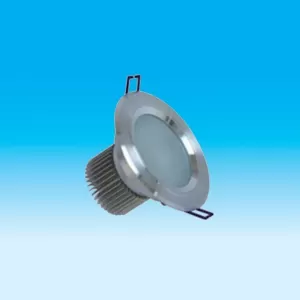
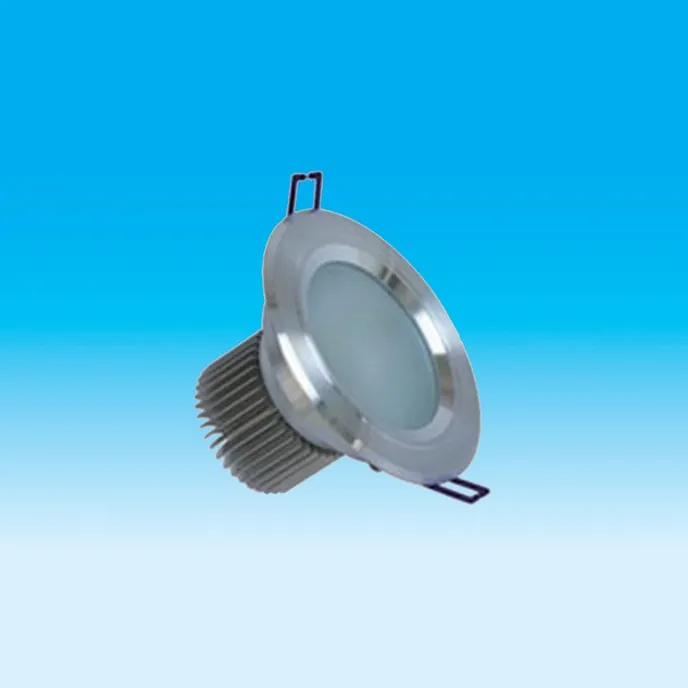
Our BG-TDT downlight uses a 90° beam, 90 lm/W, in sizes from 5 W to 24 W (cut-outs 75–170 mm). For general lighting, a grid of wide-beam downlights works like a lit ceiling: each pool overlaps its neighbours.
Worked example 1: a shop, 8 × 6 m, 3 m ceiling, 300 lux on the counters (0.75 m), light finishes. Our lighting calculator gives a utilisation factor of about 0.64:
| Downlight | Lumens each | Number | Grid | Spacing | Average lux | W/m² |
|---|---|---|---|---|---|---|
| 12 W | 1,080 | 30 | 6 × 5 | 1.33 × 1.2 m | 347 | 7.5 |
| 15 W | 1,350 | 25 | 5 × 5 | 1.6 × 1.2 m | 362 | 7.8 |
Both meet 300 lux. The 15 W layout uses five fewer fittings and cut-outs for almost the same load. With a 4.5 m beam diameter at counter height, every point in the shop sits inside several overlapping beams, so the light is even.
Worked example 2: a living room, 5 × 4 m, 2.7 m ceiling, 150 lux at table height. The calculator gives 9 downlights of 9 W in a 3 × 3 grid at about 1.7 × 1.3 m spacing, about 160 lux. In a home, it is worth putting them on a dimmer and switching the row near the sofa separately.
Spacing rules
- Wide beams (60–120°): space up to about the height above the working surface, or a little more. For 2.25 m that is roughly 2–2.5 m. The light level often requires closer spacing, as above.
- Narrow beams (24–40°): do not use them in a regular grid for general lighting. Their pools are 1–1.5 m across at table height, so a grid at 1.5–2 m leaves dark gaps between bright circles.
- Distance from walls: about half the spacing. Closer to the wall (0.3–0.6 m) gives “scallops” of light on the wall, which can be attractive in corridors and shops but looks uneven in offices. For even wall light, see our guide to wall washer downlights.
Accent lighting: narrow beams on targets
Accent lighting makes an object stand out by lighting it brighter than its surroundings, often three to five times brighter. That needs concentrated light.
Compare two fittings of similar output, both 2.25 m above a display table, assuming about 70% of the lumens fall inside the beam:
| Fitting | Lumens | Beam | Pool diameter | Average lux in the pool |
|---|---|---|---|---|
| BG-TDT12A downlight | 1,080 | 90° | 4.5 m | about 48 lux |
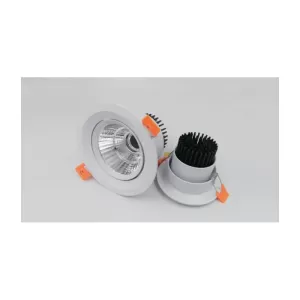
| BG-THC COB spotlight, 10 W | 900 | 25° | 1.0 m | about 800 lux |
| BG-THC COB spotlight, 10 W | 900 | 30° | 1.2 m | about 550 lux |
With less light output, the 25° spotlight puts about 17 times as much light on the table. In the shop above, with 300–360 lux of general light, a 25° spot gives the display roughly 2.5 times the surroundings, enough to draw the eye. Our COB spotlight, grille spotlight and track light ranges come with 25° or 30° beams for this job; see our guide to LED track lighting for adjustable accent lighting.
Ceiling height changes the choice
- Low ceilings (2.4–2.7 m): wide beams, 90–120°, avoid bright spots on the floor and glare from close fittings.
- Standard ceilings (2.7–3.5 m): 60–90° for general light.
- High ceilings (4–8 m) in lobbies, malls and showrooms: 36–60° to get enough light down to the floor; a 90° beam from 6 m spreads most of its light onto the walls. At these heights, check the layout in a calculator rather than by rule of thumb.
Glare and comfort
A narrow beam is not automatically low-glare. Glare depends on how bright the source looks from normal viewing angles:
- Choose downlights with the LEDs set back behind a reflector or diffuser.
- In offices and classrooms, check the unified glare rating (UGR); our office lighting fixtures guide lists typical limits.
- Avoid aiming spotlights where people sit and look up, such as above counters where staff face customers.
Retrofit and installation notes
- Match the cut-out. Our downlights need cut-outs from 75 mm (5 W) to 170 mm (24 W); see the product table before ordering for an existing ceiling.
- Check ceiling depth and insulation for the driver and heat sink. Our recessed downlight installation guide covers clearances.
- Retrofitting old halogen or CFL downlights: keep the positions if the beam suits the room; replace narrow halogen spots used for general light with wide-beam LED downlights. Our guide to LED retrofit pot lights compares retrofit options.
Quick guide
| Job | Beam angle |
|---|---|
| Even general light, low ceiling | 90–120° |
| General light, standard ceiling | 60–90° |
| Kitchen counters, tables | 36–60° |
| Artwork, displays, merchandise | 24–36° |
| High ceilings, 4 m and up | 36–60° |
Send us a plan of the room with ceiling height and the light level you want, and we will return a downlight layout with wattage, beam angle and spacing.
Sources
Frequently asked questions
What beam angle is best for LED downlights?
For general room and shop lighting, 60–120°, with 90° a common choice: it gives even light with downlights spaced about 1.2–2 m apart at normal ceiling heights. Use 24–40° only for accent lighting on displays, artwork or a table.
How far apart should downlights be?
For wide-beam downlights, roughly the ceiling height above the working surface or a little more; for a 3 m ceiling and 0.75 m tables, about 1.5–2.5 m. The number needed for the light level often makes the spacing closer, as in our shop example at 1.2–1.6 m.
Is a 60° or 90° downlight better for a living room?
90° gives softer, more even light and needs fewer fittings for the same evenness. 60° gives a little more punch on the floor and table and less light on the walls. Many living rooms use 90° downlights for general light and a few 36° spots for accents.
Does beam angle change how bright a downlight is?
It does not change the total lumens, but it changes where they go. A narrow beam concentrates the same lumens on a smaller area, so the spot is brighter while the room around it is darker.