
LED Track Lighting for Shops and Galleries: Heads, Beams, Tracks and Layout
How to plan LED track lighting for shops and galleries: track types, COB heads and beams, wattage and spacing, aiming, CRI and colour temperature, and replacing halogen track.
Key points
- Track lighting lets shops and galleries move and re-aim lights as displays change, from one power track.
- COB LED heads with 15–40° beams highlight products; wide beams or floods give general light along the track.
- Aim heads at about 30° from vertical to avoid reflections and glare, and keep spacing even along the track.
- High colour rendering (Ra 90+) and the right colour temperature matter more in retail than raw brightness.
Track lighting is the workhorse of retail and gallery lighting. When window displays, product layouts and exhibitions change every few weeks, fixed downlights cannot keep up. Track heads can be moved, added and re-aimed in minutes.
How track systems work
A track is a powered rail, surface-mounted, recessed or suspended. Light heads clip in with an adaptor and can be placed anywhere along it.
- Single-circuit track: all heads switch together
- Three-circuit track: heads on different circuits switch separately, for example window, shop floor and fitting rooms
- DALI or wireless track: heads dimmed and controlled individually
Make sure heads and adaptors match the track standard; different systems are not always compatible.
Choosing heads
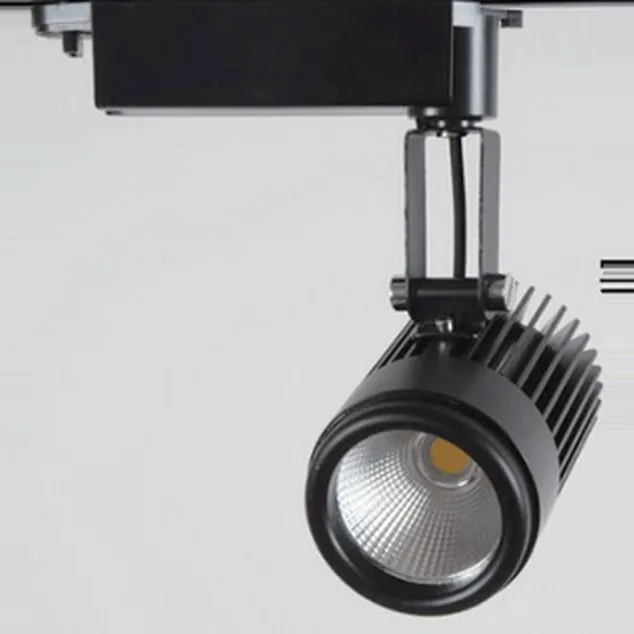
COB spotlights are the most common: a single bright source in a reflector, giving a clean beam and crisp shadows. Our COB LED track lights cover 3–18 W with a 25° beam, rotating 360° horizontally and 90° vertically.
Zoomable heads let staff adjust beam angle on site.
Wall washers light shelves and walls evenly.
Linear track heads give general light along aisles.
Beam angles by task
- 10–15°: single products, jewellery, artworks from a distance
- 20–25°: mannequins, featured products, art
- 30–40°: displays, shelves, tables
- 50–60° or wall wash: walls, general light
Mixing narrow and medium beams creates contrast that draws the eye to featured products.
Wattage and spacing
On ceilings around 3 m:
- 7–12 W heads for accents on tables and displays
- 12–18 W heads for walls and mannequins
- About 1–1.5 m between heads for accent lighting
On higher ceilings, use higher wattage or narrower beams. For general light levels, combine track with panels or downlights; see office light fixtures for general lighting layouts that also apply to shops.
Aiming
- Aim at about 30° from vertical: steep enough to avoid glare, shallow enough to light vertical surfaces
- Avoid aiming at mirrors and glass, which reflect glare
- Light products from the front and slightly to the side to show texture
- In fitting rooms, light people from the front, not from directly above
Colour rendering and colour temperature
In retail, colour quality sells:
- Ra 90 or higher for clothing, food, cosmetics and art
- 3000K for warm, premium environments (fashion, jewellery, hospitality)
- 4000K for electronics, sports and general retail
- Specialised spectra for fresh food: meat, bread and produce each look best under slightly different light
See our colour temperature chart for how kelvin values compare.
Heat and UV
LED heads produce little heat and almost no UV in the beam, which protects textiles, artworks and food better than halogen track lights did. Drivers are usually in the adaptor or the head; keep them away from hot ceiling voids.
Replacing halogen track lighting
Old 35–50 W halogen track heads can be replaced by 7–12 W LED heads with similar or better light. Check that the existing track is compatible with the new adaptors; if not, replacing the track at the same time is often worthwhile, as old tracks can have worn contacts.
Galleries and museums
Galleries need precise beams, very high CRI, low UV and dimming. Framing and narrow-beam heads, accessory lenses and glare louvres help focus light on artworks without spilling onto walls. Light levels for sensitive works are often limited, so dimming matters.
Showrooms
Car, furniture and appliance showrooms combine high general light levels with accent beams on products. Track lighting on long runs, sometimes suspended from high ceilings, gives flexibility as displays change.
Controls
- Separate circuits for windows, displays and general light
- Dimming to set scenes for day and evening
- Timers for window displays after closing
Common mistakes
- All heads aimed straight down, leaving walls and products dark
- Only one beam angle, so nothing stands out
- Cool white with low CRI, making products look dull
- Heads aimed into customers’ eyes or mirrors
Planning a shop layout
Start with the floor plan and mark the zones: window, entrance, feature tables, wall bays, fitting rooms and checkout. Run tracks parallel to the walls about 1–1.5 m from them, so heads can be aimed at wall displays at the right angle, and add tracks over feature tables. Plan more track and more heads than you think you need; it is easy to leave heads off, but adding track later means ceiling work.
Maintenance and flexibility
Track systems invite changes, so staff should know how to move and aim heads safely. Keep a ladder of the right height, a few spare heads and a simple aiming guide. Clean lenses during regular cleaning, and check after each display change that no head is pointing into customers’ eyes or at mirrors.
Energy savings
A shop that replaces 40 halogen track heads of 50 W with 10 W LED heads saves 1.6 kW. At 12 hours a day, 360 days a year, that is about 6,900 kWh a year, plus less heat for the air conditioning to remove.
Choosing quality heads
Inexpensive track heads can look similar to good ones but differ in colour consistency, flicker and heat management. Ask for the CRI and R9 value for red rendering, flicker information, the beam options and the driver details. Buy a few samples, light a real display with them and compare against your existing lights before ordering for a whole chain of stores.
Ordering
Send the store plan, ceiling height, the type of products and any existing track. We will propose heads, beams and a layout for displays and walls.
Sources
Frequently asked questions
What is LED track lighting?
A system of light heads that clip into an electrified track mounted on or suspended from the ceiling. Heads can be moved along the track and aimed in different directions, which makes it flexible for shops, galleries and showrooms.
What beam angle should track lights have?
For highlighting products or art, 15–25°. For lighting displays and shelves, 25–40°. For general light along a corridor or wall, 40–60° or wall-wash heads.
How far apart should track lights be?
It depends on ceiling height and beam. As a starting point, about 1–1.5 m apart for accent lighting on 3 m ceilings, closer for narrow beams and further apart for wide beams.