
Decorative High Bay Lighting: Pendants and Architectural High Bays for Lobbies, Retail and Gyms
Decorative high bay lighting: dome, cage and architectural pendants and suspended linear lines, with hang heights, lumens, glare control and when to mix them with industrial high bays.
Key points
- Decorative high bays are designed to be seen: dome, cage, barn and architectural pendants, and suspended linear lines for high, visible ceilings.
- They suit showrooms, lobbies, restaurants, retail, gyms, churches and converted industrial buildings.
- Choose the fitting for its look, then check lumens, beam, glare and colour quality as you would for an industrial high bay.
- In very tall or purely functional spaces, a combination of hidden industrial high bays and a few decorative pendants is often the best balance.
Industrial LED high bays are designed to put the most light on the floor for the least money. Nobody looks at them. In a showroom, hotel lobby, restaurant, boutique gym or converted warehouse, though, the ceiling is part of the design, and the fittings must look good as well as light the space. That is where decorative high bays come in.
Where decorative high bays are used
- Car showrooms and retail flagships
- Hotel lobbies, atriums and reception halls
- Restaurants, food halls and breweries in industrial buildings
- Boutique gyms, climbing walls and studios
- Churches, community halls and event venues
- Offices and co-working spaces in converted warehouses
- Airports and transport concourses
Types
Dome and bell pendants
Metal or glass shades in dome, bell or barn shapes, often with an LED engine inside. They bring an industrial-heritage look and suit exposed steel and brick.
Cage and lantern styles
Open frames around a visible light source, popular in hospitality. Glare must be controlled with frosted or recessed sources.
Architectural rings and discs
Large circular LED pendants, suspended singly or in clusters. They give a striking modern look in lobbies and atriums.
Suspended linear lines
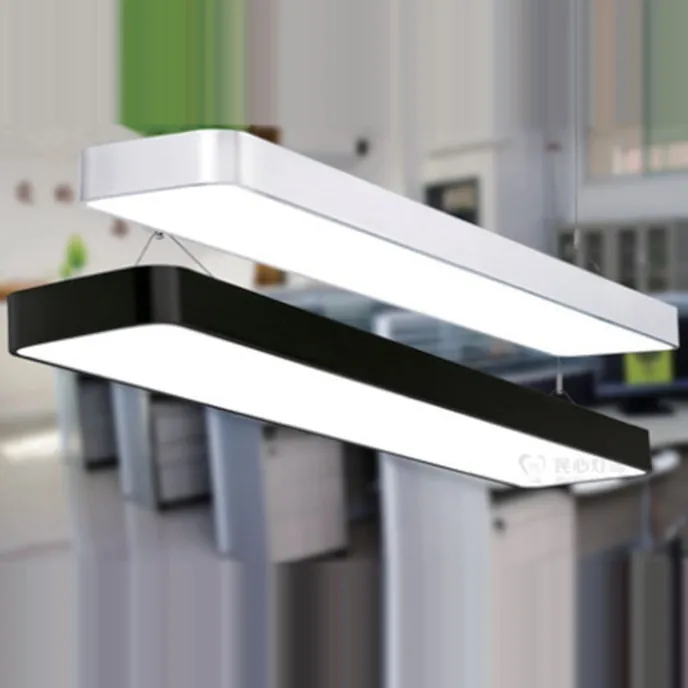
Long LED profiles hung in continuous lines or patterns. They light large spaces evenly and create strong geometry. Our LED linear pendant light is often used this way.
Industrial high bays in decorative finishes
Standard UFO or linear high bays in black, white or custom colours, sometimes with reflectors or decorative guards. A practical compromise in gyms and retail. See UFO vs linear high bays.
Mounting heights and output
| Space | Typical hang height | Typical fitting output |
|---|---|---|
| Restaurant, café | 3–5 m | 2,000–6,000 lm |
| Showroom, retail | 4–8 m | 6,000–20,000 lm |
| Lobby, atrium | 5–12 m | 8,000–30,000 lm |
| Boutique gym | 5–8 m | 10,000–20,000 lm |
Many decorative pendants hang on cables or rods well below the structural ceiling, so the effective mounting height is lower than the roof.
Getting enough light
Decorative fittings often give less light than industrial high bays of the same wattage because shades and diffusers absorb some of it. Plan the light level for the use: about 300–500 lux for retail and showrooms, 200–300 lux for lobbies and restaurants, 300–500 lux for gyms. Where decorative fittings alone cannot reach the level, add hidden industrial high bays or spotlights. The high bay lighting calculator helps estimate the number of fittings.
Glare and comfort
Decorative fittings are often seen directly, so glare is a real issue:
- Choose diffused or recessed LED sources
- Avoid bare high-power LEDs in open cages at low height
- Use reflectors that throw light down and cut sideways glare
- In gyms, consider players looking up; see gym lighting
Colour temperature and CRI
- 2700–3000 K: restaurants, hotels, bars
- 3000–4000 K: retail, showrooms, offices
- 4000–5000 K: gyms and sports spaces
CRI 90 makes products, food and finishes look their best, important in retail and hospitality.
Combining decorative and functional lighting
In tall spaces, a common approach is:
- Functional layer: discreet high bays or linear lights for the bulk of the light
- Decorative layer: pendants or rings for character, at a lower level
- Accent layer: spotlights on displays, artwork or features
This lets the decorative fittings be chosen for looks without carrying the whole lighting load. See LED track lighting for accent options.
Controls
Decorative spaces often change mood through the day: bright for cleaning, comfortable for business, dimmed for evening events. Specify dimmable drivers, scene control and, in daylit atriums, daylight sensors. Our guide to dimmable LED panel lights explains the dimming methods, which apply equally to pendants.
Maintenance and access
Decorative fittings at height need cleaning and occasional repair. Plan access by lift or scaffold, choose fittings with long-life LEDs and drivers, and consider lowering winches for very high chandeliers and rings.
Sound and heat in converted buildings
Large shades can reflect sound, and LED drivers produce some heat. In restaurants and halls with exposed roofs, check that fittings do not add noise from drivers and that heat is dissipated well.
Industrial looks with modern performance
The industrial look remains popular, and the good news is that LED high bays now come in finishes that suit it. For gyms, workshops-turned-showrooms and food halls, a well-chosen industrial high bay in matt black can look intentional, while delivering far more light per watt than a decorative shade. Our UFO LED high bay is used this way in sports and retail spaces.
Examples of mixed schemes
A car showroom might use suspended linear lines at about 5 m for even light on the vehicles, a cluster of large ring pendants over the reception desk, and track spotlights to highlight featured models. A brewery restaurant in an old warehouse might keep matt black industrial high bays hidden in the roof trusses for cleaning light, with warm dome pendants at 3–4 m over the tables for atmosphere. A boutique gym might use linear high bays for training areas and decorative pendants only over the reception and lounge. In each case, the decorative fittings set the character and the functional fittings do the heavy lifting.
Choosing a supplier
Ask for:
- Photometric data in the decorative housing, not just the LED engine
- Glare data or UGR estimates for the layout
- Finish options and samples
- Suspension kits and adjustable cable lengths
- Spare parts and driver access
Send us the ceiling height, the floor area, the look you want and photos of the space, and we will suggest a combination of decorative and functional fittings.
Sources
Frequently asked questions
What is decorative high bay lighting?
High-ceiling lighting chosen as much for appearance as for light: dome, cage and barn pendants, architectural rings and suspended linear LED lines, used in spaces where the ceiling and fittings are part of the design.
How high should decorative high bays hang?
Typically 4–8 m above the floor in lobbies, showrooms and restaurants, often on cables or rods that bring them below a very high ceiling. Keep them high enough to avoid glare and clear of equipment.
Are decorative high bays as efficient as industrial ones?
Often slightly less, because shades, diffusers and decorative housings absorb some light. Good decorative LED fittings still reach 100–130 lm/W.