
LED Tube Strip Lights: Battens and Linear Fixtures for Garages, Shops and Industry
LED tube strip lights explained: integrated battens vs strip fixtures with replaceable tubes, 4 ft and 8 ft lengths, lumens and spacing, vapour-tight versions, linking, mounting heights and uses.
Key points
- An LED tube strip light is a long, narrow fixture: either a batten with integrated LEDs or a strip channel that holds replaceable LED tubes.
- 4 ft (1.2 m) versions give about 2,000–5,000 lm; 8 ft (2.4 m) versions about 5,000–10,000 lm.
- Integrated battens are cheaper and sealed; tube-holding strips allow lamp replacement but have more parts.
- Below about 5 m, strip lights are often better than high bays; above 6–8 m, high bays usually work better.
The fluorescent strip light was the workhorse of garages, stockrooms, workshops and corridors for decades. Its LED successor comes in two main forms: integrated LED battens and strip fixtures that hold LED tubes. Both are called “LED tube strip lights”. This guide explains the differences and how to use them.
Two kinds of LED strip light
Integrated LED batten
LEDs mounted on a board inside a slim housing with an opal or prismatic diffuser. The whole fixture is the light; there is no separate lamp.
- Slim, light and quick to install
- Higher efficacy, often 120–150 lm/W
- Fewer parts to fail
- When the LEDs fail, replace the fixture (or the gear tray in some models)
Strip fixture with LED tubes
A channel with G13 sockets that hold one or two LED T8 or T5 tubes. Looks like the old fluorescent strip, but wired for LED tubes.
- Tubes can be replaced individually
- Can reuse a familiar format
- More joints and sockets; slightly lower efficiency
- Check that tubes and fixture wiring match (single-ended or double-ended mains feed)
For converting existing fluorescent strips, see LED fluorescent tube replacement. Our LED T8 tube suits strip fixtures wired for LED tubes.
Sizes and output
| Length | Typical LED wattage | Typical lumens |
|---|---|---|
| 2 ft (0.6 m) | 9–20 W | 1,000–2,600 lm |
| 4 ft (1.2 m) | 18–40 W | 2,000–5,000 lm |
| 5 ft (1.5 m) | 25–50 W | 3,000–6,500 lm |
| 8 ft (2.4 m) | 40–80 W | 5,000–10,000 lm |
Twin-tube and high-output versions push these higher. Compare fixture lumens, not the LED chip ratings.
Industrial and vapour-tight versions
In car washes, cold stores, food factories, farms and car parks, strip lights must resist water, dust and cleaning. Vapour-tight (tri-proof) linear fixtures have sealed polycarbonate housings rated IP65 or higher, stainless clips and gaskets. They are the usual choice for:
- Parking garages and underpasses
- Food processing and cold rooms
- Livestock buildings
- Washdown areas
See parking garage lighting for one common use.
Linkable strips
Many LED battens and linear fixtures can be linked end to end with connectors, forming continuous lines with one mains feed. Continuous lines give even light down aisles and along workbenches and look tidy. Check the maximum number of fixtures per feed.
Mounting height and spacing
Strip lights have wide distributions, ideal for low ceilings:
- 2.5–3.5 m: stockrooms, garages, corridors, workshops; space rows about 1.5–2.5 m apart
- 3.5–5 m: small warehouses and workshops; rows about 2.5–3.5 m apart, or continuous lines
- Above 5–6 m: light spreads too wide and is wasted on walls; high bays with focused optics usually perform better
Our LED shop lights vs high bay lights guide compares the two, and the high bay lighting calculator works out quantities for higher ceilings.
Linear pendants for offices and shops
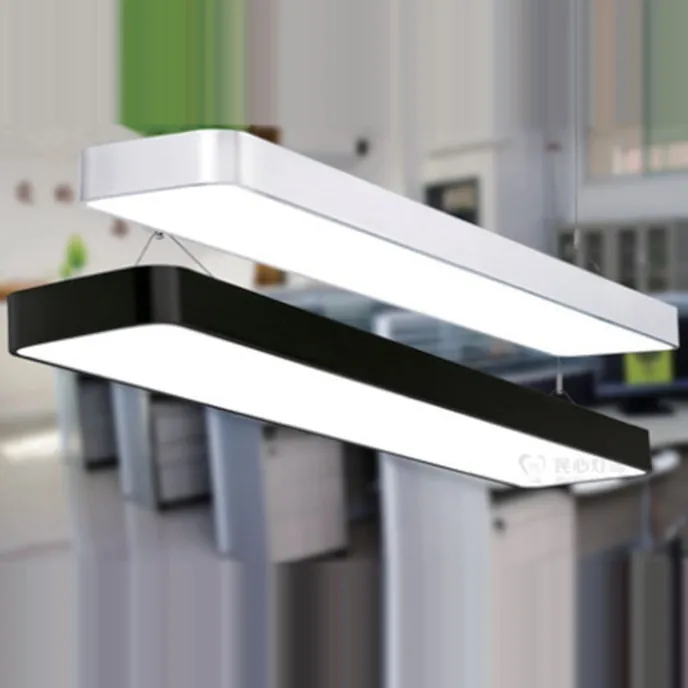
In offices, shops and showrooms, linear LED pendants and suspended lines replace strip lights with a more architectural look, often with up-and-down light and low glare. Our LED linear pendant light is designed for this. See also office lighting fixtures.
Garages at home
For a home garage, two to four 4 ft LED battens of 3,000–5,000 lm each give bright, even light for a single or double garage. Choose 4000–5000 K for workshops and a high CRI if you paint or detail cars.
Colour temperature
- 4000 K: offices, shops, schools, general use
- 5000 K: workshops, garages, warehouses
- 6500 K: some industrial and inspection uses
Controls
Battens are available with on/off, 1–10 V or DALI dimming, microwave motion sensors and emergency battery packs. In corridors, stairwells and parking garages, sensors cut energy dramatically because lights spend most of the time at low level.
Choosing quality
- Fixture lumens and efficacy from test data
- Flicker-free driver
- Diffuser that hides LED dots and reduces glare
- Housing material and IP rating suited to the space
- Warranty and replacement parts
Replacing fluorescent strips: batten or tubes?
If the old fluorescent strips are in good condition and you want minimal work, LED tubes in rewired fixtures are an option. If fixtures are old, yellowed or corroded, replacing them with integrated LED battens is usually simpler and gives better results. The LED retrofit savings calculator shows the energy savings for either route.
Example: a small workshop
A workshop of 10 × 15 m with a 4 m ceiling, used for general assembly, needs about 300–500 lux. With 4 ft battens of about 4,500 lm each and typical losses, roughly 16–20 fixtures in four rows give an even result. Running the rows parallel to the benches, slightly to the side so the worker’s head does not shade the work, avoids shadows. In a store area of the same size, half as many may be enough. A quick calculation for each area avoids both dark corners and wasted energy, and the same approach works for garages, stockrooms and plant rooms.
Maintenance
LED battens need little maintenance: wipe diffusers in dusty spaces, check fixings and replace any failed units. In damp areas, check gaskets on vapour-tight fixtures once a year.
Supply for projects
We supply LED battens, linear pendants, tubes and high bays for warehouses, factories, garages, schools and offices. Send us the room sizes, ceiling heights and use, and we will propose fixtures and a layout.
Sources
Frequently asked questions
What is an LED tube strip light?
A long, narrow ceiling or wall fixture, either with integrated LEDs behind a diffuser (an LED batten) or a channel with sockets for replaceable LED tubes. It replaces the old fluorescent strip light.
Are integrated LED battens better than strip lights with tubes?
Integrated battens are usually cheaper, slimmer, better sealed and more efficient. Strips with tubes let you change just the tube when it fails. For most new installs, integrated battens are the simpler choice.
How high can LED strip lights be mounted?
Strip lights work well from about 2.5 m up to about 5–6 m. Above that, light spreads too much and high bays with focused optics are usually more effective.