
LED Troffer Lights: 2×2 vs 2×4, Lumens and Retrofit Options
How to choose LED troffers for suspended ceilings: 2x2 vs 2x4 and 600 × 600 sizes, lumens and watts, panel vs basket vs grille, retrofit kits vs new fixtures.
Key points
- A troffer is a light that drops into a suspended ceiling grid: 2 × 2 ft or 2 × 4 ft in North America, 600 × 600 mm or 1200 × 600 mm elsewhere.
- Typical LED output: about 3,000–4,000 lm for 2x2 and 4,000–6,000 lm for 2x4, at 25–50 W.
- Flat panels are thinnest, basket (centre-basket) troffers soften glare, grille (louvre) troffers control glare best for screens and long corridors.
- Retrofit kits reuse the existing housing; new troffers are simpler when the old ones are dirty, yellowed or damaged.
Troffers light most offices, schools, hospitals and shops with suspended ceilings. Moving from fluorescent to LED is one of the easiest lighting upgrades a building can make, but there are several troffer types and sizes, and the right choice depends on the ceiling grid and the work underneath.
Sizes
| Market | Standard sizes | Grid |
|---|---|---|
| North America | 2 × 2 ft, 2 × 4 ft, 1 × 4 ft | Imperial T-bar (about 610 mm) |
| Europe, Asia, Middle East, Africa | 600 × 600 mm, 1200 × 600 mm, 300 × 1200 mm | Metric (595 mm visible) |
The two grids are close but not identical; a 600 × 600 mm fitting will not always drop into a 2 × 2 ft grid. Confirm the grid before ordering.
Lumens and wattage
| Troffer | Typical LED power | Typical output |
|---|---|---|
| 2×2 / 600 × 600 | 25–40 W | 3,000–4,000 lm |
| 2×4 / 1200 × 600 | 35–50 W | 4,000–6,000 lm |
| 1×4 / 300 × 1200 | 25–40 W | 3,000–4,500 lm |
Efficacy varies from about 90 lm/W for grille troffers with tubes to 120 lm/W or more for good panels.
Types of troffer
| Type | Look | Glare | Typical use |
|---|---|---|---|
| Flat panel | Thin, uniform surface | Medium; low-glare versions with micro-prisms | Offices, schools, retail |
| Centre basket | Curved diffuser, soft | Low to medium | Offices, healthcare |
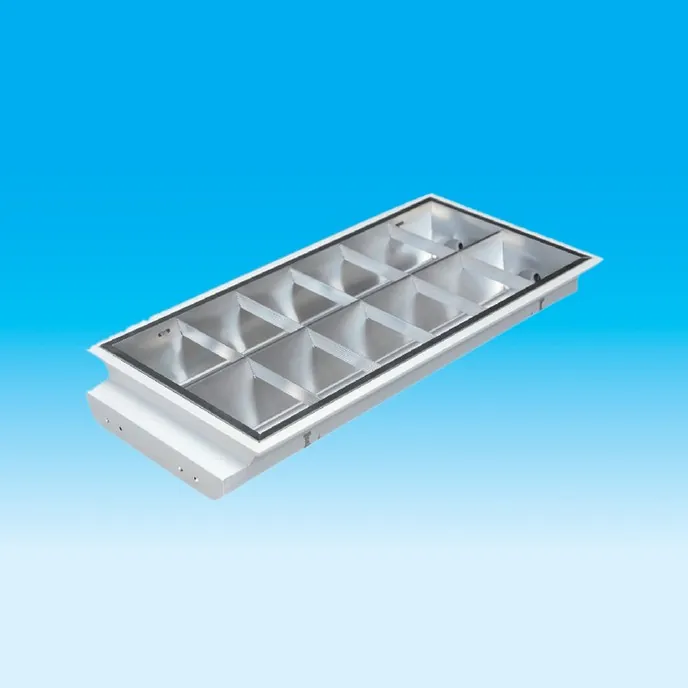
| Grille / louvre | Mirror aluminium louvres over tubes | Lowest at viewing angles | Screen work, long corridors, banks |
| Lensed (prismatic) | Traditional look | Medium | Retrofit, budget projects |
Our LED panel lights come in 300 × 300 to 600 × 1200 mm, and our LED grille troffers use mirror aluminium louvres for glare control.
Retrofit kit or new troffer?
| Retrofit kit | New troffer | |
|---|---|---|
| What changes | LED tubes, strips or a panel inside the old housing | The whole fitting |
| Cost | Lower | Higher |
| Time per fitting | 10–20 minutes, often without touching the ceiling | 15–30 minutes, tile out and in |
| Result | Depends on the old housing | Like new |
| Best when | Housings clean and sound | Old housings yellowed, ceiling being renewed |
The cheapest retrofit is a direct LED tube; see our LED T8 tubes. Check whether the tube is ballast-compatible or needs the ballast bypassed, and label bypassed fittings for safety.
How many troffers for a room
Take an office of 8 × 6 m with a 2.8 m ceiling, light surfaces and a target of 500 lux on desks. With 36 W panels at about 117 lm/W (about 4,200 lm), the lumen method in our lighting calculator gives 12 panels in a 4 × 3 layout, about 535 lux and 9 W/m².
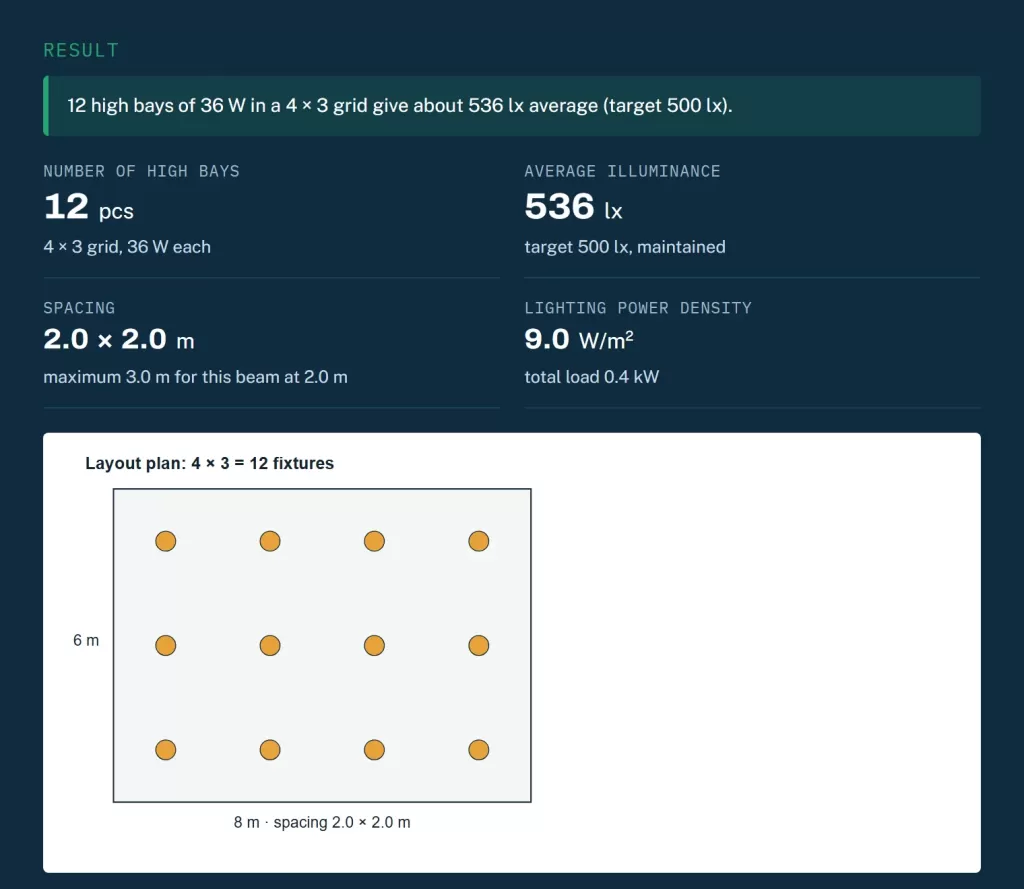
Open the office example and enter your room.
With older 90 lm/W fittings, the same room needs 16. Efficacy decides the count as much as wattage does.
Glare and comfort
For offices with screens, look for a UGR of 19 or lower; classrooms often use 19, drawing offices 16. Low-glare panels, grille troffers and basket diffusers help. Colour rendering of Ra 80 or higher is standard for indoor work; 4000K is the usual office choice, 3000K for warmer spaces.
Office, classroom or hospital?
- Offices: 500 lux on desks, UGR 19 or lower, 4000K. Panels or low-glare panels in a regular grid; switch rows near windows separately.
- Classrooms: 300–500 lux, uniform light on desks and the board, low glare. Our low-glare office panel is designed for this.
- Corridors: 100–200 lux; 1×4 troffers or grille fittings in a line, often with sensors.
- Hospitals: cleanable, sealed panels in clinical rooms, higher CRI for examination.
Energy saving
Replacing a 2×4 troffer with three 32 W T8 fluorescent tubes (about 90–100 W with ballast) by a 40 W LED troffer saves around 50–60 W per fitting. In an office with 200 fittings burning 3,000 hours a year, that is about 30,000–36,000 kWh a year. Our retrofit savings calculator gives the payback with your tariff.
Emergency and controls
- Emergency versions with a battery for 90 minutes or more, for escape routes
- Dimmable drivers (0–10 V or DALI) for daylight dimming near windows
- Occupancy sensors for meeting rooms, toilets and storage
Colour temperature and colour rendering
| Space | Typical CCT | CRI |
|---|---|---|
| Offices, schools | 4000K | Ra 80+ |
| Hospitals, labs | 4000–5000K | Ra 90 for examination areas |
| Shops | 3000–4000K | Ra 90 for clothing and food |
| Hotels, lounges | 3000K | Ra 80+ |
Some panels are tunable (CCT-switchable) so one product can serve several spaces; this simplifies stock for contractors.
Installation notes
- Lay-in: the troffer drops into the T-bar grid like a ceiling tile; secure it with clips or safety wires as local codes require.
- Surface or suspended: many panels accept a surface frame or suspension kit for ceilings without a grid.
- Recessed in plasterboard: use a flange frame and cut the hole to the size the maker specifies.
- Driver access: external drivers should sit where they can be reached from the opening.
- Flicker: ask for a flicker-free driver (low percent flicker) for offices and classrooms with screens and cameras.
What to send for a quotation
Ceiling grid type and size, room plans and heights, target lux, any glare requirement, and whether you want retrofit kits or new fittings. We will propose panel, grille or tube options and a layout.
Sources
Frequently asked questions
What is a troffer light?
A troffer is a rectangular light fixture that fits into a modular suspended ceiling, replacing one ceiling tile. The name comes from 'trough' and 'coffer'. Modern troffers use LED panels, LED tubes or LED modules instead of fluorescent tubes.
How many lumens should a 2x4 LED troffer have?
Most 2x4 LED troffers give about 4,000–6,000 lumens. For general offices, 4,000–5,000 lumens per troffer at about 2.4 m spacing gives roughly 400–500 lux on desks, depending on the room.
Is it better to retrofit or replace troffers?
Retrofit kits are cheaper and quicker when the existing housings are in good condition. Replace the troffer when the housing is damaged, discoloured or the ceiling is being renewed, or when you need better glare control than the old optic provides.