Bugeye Emergency Lights: How Far Two Heads Reach and How to Aim Them
How twin-head bugeye emergency lights work, how far each head can light an escape route at 1 lux, how to aim them, battery sizing, and a twin-head option for hazardous areas.
Key points
- A bugeye is a self-contained emergency light with two adjustable lamp heads, so one unit can light a route in two directions.
- Reach depends on the lumens each head gives in emergency mode, the beam angle and the mounting height, not on the wattage printed on the box.
- In our example, a 30° head giving 100 lm in emergency mode at 2.5 m height still gives 1 lux on the floor about 10 m away along its aim line.
- Two heads drawing 3 W each for 2 hours need roughly 21 Wh of rated battery once driver losses and ageing are counted.
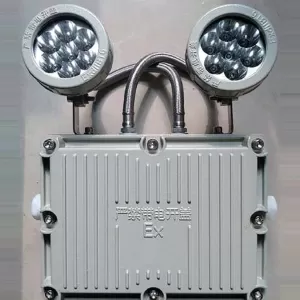
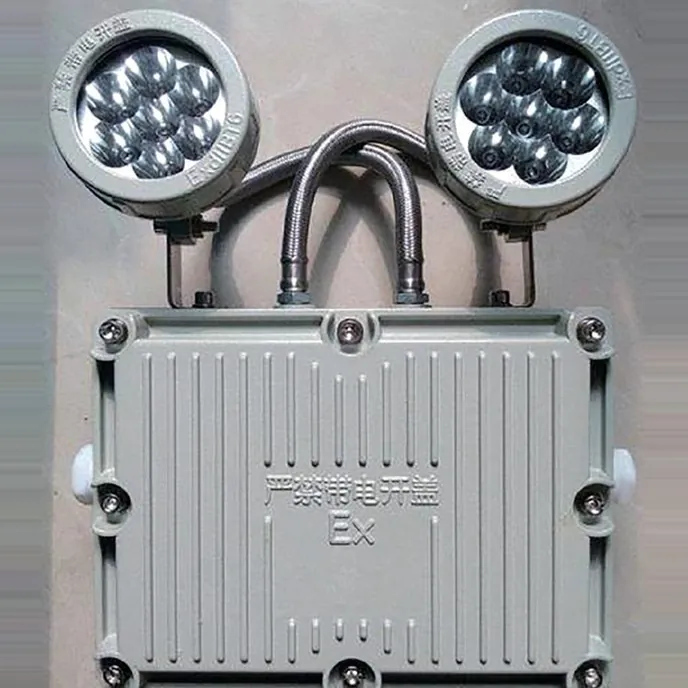
- For gas hazardous areas, our BG-FBYJ10A is a twin-head unit marked Ex d IIC T4 with 2 hours of emergency operation.
Bugeye emergency lights are the twin-headed boxes you see above doors and along corridors in warehouses, schools and plant rooms. They are cheap, easy to install and quick to aim, which is why they are still everywhere. But buyers often pick them by wattage or by price alone and then find gaps of darkness along the route when they run the annual test. This guide shows how to work out how far each head really reaches, how to aim the two heads, and how big the battery has to be.
What a bugeye unit is
A bugeye is a self-contained emergency light. The box contains:
- A battery (traditionally sealed lead-acid or NiCd, increasingly lithium iron phosphate)
- A charger fed from the permanent supply
- A changeover circuit that switches to battery when the supply fails
- Two adjustable lamp heads, each with an LED and a reflector or lens
- A test switch and a charge indicator
It is the non-maintained type: dark in normal use, on only in a power failure. Our emergency light types guide compares it with bulkheads, exit-sign combos and emergency drivers, and emergency light remote heads covers adding extra heads to one battery.
What decides how far a head reaches
Three numbers matter, and none of them is the wattage on the box:
- Emergency-mode lumens per head. Some units run the LED at reduced power on battery. Ask for the lumen output in emergency mode.
- Beam angle. A narrow beam (around 30°) throws light further along a corridor; a wide beam (90° or more) lights a broad room but reaches less far.
- Mounting height. Higher heads cover longer distances, up to the point where the light spreads too thin.
Escape route codes ask for a minimum on the floor along the route centre line. EN 1838 asks for at least 1 lux on the centre line of an escape route; NFPA 101 asks for an average of 1 foot-candle (about 10.8 lux) with a minimum of 0.1 foot-candle (about 1.1 lux) at the start of the emergency period. Check which your project follows.
Worked example: reach of one 30° head
Assume one head gives 100 lm in emergency mode in a 30° beam, mounted 2.5 m above the floor. These are example values; use the datasheet of your unit.
Step 1: average intensity in the beam. A 30° beam fills a cone with a half-angle of 15°. The solid angle of that cone is 2π × (1 − cos 15°) = 0.214 steradian. So the average intensity is 100 ÷ 0.214 ≈ 467 candela.
Step 2: floor illuminance at a distance. If the head is aimed at a point on the floor at horizontal distance d, the slant distance is r = √(2.5² + d²), and the illuminance on the floor is E = I × 2.5 ÷ r³.
| Horizontal distance d | Slant distance r | Floor illuminance E |
|---|---|---|
| 4 m | 4.7 m | 11 lux |
| 6 m | 6.5 m | 4.2 lux |
| 8 m | 8.4 m | 2.0 lux |
| 10 m | 10.3 m | 1.07 lux |
| 12 m | 12.3 m | 0.63 lux |
So, aimed along the corridor, this head keeps the centre line at 1 lux or more out to about 10 m. Two heads pointing in opposite directions cover about 20 m of corridor from one box, provided the zone under the unit is also lit (which it is, by the spill from both heads).
The same head at 90° would spread its 100 lm over a solid angle of about 1.84 sr, giving only about 54 cd, and would reach 1 lux at only around 4–5 m. That is why the beam angle matters more than the wattage.
Aiming the two heads
- Corridor: point one head each way along the route, tilted down so the beam centre lands at the far end of the stretch you want to cover.
- Door and change of direction: point one head at the door or turn, the other down the main route. Codes ask for light at each exit door, change of direction, stairs and firefighting equipment.
- Open room: aim the heads apart at roughly 90° to cover the open area and the route out.
- Stairs: aim at the treads, not at people’s eyes on the flight above.
After aiming, run a test at night and walk the route. A cheap light meter on the floor at the darkest point settles any doubt.
Battery sizing for a twin-head unit
Take two heads drawing 3 W each in emergency mode, required to run for 2 hours:
- Energy at the LEDs: 2 × 3 W × 2 h = 12 Wh
- Driver losses at an assumed 85 % efficiency: 12 ÷ 0.85 = 14.1 Wh
- Allowance for 80 % capacity at end of battery life: 14.1 ÷ 0.8 = 17.6 Wh
- Allowance for a cold location (assume 85 % of rated capacity at low temperature): 17.6 ÷ 0.85 = about 21 Wh rated
As a 6 V lead-acid battery that is about 3.5 Ah; as a 6.4 V LiFePO4 pack, about 3.3 Ah. If your code needs 3 hours, multiply by 1.5. Our article on the emergency light unit explains each loss in more detail.
Bugeye lights in hazardous areas
A standard bugeye is not explosion-protected. In a classified zone, you need a twin-head unit that is. Our BG-FBYJ10A explosion-proof emergency light has:
| Item | Value |
|---|---|
| Heads | Twin adjustable LED heads, 30° beam |
| Power | 10 W |
| Ex marking | Ex d IIC T4 |
| Emergency time | 2 h |
| Luminous efficacy | > 80 lm/W |
| Operating temperature | −30 °C to +50 °C |
| Housing | Die-cast aluminium |
Check its marking against your area classification: IIC covers all gas groups and T4 limits the surface to 135 °C. Our guide to explosion-proof emergency exit lights covers signs and route lighting together in hazardous areas.
Common mistakes
- Spacing units by habit, such as “one every 15 m”, without checking each head’s reach.
- Pointing heads at the ceiling or walls, often after someone knocks them. Check aim during the monthly test.
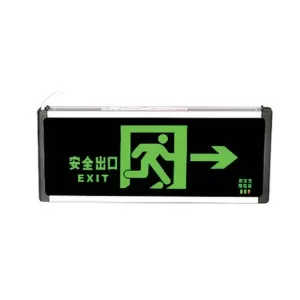
- Ignoring the exit sign. A bugeye lights the floor; you still need illuminated signs. Our BG-XFYJ exit sign runs at least 90 minutes on battery.
- Mounting near heaters or under hot roofs, which shortens battery life.
- Skipping the annual full-duration test. Our emergency light testing guide gives the routine.
What to send us
Send the route lengths, ceiling or wall heights, the duration your code needs and whether any area is classified. We will check reach per head and quote the number of units for the route.
Sources
Frequently asked questions
What is a bugeye emergency light?
It is a battery-backed emergency light with two round, adjustable lamp heads on a box that holds the battery, charger and changeover circuit. The name comes from the two heads, which look like eyes. It switches on automatically when the normal supply fails.
How far does a bugeye emergency light reach?
It depends on each head's emergency-mode lumens, beam angle and mounting height. As an example, a 30° head giving 100 lm at 2.5 m height reaches about 10 m along the floor at 1 lux. Wider beams spread the light more but reach less far.
How high should bugeye emergency lights be mounted?
Usually 2 to 2.5 m above the floor, high enough to avoid knocks and to throw light down the route, but below smoke layers that collect at the ceiling. Check your local code, which may set a minimum height.
How long do bugeye emergency lights last on battery?
Most are rated for 90 minutes, the common North American requirement; many markets require 1 or 3 hours. Our BG-FBYJ10A runs for 2 hours. The battery itself typically needs replacing every few years.
Can I use a normal bugeye light in a hazardous area?
No. A standard bugeye is not explosion-protected. Inside a classified zone you need an Ex-rated unit, such as our BG-FBYJ10A (Ex d IIC T4), checked against the zone, gas group and temperature class.