Emergency Lights with Remote Heads: Remote Capacity, Cable Size and Exit Combos
How emergency units and exit sign combos with remote head capability work, how to check remote capacity in watts, and a voltage drop table for remote head cable runs.
Key points
- A remote head is a lamp head with no battery of its own, powered over a low-voltage cable from an emergency unit or exit combo that has spare battery capacity.
- Add up every watt the unit must carry: its own lamps, the sign and all remote heads. Battery energy needed = total watts × hours ÷ converter efficiency; 15 W for 90 minutes needs about 26 Wh.
- Low voltage makes cable runs critical: two 3 W heads on a 6 V circuit 30 m away lose about 12% of their voltage on 1.5 mm² cable, and about 7% on 2.5 mm². The same heads on a 12 V unit lose under 3% on 1.5 mm².
- Remote heads let the battery stay in a cool, dry, accessible place while the heads go outdoors, into wet areas or onto high walls.
Most emergency lights are self-contained: battery, charger and lamps in one box. Sometimes, though, light is needed where a self-contained unit is a poor fit: outside an exit door in the rain, high on a wall in a stairwell, in a cold store or in a wash area. Remote heads solve this. The battery stays in one unit, indoors and accessible, and feeds one or more lamp heads over a low-voltage cable. This guide explains how remote capacity works, how to check that a unit can carry its heads, and how to size the cable.
What a remote head system is
A remote head system has three parts:
- The emergency unit: a battery, charger and converter, often combined with its own lamp heads or with an exit sign (an “exit and emergency combo”).
- Remote heads: lamp heads with no battery or charger, rated for the unit’s output voltage, commonly 6 V, 12 V or 24 V in North American systems.
- The cable between them, which carries the battery current during an outage.
The unit’s datasheet states its remote capacity: how many watts it can supply to remote heads, at which voltage, for how long. A combo with remote capacity might, for example, run its own sign and lamps plus a stated number of watts of remote heads for 90 minutes.
In Europe, systems more often use self-contained fittings or a central battery system feeding mains-voltage emergency fittings. The remote head arrangement described here is most common in North America and in markets that follow US practice, but the sizing logic applies to any low-voltage emergency circuit.
Typical uses
- Exterior exit discharge. Lighting the path outside an exit door, so people do not step into darkness. The unit stays inside; the head is mounted outside above the door.
- Wet and cold areas. The battery stays in a dry, heated space while sealed heads go into wash bays, cold stores or car parks. See our guide to wet location emergency lights.
- High walls and stairwells. Heads mounted high where battery maintenance would need a ladder or lift; the unit is mounted lower.
- Long corridors. One unit feeds several heads along the route instead of several self-contained units to test.
Step 1: Check the battery capacity
Add up everything the unit must power during an outage:
| Load | Example |
|---|---|
| Exit sign | 3 W |
| Unit’s own two lamp heads | 2 × 3 W = 6 W |
| Two remote heads | 2 × 3 W = 6 W |
| Total | 15 W |
Then work out the energy the battery must deliver:
Battery energy (Wh) = total watts × duration (h) ÷ converter efficiency
For 15 W over 90 minutes with an 85% converter: 15 × 1.5 ÷ 0.85 ≈ 26 Wh, or about 4.4 Ah at 6 V. If the unit’s stated remote capacity is less than the 6 W of remote heads in this example, it cannot carry them for the full duration, even if they light up when tested for a few seconds. Batteries also lose capacity with age, so the unit must still meet its duration at the end of battery life; that is why makers rate remote capacity conservatively.
For comparison, our BG-XFYJ LED exit sign draws 3 or 5 W and runs at least 90 minutes on its own battery. It is a self-contained sign without remote head terminals.
Step 2: Size the cable
This is where many remote head installations fail. At 6 V, a 3 W head draws 0.5 A, so two heads on one run draw 1 A. Low voltage means that a small voltage loss is a large share of the supply, and LED heads may dim or drop out when the voltage at the head falls too far.
The voltage drop over a two-wire run is: current × 2 × length × resistivity ÷ cross-section, with copper at about 0.0175 Ω·mm²/m. For a 30 m run (one way) carrying two 3 W heads:
| System voltage | Current | Cable | Voltage drop | Share of supply |
|---|---|---|---|---|
| 6 V | 1.0 A | 1.5 mm² | 0.70 V | about 12% |
| 6 V | 1.0 A | 2.5 mm² | 0.42 V | about 7% |
| 6 V | 1.0 A | 4.0 mm² | 0.26 V | about 4.4% |
| 12 V | 0.5 A | 1.5 mm² | 0.35 V | about 2.9% |
| 12 V | 0.5 A | 2.5 mm² | 0.21 V | about 1.8% |
The table makes two points. On 6 V, long runs need much heavier cable than the current alone suggests. And doubling the system voltage halves the current and quarters the percentage loss on the same cable. For long runs, a 12 V or 24 V unit is often the cleaner solution. In the US, 14 AWG is about 2.1 mm² and 12 AWG about 3.3 mm²; manufacturers’ distance tables are usually given in AWG.
Always use the maker’s maximum distance table when one is published; the figures above are for checking and planning.
Step 3: Mount and protect the heads
- Match the IP rating to the location. Outdoor heads need protection against rain and dust; IP65 is a common choice.
- Use cable suited to the route: outdoor-rated where exposed, fire-resistant where your code asks for it on emergency circuits.
- Aim the heads along the escape route and at changes of direction, stairs and doors.
- Label the circuit at the unit, so a technician knows which heads depend on it.
Exit sign combos with remote heads
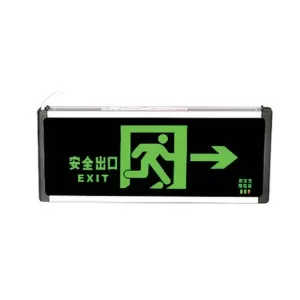
An exit and emergency combo puts the sign and lamp heads in one housing. Versions with remote capacity are a neat way to light both sides of an exit door: the combo inside, a remote head outside over the discharge path. When choosing one, check:
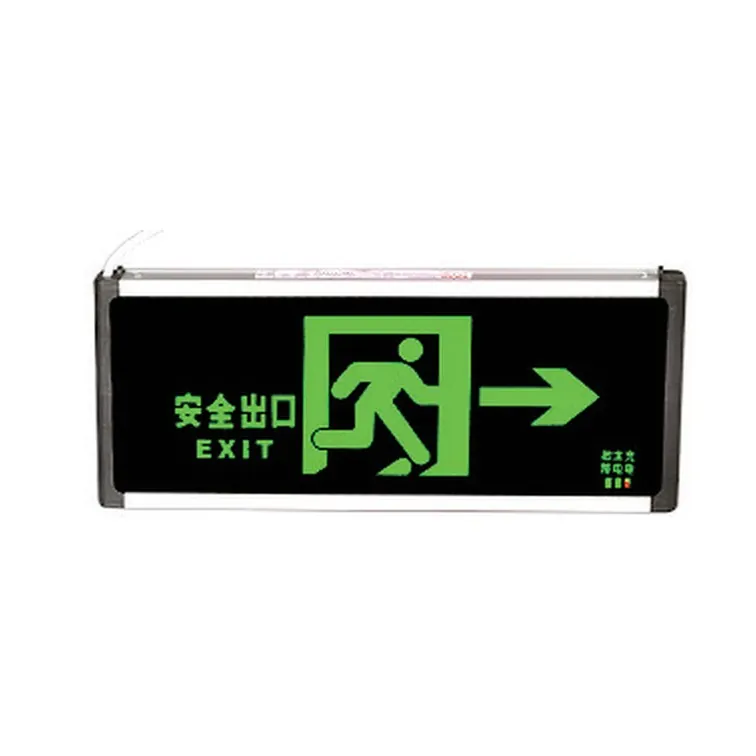
- The sign meets your local legend and colour rules (for example red “EXIT” in much of the US, green pictograms under ISO 7010 elsewhere).
- Remote capacity in watts at the stated voltage and duration.
- Self-test or manual test function. See our guide to emergency light testing.
- Mounting: wall, ceiling or end mount.
Our guide to edge-lit exit signs covers sign types in more detail.
Hazardous areas
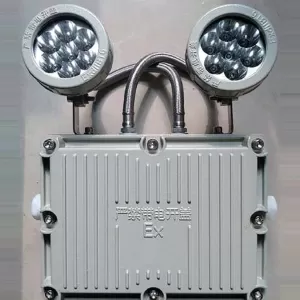
A remote head mounted inside a classified hazardous zone must itself be certified for that zone, and the circuit may need protection measures of its own. In such areas it is usually simpler to use a certified self-contained emergency fitting, such as our explosion-proof emergency light BG-FBYJ10A; the certificate for the exact model is supplied with the quotation.
Common mistakes
- Counting the heads but not the sign and the unit’s own lamps when checking capacity.
- Thin cable on long 6 V runs, so heads at the far end are dim or fail during the duration test.
- Testing for a few seconds only. A unit that lights all heads briefly may not hold them for 90 minutes.
- Indoor heads used outdoors. Rain gets in, and the head fails before anyone notices.
- No record of which heads belong to which unit, making maintenance a guessing game.
For a full overview of the options, see our guide to emergency light types and emergency light installation.
Frequently asked questions
What does remote head capability mean on an emergency light?
It means the unit has battery and output capacity beyond its own lamps, and terminals for extra low-voltage lamp heads mounted elsewhere. The datasheet states the remote capacity in watts at a stated voltage, for example a certain number of watts at 6 V or 12 V for 90 minutes.
How far can a remote head be from the emergency unit?
It depends on the voltage, the wattage on the run and the cable size. Low-voltage circuits lose a large share of their voltage over long thin cables, so manufacturers publish maximum distance tables. As a rule, keep voltage drop to a few percent; our table shows how quickly it grows on 6 V circuits.
Can a remote head be mounted outside?
Yes, that is one of the most common uses: lighting the path outside an exit door while the battery unit stays indoors. Use a head with an IP rating suitable for outdoor exposure and outdoor-rated cable.
Can I mix remote heads from different makers?
Only if the voltage and wattage match what the unit is designed to supply. It is safer to use heads specified by the unit's maker, because emergency systems are tested and listed as a combination in many markets.