Edge-Lit Exit Signs with Emergency Battery: How They Work and What to Specify
How edge-lit exit signs work, how they compare with box signs, battery runtime for 90 minutes or 3 hours, and what 60 LED signs save over older lamp signs.
Key points
- An edge-lit sign sends LED light into the edge of a clear acrylic panel; the legend glows evenly and the sign is thin, but it is more fragile and harder to see in smoke than a solid box sign.
- Exit signs run 24 hours a day: 60 LED signs at 3 W use about 1,580 kWh a year, against about 15,770 kWh for signs with two 15 W lamps, a 90% saving in our retrofit calculator.
- For a 3 W sign, 90 minutes of emergency operation needs only about 5 Wh of usable battery and 3 hours about 11 Wh, by our calculation, so the battery is small; its age is the real risk.
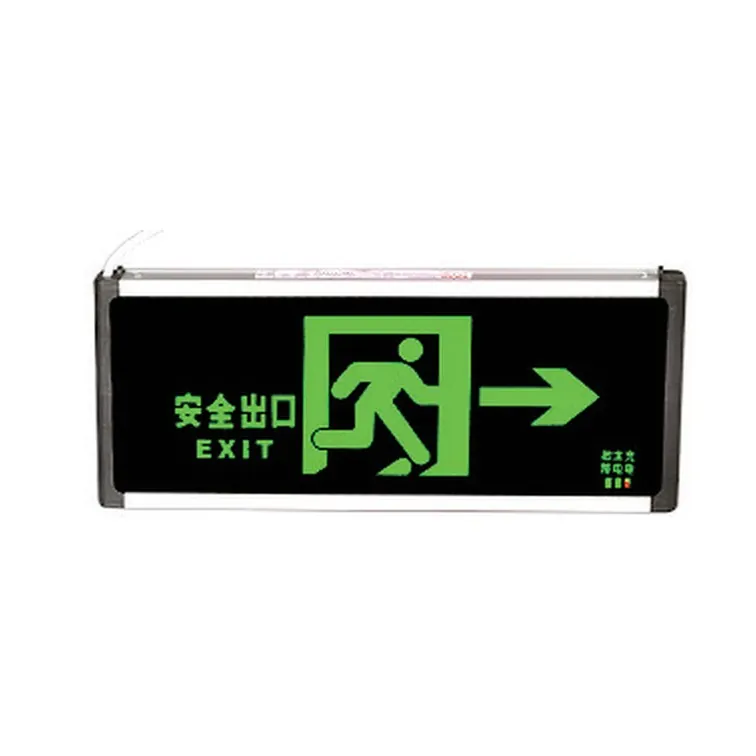
- Our BG-XFYJ exit sign is 3 or 5 W, 19–22 mm thick, at least 90 minutes on battery, switchover under 2 s, IP40 for dry indoor areas.
Exit signs are among the few lights in a building that are on all the time. They also have to work when everything else has failed. Edge-lit exit signs have become popular in offices, hotels, shops and airports because they are slim and look clean against modern interiors. This guide explains how they work, how they compare with other designs, and what to check: legend, viewing distance, battery runtime and the energy they use.
How an edge-lit sign works
An edge-lit sign has a clear acrylic panel, usually 5–10 mm thick, set into a slim housing. A row of LEDs sits along one edge. The light travels inside the panel by internal reflection and escapes where the surface has been engraved, printed or masked, so the legend and the running-man symbol glow evenly. A battery and charger sit in the housing or in the ceiling canopy.
Common designs compared:
| Design | Look | Strengths | Weak points |
|---|---|---|---|
| Edge-lit acrylic panel | Thin, glowing legend | Modern, double-sided easily, even light | Acrylic can scratch or crack; less visible in smoke if dim |
| Box (lightbox) sign | Solid illuminated face | Robust, bright, cheap | Bulkier |
| Slim aluminium flat sign | Thin metal body, printed face | Robust and slim | Usually single-sided or wall-mounted |
| Photoluminescent sign | No power, glows after charging | No wiring | Needs enough ambient light; fades over time |
Our BG-XFYJ exit sign is the slim flat type: 330 mm long and only 19–22 mm thick, aluminium with fire-retardant material, for wall, ceiling or hanging mounting. If your project calls specifically for an edge-lit acrylic design, tell us the size and legend and we will confirm what can be supplied.
Legend, colour and viewing distance
Exit sign rules vary by country, but they cover the same points:
- Symbol and colour. Most of the world uses the green running-man pictogram of ISO 7010; the US commonly uses red or green “EXIT” lettering under local codes.
- Size and viewing distance. The larger the sign, the further away it can be read. Standards such as EN 1838 link the sign height to the maximum viewing distance, and internally illuminated signs can be read from further than printed ones of the same size.
- Placement. Above every exit and final exit door, at changes of direction and at stairs, so that from any point on the escape route a sign is visible.
Our guide to emergency light installation covers placement in more detail.
Battery runtime
The emergency requirement is usually 90 minutes or 3 hours. Because LED signs use so little power, the battery is small. We estimated the usable battery energy for a sign with an 85% efficient emergency circuit:
| Sign power in emergency | 90 minutes | 3 hours |
|---|---|---|
| 3 W | about 5 Wh | about 11 Wh |
| 5 W | about 9 Wh | about 18 Wh |
| 8 W | about 14 Wh | about 28 Wh |
The BG-XFYJ gives at least 90 minutes after a 24-hour charge and switches over in under 2 seconds. If your building needs 3 hours, say so when ordering; it is a battery choice, not a different sign.
The real risk is not the capacity on day one but the battery’s ageing. Batteries in exit signs sit at full charge in a warm ceiling for years. Monthly function tests and an annual full-duration test catch weak batteries before they matter; our emergency light testing guide covers both.
Energy: signs that never switch off
An exit sign runs 8,760 hours a year. Older signs with incandescent or compact fluorescent lamps drew tens of watts; LED signs draw a few. We ran 60 signs with two 15 W lamps each (30 W) replaced with 3 W LED signs through our LED retrofit savings calculator, at $0.15/kWh:
| Lamp signs (30 W) | LED signs (3 W) | |
|---|---|---|
| Annual use, 60 signs | 15,768 kWh | 1,577 kWh |
| Saving | — | 14,191 kWh (90%) |
| Energy cost saving | — | about $2,130 a year |
Lamp replacements in old signs also add up; LED signs rated above 80,000 hours, as the BG-XFYJ is, remove most of that work.
Choosing between edge-lit and other designs
Choose edge-lit where appearance matters most: hotel lobbies, offices, retail and airports with high ceilings and suspended signs. Choose a solid box or aluminium flat sign for factories, car parks, warehouses, schools and anywhere signs may be knocked. In hazardous areas, use a certified explosion-proof emergency exit light instead.
Maintained or non-maintained
- Maintained signs are lit all the time and stay lit on battery during a power cut. This is the normal mode for exit signs in most buildings.
- Non-maintained signs light only when the power fails; more common for emergency lighting fittings than for exit signs.
Our guide to emergency light types explains the two modes and the self-contained and central-battery systems.
Common mistakes
- Choosing by look and forgetting the viewing distance. A small elegant sign at the end of a 40 m corridor may not be readable.
- Ordering 90-minute signs for a 3-hour building.
- Mounting edge-lit signs where they will be hit by trolleys, forklifts or ladders.
- Using IP40 signs in wet areas, such as car washes, pool halls or outdoor walkways.
- Not testing. A sign that looks lit every day may have a dead battery.
Ordering
Send the legend and standard you need, the viewing distances, mounting type (wall, ceiling, hanging), single- or double-sided, the battery duration and the quantity. We will confirm the sign type and the battery option for your code.
Sources
Frequently asked questions
What is an edge-lit exit sign?
A sign with a clear acrylic panel and LEDs along its top edge. The light travels through the panel and lights the engraved or printed legend. It looks thin and modern and is often hung from the ceiling or mounted on a wall bracket.
How long do exit signs need to run on battery?
It depends on the local code. Many require at least 90 minutes; some buildings, such as large public venues or those with long evacuation times, require 3 hours. Check before ordering.
Are edge-lit exit signs legal everywhere?
Where the legend, colour, size and viewing distance meet the local standard, yes. Codes care about what the sign shows and how far it can be read, not the light source. Confirm the standard (for example ISO 7010 or a national code) with the supplier.
Can edge-lit exit signs be used outdoors?
Most are designed for dry indoor areas. For wet, dusty or outdoor locations, use a sign with a higher IP rating; our BG-XFYJ is IP40, for dry indoor areas only.