4 ft 36 W LED Emergency Linear Lights: Emergency Output, Battery Size and Corridor Layout
How a 4 ft 36 W linear light works in emergency mode, what share of its output a battery should run, the battery size for 90 minutes or 3 hours, and a corridor check.
Key points
- An emergency linear light is a normal 4 ft fitting with a battery and emergency driver; on mains failure it runs at a reduced share of its output, typically 10–30%.
- For a 36 W fitting at 90 lm/W, 10% emergency output is 3.6 W and about 324 lm; 90 minutes needs about 6.4 Wh of usable battery and 3 hours about 12.7 Wh, by our calculation.
- In a 2 m wide corridor with fittings every 6 m, 10% output already gives about 11 lux average in our estimate, far above the 1 lux minimum EN 1838 sets on an escape route centreline.
- Choosing a higher emergency share than the route needs makes the battery three times larger and hotter for no safety gain; size it to the requirement and test it.
In corridors, stairwells, plant rooms and car parks, the cheapest way to provide emergency lighting is often not a separate emergency fitting but an emergency version of the normal light. A 4 ft (1.2 m) 36 W linear fitting with a battery inside does both jobs: it is the everyday light and the escape route light. This guide explains how such fittings work, how much light they give on battery, how big the battery needs to be, and how to check a corridor layout.
How an emergency linear light works
The fitting contains three extra parts compared with the standard version:
- an emergency driver that monitors the mains supply and switches to battery when it fails,
- a battery, usually lithium iron phosphate or nickel-metal hydride,
- a charge indicator (often a small green LED) and sometimes a test button.
On mains, the main LED driver runs the fitting at full output and the emergency driver charges the battery. When the mains fails, the emergency driver takes over and runs the LEDs at a reduced output until the battery reaches its cut-off.
The fitting can be maintained (it is lit on mains and stays lit on battery) or non-maintained (it is lit on mains only when switched on, and on battery whenever the mains fails, even if the switch was off). Escape routes usually need the non-maintained function at least, so that the light comes on during a power cut even if the circuit was switched off.
How much emergency output
Emergency drivers typically run the LEDs at 10–30% of normal power. For a 36 W fitting at 90 lm/W, the rating of our BG-TXH LED linear light, that gives:
| Emergency share | Emergency power | Emergency light output | Usable battery for 90 min | Usable battery for 3 h |
|---|---|---|---|---|
| 10% | 3.6 W | about 324 lm | about 6.4 Wh | about 12.7 Wh |
| 20% | 7.2 W | about 648 lm | about 12.7 Wh | about 25.4 Wh |
| 30% | 10.8 W | about 972 lm | about 19.1 Wh | about 38.1 Wh |
The battery figures assume an 85% efficient emergency circuit. The battery fitted must be somewhat larger than the usable figure, because it is not run to zero and it loses capacity with age and heat.
Is 10% enough? A corridor check
EN 1838 sets at least 1 lux on the centreline of an escape route up to 2 m wide, with a limit on the ratio between the brightest and dimmest points, and at least 0.5 lux on the floor of open areas. We estimated the average emergency illuminance in a 2 m wide corridor with the lumen method, assuming a utilisation factor of 0.5 for a ceiling-mounted linear fitting in a narrow corridor and a maintenance factor of 0.8:
| Emergency share | Fittings every 4 m | Every 6 m | Every 8 m |
|---|---|---|---|
| 10% (324 lm) | 16 lux | 11 lux | 8 lux |
| 20% (648 lm) | 32 lux | 22 lux | 16 lux |
| 30% (972 lm) | 49 lux | 32 lux | 24 lux |
Averages hide the dark points between fittings, which is why the standard sets a minimum on the centreline. Even so, 10% output is well above 1 lux at these spacings. A higher share makes the corridor brighter during a power cut but triples the battery, its heat and its replacement cost. Size it to the route’s needs, then confirm with a point-by-point calculation or a measurement at the darkest point.
Not every fitting needs a battery. In a long corridor, making every second or third fitting an emergency version usually meets the requirement. Stairwells, changes of direction, fire alarm call points and first-aid points need emergency light close by.
36 W pendant, batten or tube?
A 4 ft 36 W emergency light can be built as:
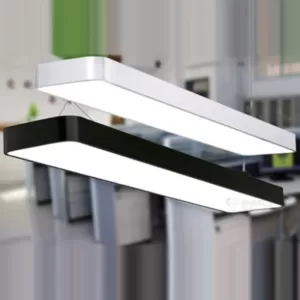
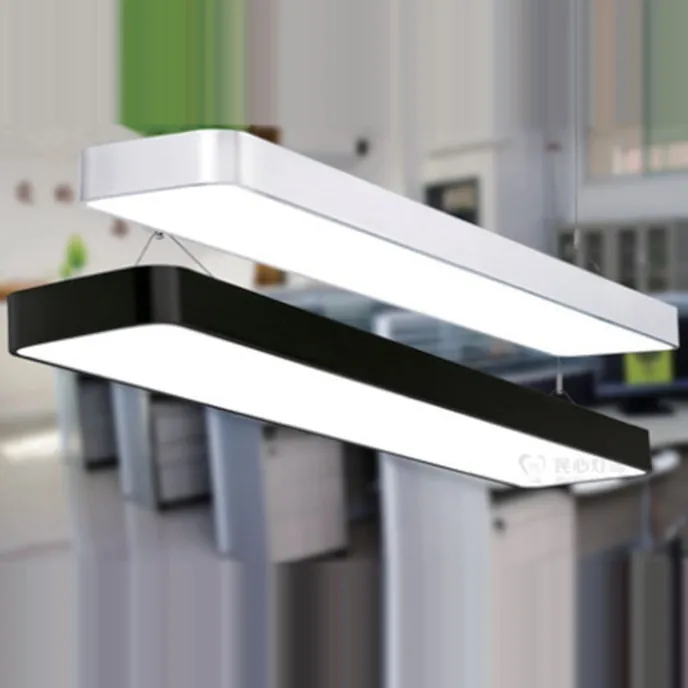
- a pendant or surface linear fitting, like our BG-TXH (1200 × 200 × 60 mm at 36 W, 120° beam), for offices, shops and corridors with a finished look;
- a batten, for plant rooms, car parks and back-of-house areas;
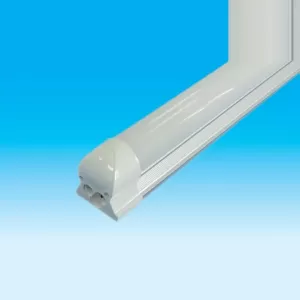
- a T8 tube fitting with an emergency kit, for existing tube installations; our BG-RG T8 tube comes in 16 and 18 W in 1,200 mm length.
For ceiling grids, the emergency panel is the equivalent; our guide to LED flat panels with emergency backup covers integrated and remote kits for panels.
Batteries, heat and life
Battery life depends mostly on temperature. A battery above a hot driver in a closed fitting ages fast. Points to check:
- Battery position and ventilation inside the fitting.
- Battery type. LiFePO4 tolerates heat and cycling better than older chemistries.
- Ambient temperature range of the emergency driver and battery, not only the LEDs.
- Replaceability. A battery that can be changed without replacing the fitting saves money in year four or five.
For wet or dusty areas, the emergency version needs the same IP rating as the standard fitting; see our guide to wet location emergency lights.
Testing
Emergency linear lights need the same routine as dedicated emergency fittings:
- a short monthly function test, simulating a mains failure;
- an annual full-duration test, for the full 90 minutes or 3 hours;
- records of every test.
Self-test drivers run these automatically and show faults on an indicator. Our emergency light testing guide covers the procedures.
Wiring
An emergency linear light needs an unswitched live to monitor the mains and charge the battery, in addition to the switched live that turns the light on and off. Forgetting the unswitched live is the most common installation fault: the battery never charges, or the light comes on whenever the switch is turned off.
Ordering
Send the length and wattage, the mounting type, the emergency duration (90 minutes or 3 hours), the emergency share you need or the escape route layout, maintained or non-maintained, and whether you want self-test. We will confirm the emergency driver and battery for your fittings, and check the corridor layout against the requirement.
Sources
Frequently asked questions
What is a 4 ft emergency linear light?
A 1.2 m LED linear fitting, batten or pendant, with a built-in battery and emergency driver. It works as a normal light on mains, and when the supply fails it switches to battery and keeps a reduced output for the rated duration, usually 90 minutes or 3 hours.
How bright is a linear light in emergency mode?
It depends on the emergency driver. Typical settings are 10–30% of normal output. For a 36 W fitting at 90 lm/W, that is about 324–972 lumens.
How long does the battery last in an emergency linear light?
The rated duration is set by the battery and the emergency output: usually 90 minutes or 3 hours. Battery life in service is typically a few years; test monthly and run a full-duration test once a year.
Is a 36 W emergency linear light enough for a corridor?
In most corridors, yes. In our estimate, a 2 m corridor with fittings every 6 m reaches about 11 lux average at 10% emergency output, well above the 1 lux centreline minimum in EN 1838. Check the minimum point, not only the average.