How an Emergency Light Unit Works: Charger, Battery, Changeover and Battery Sizing
Inside a self-contained emergency light unit: mains sensing, automatic changeover, charger, battery chemistry and test switch, with a battery sizing calculation for a 3-hour fitting.
Key points
- A self-contained emergency light unit has five parts: mains sensing, charger, battery, changeover circuit and LED driver, plus a test switch and indicator.
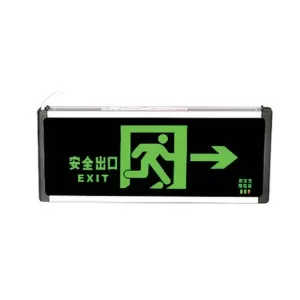
- Changeover is automatic: when the supply drops below a threshold, the unit switches to battery, typically within seconds; our BG-XFYJ exit sign does it in under 2 s.
- A fitting drawing 3 W in emergency mode for 3 hours needs about 13 Wh of battery once driver losses and end-of-life capacity are counted.
- Battery chemistry (NiCd, NiMH, LiFePO4) sets the charging time, the temperature range and how long the battery lasts.
- Central battery systems feed many fittings from one battery room; self-contained units are simpler to install and test in small buildings.
An emergency light looks like an ordinary fitting with a small red or green indicator. Inside, it is a small power system that has to work after months or years of doing nothing. Buyers searching for “automatic emergency light”, “chargeable emergency light” or “emergency light unit” are usually asking the same thing: what is inside, how does it switch over, and how long will it last. This guide opens the box and sizes a battery step by step.
The five parts inside
| Part | Job | What goes wrong if it fails |
|---|---|---|
| Mains sensing | Watches the unswitched supply voltage | Unit never switches over, or switches when it should not |
| Charger | Recharges and then maintains the battery | Battery never full, or overcharged and short-lived |
| Battery | Stores the energy for the emergency duration | Duration falls short in a real outage |
| Changeover circuit | Connects the battery to the LED driver on failure | Light stays dark despite a charged battery |
| LED driver | Runs the LEDs from battery voltage | Dim or flickering emergency light |
Add a test switch (or an automatic self-test controller) and a charge indicator, and you have a complete self-contained unit. Our emergency light test button not working guide covers faults in those last two parts.
How the automatic changeover works
- In normal operation, the charger takes power from the permanent live and keeps the battery topped up. The indicator shows that charging is active.
- When the supply drops below the threshold (often around 60–85 % of rated voltage, depending on the design), the sensing circuit triggers the changeover.
- The battery feeds the LED driver. Standards set how quickly the light must come on; EN 1838 requires 50 % of the required level within 5 seconds.
- When the supply returns, the unit switches back, and the charger begins a full recharge.
- A deep-discharge cut-off disconnects the load when the battery is nearly empty, so it is not damaged.
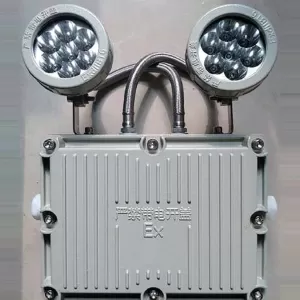
Our BG-XFYJ exit sign switches over in under 2 seconds and runs at least 90 minutes; our BG-FBYJ10A twin-head light for hazardous areas runs for 2 hours.
Wiring: why the permanent live matters
A self-contained unit needs an unswitched supply for its charger. If it were wired to the switched lighting circuit, every time someone turned the lights off the unit would treat it as a power failure, light up and drain its battery.
| Fitting type | Supply connections |
|---|---|
| Non-maintained | Permanent live, neutral, earth |
| Maintained | Permanent live, neutral, earth (lamp always on) or plus a switched live if the maintained lamp is switchable |
| Combined | Permanent live for the charger, switched live for the normal lamp |
Our emergency light installation guide shows the wiring in more detail.
Battery sizing: a worked example
Suppose a fitting draws 3 W at its LEDs in emergency mode and must run for 3 hours. How big must the battery be?
- Energy at the LEDs: 3 W × 3 h = 9 Wh
- Driver losses: with an assumed driver efficiency of 85 %, 9 ÷ 0.85 = 10.6 Wh from the battery
- End-of-life capacity: batteries lose capacity with age. Designing for 80 % of rated capacity at the end of the battery’s service life: 10.6 ÷ 0.8 = 13.2 Wh rated
- Convert to amp-hours:
– LiFePO4 cell at 3.2 V: 13.2 ÷ 3.2 = about 4.1 Ah
– NiCd pack of three cells at 3.6 V: 13.2 ÷ 3.6 = about 3.7 Ah
The same fitting at 1 hour would need about a third of that. This is why a 3-hour version of a fitting is often larger or heavier than the 1-hour version, and why a 3-hour requirement should be stated before ordering. Our how long do emergency lights last article covers duration rules and battery replacement intervals.
Battery chemistries compared
| Chemistry | Strengths | Weaknesses | Typical service life in a fitting |
|---|---|---|---|
| NiCd | Robust, tolerates heat and continuous charging | Contains cadmium; restricted in some markets | Around 4 years |
| NiMH | No cadmium, good capacity | Less tolerant of high temperatures | Around 4 years |
| LiFePO4 | Light, long cycle life, stable chemistry | Needs a dedicated charger and protection circuit | Often longer than nickel types |
Service life depends heavily on temperature. A unit mounted near a hot ceiling or in a plant room above 40 °C will lose capacity faster than one in a cool corridor. Our BG-FBYJ10A is rated for −30 °C to +50 °C ambient; check the rating of any unit used in cold stores or hot plant rooms.
Self-contained or central battery?
| Self-contained units | Central battery system | |
|---|---|---|
| Battery location | In each fitting | One battery room or cabinet |
| Installation | Standard cabling | Fire-resistant cabling to each fitting |
| Testing | Each fitting (or automatic self-test) | At the central panel |
| Battery replacement | Many small batteries | One large battery bank |
| Best for | Small to medium buildings | Large buildings, hospitals, tunnels |
Central systems follow EN 50171 in Europe. They make testing and replacement simpler in large buildings but need a protected battery room and fire-resistant wiring.
Keeping the unit ready
- Monthly: a short function test, switching each unit to battery briefly.
- Annually: a full-duration test, then a full recharge before the building is used at night.
- Replace batteries when a full-duration test falls short, or at the interval the maker states.
Our emergency light testing guide gives the full procedure, and our escape route lighting article shows where the units should go and how bright they must be.
What to send us
Tell us the duration your code requires, maintained or non-maintained mode, the ambient temperature and whether any fittings are in a hazardous area. We will confirm which of our units match and their emergency-mode output.
Sources
Frequently asked questions
What is an emergency light unit?
It is a light with its own battery, charger and changeover circuit. When the mains supply fails, it switches to the battery automatically and lights for its rated duration, typically 1, 2 or 3 hours.
How does an automatic emergency light know the power has failed?
A sensing circuit monitors the permanent (unswitched) supply. When the voltage falls below a set threshold, the changeover circuit connects the battery to the LED driver. When the supply returns, it switches back and starts recharging.
How long does an emergency light battery take to charge?
Most units are designed to recharge fully within 24 hours, which is the usual requirement in emergency lighting standards. Our BG-XFYJ exit sign needs up to 24 hours.
Why does an emergency light need a permanent supply?
If it were connected to a switched circuit, turning the lights off would look like a power failure and drain the battery. The charger needs an unswitched live; a separate switched live is used only for maintained or combined fittings.
Which battery is best for emergency lights?
NiCd tolerates heat and abuse and is still common; NiMH avoids cadmium; LiFePO4 is lighter, lasts longer and is now widely used. The right choice depends on the ambient temperature and the required duration.