LED High Bay Lights with Battery Backup: Emergency Output, Battery Size and Layout
How high bays with battery backup work, how much emergency light a hall needs, how to size the battery in Wh, and a 40 × 25 m warehouse worked through our calculator.
Key points
- A high bay with battery backup keeps a reduced output (often around 10–20% of normal) running when the mains fails, so the hall itself becomes the emergency lighting instead of separate fittings.
- In our 40 × 25 m warehouse example, 24 high bays each running 15 W in emergency mode give about 21 lux average; equipping one fitting in four still gives about 5 lux, far above the 0.5 lux open-area minimum of EN 1838.
- Battery size follows from emergency watts × duration ÷ conversion efficiency: 15 W for 90 minutes needs about 26 Wh before ageing margin.
- Heat is the battery's enemy. Under a hot roof, choose packs rated for the ceiling temperature or mount the emergency unit lower, away from the fitting.
When the mains fails in a warehouse at night, people need enough light to stop machines, put down loads and walk out safely. The traditional answer is a separate set of emergency fittings and exit signs. An alternative is to give some of the high bays themselves a battery, so the same fittings that light the work also light the escape. This guide explains how high bays with battery backup work, how much light they need to give, and how to size the battery.
How a battery backup high bay works
An emergency high bay has three extra parts: a charger, a battery, and a converter that drives the LEDs from the battery. While the mains is healthy, the charger keeps the battery full and the fitting works normally. When the supply fails, the converter switches over automatically and runs the LEDs at a reduced power from the battery until the mains returns or the battery is exhausted.
There are three common arrangements:
| Arrangement | Description | Points to watch |
|---|---|---|
| Integrated | Battery and emergency driver built into or onto the fitting | Battery sits in the hottest place, under the roof |
| External pack | A separate emergency driver and battery box wired to a standard fitting, mounted nearby | Must match the fitting’s LED voltage and current; needs a permanent live feed for charging |
| Central inverter | One large battery system feeds selected fittings through dedicated circuits | Higher cost, but one battery to test and maintain |
Whichever is used, the fitting needs an unswitched live to charge the battery. If the battery is fed through the lighting switch, it discharges every time the lights are turned off and the system is useless.
How much emergency light a hall needs
EN 1838 sets the minimum light levels for emergency lighting in Europe and many other countries:
- Escape routes: at least 1 lux on the centre line of the route.
- Open areas (anti-panic): at least 0.5 lux on the floor over the open area, with a maximum-to-minimum ratio not above 40:1.
- High-risk task areas: at least 10% of the normal maintained level, and not less than 15 lux, available within 0.5 seconds.
In the US, NFPA 101 asks for an average of 1 foot-candle (about 10.8 lux) along the egress path at the start, with a minimum of 0.1 foot-candle, for 90 minutes. Fire codes vary by country, so use the values your authority applies.
Worked example: a 40 × 25 m warehouse
We used our high bay lighting calculator for a 40 × 25 m warehouse with an 8 m mounting height and a 200 lux target. With 150 W fittings at 110 lm/W, the normal layout is 24 fittings in a 6 × 4 grid, about 213 lux, with a utilisation factor of 0.67.
Now suppose each emergency pack runs the fitting at 15 W (10% of full power) and the LEDs keep the same efficacy. Using the same room data and utilisation factor:
| Emergency configuration | Fittings on battery | Average emergency lux | Compared with EN 1838 open area (0.5 lux) |
|---|---|---|---|
| Every fitting | 24 | about 21 lux | about 40 times the minimum |
| One in two | 12 | about 10.6 lux | about 20 times |
| One in four | 6 | about 5.3 lux | about 10 times |
Average lux is not the whole story: with only six fittings lit, the floor between them is darker than the average. At 8 m mounting height, though, each fitting spreads light widely, and a check of the minimum and the 40:1 ratio is usually easy to pass with one in four, plus fittings over exits, stairs and machine controls. High-risk areas, such as around saws or presses, may need their fittings on battery at a higher emergency output to reach 15 lux.
The example shows why battery high bays work well: emergency levels are tiny compared with working levels, so a small share of fittings at low power covers the requirement.
Sizing the battery
The battery must deliver the emergency power for the required time, allowing for conversion losses and ageing:
Battery energy (Wh) = emergency power (W) × duration (h) ÷ converter efficiency
For 15 W over 90 minutes with an 85% converter: 15 × 1.5 ÷ 0.85 ≈ 26 Wh. For three hours, about 53 Wh. Batteries lose capacity with age and heat, and emergency systems must still pass their duration test at the end of the battery’s life, so suppliers add a margin on top of this figure. Ask for the rated duration at end of life, not only on a new battery.
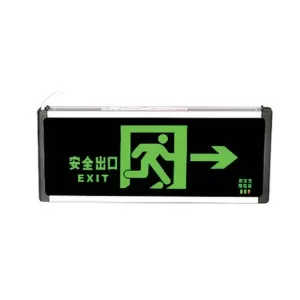
For comparison, a dedicated exit sign such as our BG-XFYJ LED exit sign runs 3–5 W for at least 90 minutes. Exit signs remain necessary even when the high bays carry the emergency light, because they show the direction of escape.
Heat: the main risk
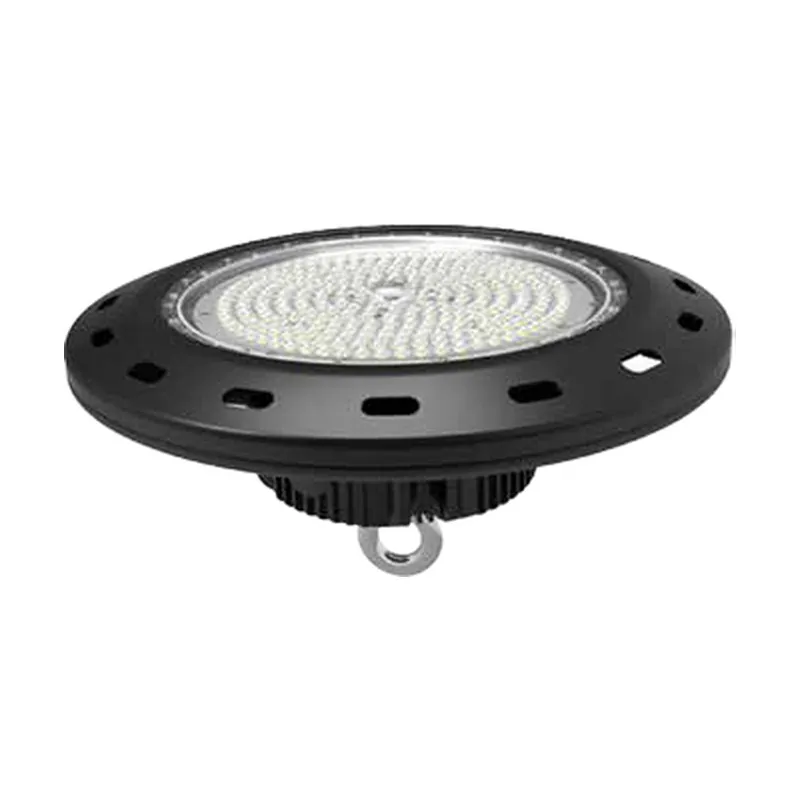
High bays sit under the roof, which is often the hottest part of the building. Our GKP40F UFO high bay is rated for −10 °C to +50 °C; many batteries prefer much lower temperatures for long life. Practical points:
- Check the pack’s rated ambient, not only the fitting’s.
- Mount external packs lower, on a column or wall where it is cooler, where cable lengths allow.
- In hot processes (foundries, drying rooms, upper levels of unventilated sheds), consider a central inverter in a cool room. See our guide to high temperature LED high bays.
- In cold stores, battery capacity drops at low temperatures; use packs rated for the store temperature.
Testing and maintenance
Emergency lighting only matters if it works on the day it is needed. Most codes call for a short monthly function test and a full-duration test once a year, with records kept. Self-testing emergency drivers run these tests automatically and show a fault indicator; in a large hall this saves a lift and a technician walking every aisle. Our guide to emergency light testing explains the routine.
Common mistakes
- Charging circuit on the switch. The battery must have a permanent live.
- Choosing too few fittings and too low output. Average lux looks fine but the minimum or uniformity fails in corners.
- Forgetting the exits. Fittings over exit doors, stairs and first-aid points should be on battery.
- Ignoring roof heat. A pack that lasts five years in an office may last a fraction of that under a hot steel roof.
What to send for a quotation
- Hall drawings with exits, escape routes and high-risk areas.
- Mounting height and the normal target lux.
- The emergency standard and duration your authority requires.
- Ambient temperature at the fitting.
- Whether you prefer integrated packs, external packs or a central system.
We will return the normal layout from our calculator and the emergency configuration that meets your duration. See also how many LED high bay lights you need and our guide to emergency light installation.
Sources
Frequently asked questions
How long must high bay emergency lights stay on?
It depends on the code that applies. EN 1838 requires at least one hour for escape lighting, and many European countries require three hours in buildings that may be reoccupied. NFPA 101 in the US requires 90 minutes. Use the longest duration your authority asks for.
Do all high bays in a hall need battery backup?
Usually not. The light levels for escape are low, so equipping a share of the fittings (for example one in three or four, plus those over exits and hazards) often meets the requirement. A layout check confirms the minimum and uniformity.
What battery type is used in high bay emergency packs?
Nickel-cadmium, nickel-metal hydride and lithium iron phosphate are all used. Lithium packs are lighter and hold capacity well, but every type ages faster in heat, so the rated ambient temperature of the pack matters more than the chemistry.
Can I add battery backup to existing LED high bays?
Often yes, with an external emergency driver wired between the mains supply and the fitting, if the fitting's LED voltage and current fall within the pack's output range. Check this with the fitting and pack datasheets before ordering.