Explosion Proof LED Lights: A Buyer’s Guide to Types, Wattage and Certification
How to choose explosion proof LED lights: fitting types, wattage by mounting height, matching zone, gas group and temperature class, and what to check on the certificate.
Key points
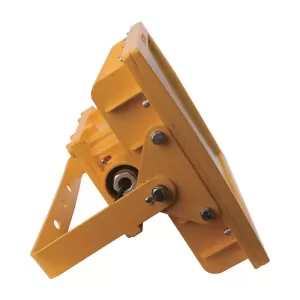
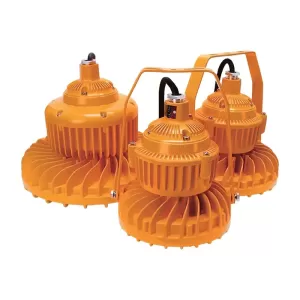
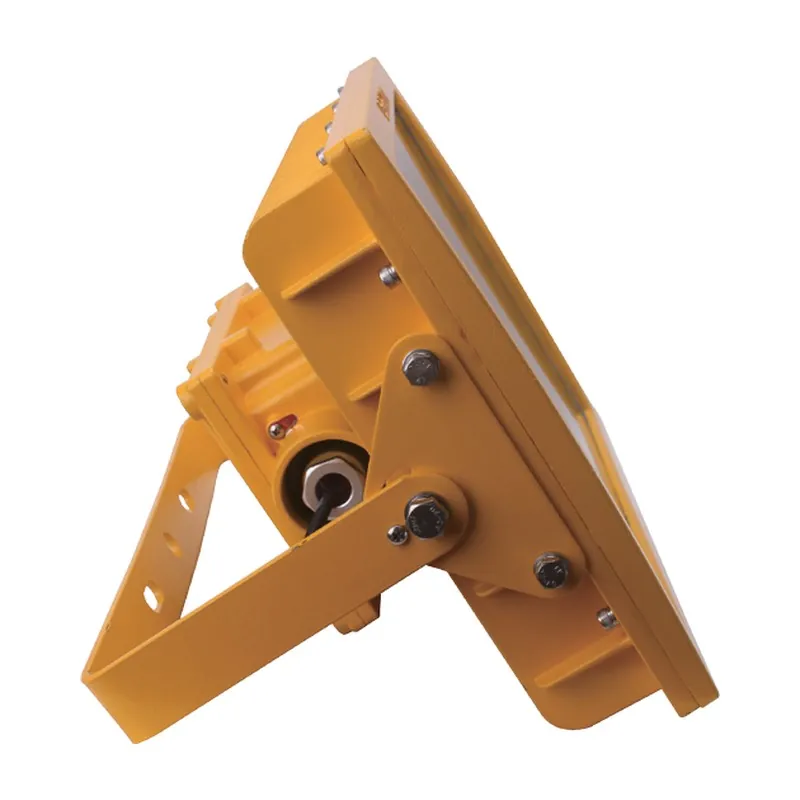
- Choose the fitting type by the space: floodlights for open plant and tank farms, high bays for process halls, ceiling and linear fittings for corridors and pump rooms, emergency fittings for escape routes.
- The certificate must cover the exact model and match the zone, gas or dust group and temperature class of the site, under the certification scheme your country requires.
- LED cuts energy by roughly half to two thirds against old explosion proof HID fittings, and removes most lamp changes in hazardous areas.
- Our BED series is certified under China's GB 3836; for other series and for ATEX, IECEx or UL requirements, confirm the certificate at the quotation stage.
Explosion proof lighting is bought differently from ordinary lighting. A cheaper fitting that lasts two years less is a cost problem; an explosion proof fitting with the wrong certificate is a safety and legal problem. This guide covers the types of fitting, how to choose the wattage, and what to check before you order. For the meaning of the markings themselves, see explosion proof lighting explained.
Types of explosion proof LED fittings
| Type | Typical power | Where it is used |
|---|---|---|
| Floodlight | 50–600 W | Tank farms, loading bays, jetties, open process plant, perimeter |
| High bay | 60–300 W | Process halls, compressor houses, warehouses for chemicals |
| Ceiling / well-glass | 15–60 W | Pump rooms, corridors, control rooms, under platforms |
| Linear | 20–60 W | Walkways, tunnels, cable trenches, paint and mixing rooms |
| Emergency | 5–20 W | Escape routes and exits, with built-in battery |
| Portable / hand lamp | Low power, often Ex i | Inspection and maintenance |
For the portable end of this table, such as work lights for tanks and vessels, drop lights and battery models, see our guide to explosion-proof work lights, linear lights and drop lights.
Choosing the wattage
| Area | Mounting height | Typical LED power |
|---|---|---|
| Pump rooms, corridors, stairs | 2.5–4 m | 20–40 W |
| Process areas, platforms | 4–8 m | 60–150 W |
| High halls, compressor houses | 8–15 m | 150–300 W |
| Tank farms, loading areas, open plant | 10–20 m (poles, structures) | 200–600 W floodlights |
Light levels in process plants are usually set by the operator’s standard or the national work-place lighting standard, often 50–100 lx for walkways and general plant, 150–300 lx for operating and control positions, and more for inspection. Treat the table as a starting point and confirm it with a lighting calculation.
Matching the certificate to the site
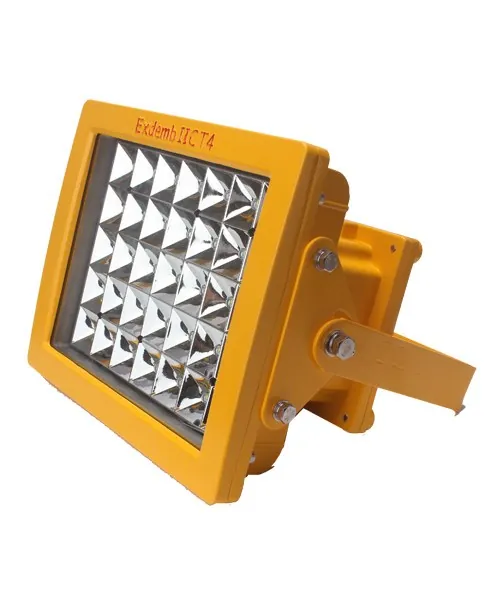
Five things on the certificate must match the site:
- Zone (1 or 2 for gas, 21 or 22 for dust), through the equipment protection level (Gb, Gc, Db, Dc)
- Gas group (IIA, IIB or IIC) or dust group (IIIA, IIIB or IIIC)
- Temperature class (T1–T6), below the ignition temperature of every substance present; for dust, the maximum surface temperature
- Ambient temperature range of the certificate, which must cover the site
- Certification scheme: ATEX in the EU, IECEx or national schemes based on IEC 60079 elsewhere, UL or CSA listings for Class/Division in North America, GB 3836 in China
The certificate must also name the exact model you are buying. A certificate for one series says nothing about another, even from the same factory.
Our position, stated plainly: our BED series is certified under China’s GB 3836 (certificate ZJEx23.0914, Ex db eb mb IIC T4 Gb / Ex tb IIIC T130 °C Db). For our other explosion proof series, the certificate is supplied with the quotation. If your project requires ATEX, IECEx or UL, tell us at the start so we can confirm what can be supplied rather than assume equivalence.
Electrical and mechanical details
- Supply voltage: 100–277 V AC is common; 24 V or 36 V versions for confined spaces and some mines; DC versions for some plants.
- Cable entries and glands: thread size and type (M20, M25, NPT), the number of entries, and certified glands suited to the cable and protection type.
- Mounting: ceiling, pendant, wall, bracket, pole or U-bracket for floodlights; check the bracket allows the aiming angle needed.
- Corrosion: chemical plants and coastal sites need stainless steel fasteners, durable coatings and a corrosion grade suited to the atmosphere (for example WF1 or WF2 under the Chinese standard).
- Ingress protection: IP65–IP66 is typical; IP67 for washdown and flooding risk.
- Ambient temperature: check the certified range against the site, especially near hot processes or in cold climates.
Why LED pays in hazardous areas
Explosion proof fittings are expensive to maintain: every lamp change needs a work permit, sometimes gas testing and a scaffold or lift, and the fitting must be inspected after opening. LED reduces energy by roughly half to two thirds against old high-pressure sodium or metal halide explosion proof fittings, and removes most lamp changes.
For example, replacing 40 explosion proof 250 W HPS fittings (about 290 W with ballasts) with 100 W LED, running 24 hours a day, saves about 66,600 kWh a year, roughly US$10,000 at US$0.15/kWh, before counting the maintenance saved. Try your own numbers in the LED retrofit savings calculator.
Common mistakes
- Buying on the marking alone, without checking that the certificate covers the model and the ambient range.
- Choosing T4 for a substance that needs T5 or T6, such as carbon disulphide.
- Ignoring dust: grain, flour, sugar, coal and metal dusts need dust protection (Zone 21/22) as well as or instead of gas protection.
- Wrong cable glands, or unused entries left open.
- Converting old certified fittings with LED lamps, which usually voids the certificate.
- No emergency lighting on escape routes in hazardous areas.
What to send with an enquiry
- The area classification drawing, or the zones, gas/dust groups and temperature classes
- The certification scheme required
- Mounting heights, areas and the light levels required
- Supply voltage and cable entry requirements
- Ambient temperature range and corrosion conditions
Our explosion proof lighting range covers 10 W emergency lights, 15–30 W ceiling fittings, 50–150 W ExF fittings and 30–600 W BED and BAD series floodlights and high bays. Send us the details and we will propose models, with certificates, for each area.
Sources
Frequently asked questions
What is the difference between explosion proof and intrinsically safe lights?
Explosion proof (flameproof, Ex d) lights contain any internal ignition inside a strong enclosure. Intrinsically safe (Ex i) equipment limits energy so that it cannot ignite the atmosphere at all; it suits low-power instruments and torches, while fixed lighting usually uses flameproof or increased-safety protection.
What wattage explosion proof LED light do I need?
Roughly 20–40 W for corridors, pump rooms and low ceilings; 60–150 W for process areas at 4–8 m; 150–300 W for high halls and platforms; and 200–600 W floodlights for tank farms, loading areas and large open plant. A lighting calculation for the area sets the exact value.
Can I replace an explosion proof HID light with LED?
Yes, by replacing the complete fitting with a certified LED fitting for the same zone, gas group and temperature class. Converting a certified HID fitting with an LED lamp or kit usually voids its certification unless the manufacturer offers a certified conversion.