Coal Handling Plant Lighting: Conveyor Galleries, Crusher Houses and Coal Dust Zones
How to light a coal handling plant at a power station, steelworks or port: coal dust zones, the temperature check against layer ignition, vibration, wash-down, and a crusher-house layout.
Key points
- Coal dust is a combustible dust: NEC Class II, Group F, and IEC dust group IIIB; transfer towers, crushers and bunker tops are typically Zone 21 or 22.
- Coal dust layers can smoulder at relatively low temperatures, so check the light's maximum surface temperature against the tested layer ignition temperature minus 75 K.
- Crusher houses and transfer towers vibrate; fittings need secure mounting, safety cables and drivers that tolerate vibration.
- A 24 × 15 m crusher house with lights at 10 m needs 6 floodlights of 150 W for about 106 lux by our lighting calculator.
Coal arrives by rail, ship or truck, is unloaded, crushed, conveyed and stored before it reaches the boiler, coke oven or ship. Every transfer creates dust, and the dust settles on every surface, including light fittings. This guide explains the dust zones, the temperature check, the mechanical demands, and how many fittings a crusher house needs.
Coal dust classification
| System | Classification |
|---|---|
| NEC (US) | Class II, Group F (carbonaceous dust), Division 1 or 2 |
| IEC / ATEX | Dust group IIIB (non-conductive), Zone 20, 21 or 22 |
Typical zones in a coal handling plant:
| Area | Typical zone |
|---|---|
| Inside crushers, bunkers, silos and dust collectors | Zone 20 (no lights) |
| Crusher house floor near the crusher, transfer chutes, bunker tops | Zone 21 |
| Conveyor galleries and tunnels with good housekeeping | Zone 22 |
| Open coal yard | Usually unclassified; check stacker and reclaimer areas |
| Control rooms, substations | Unclassified (pressurised or separated) |
Dust suppression sprays and enclosed chutes reduce the extent of zones, but they do not remove them. Our combustible dust lighting guide explains the zone definitions.
The temperature check
Coal dust layers can start to smoulder at temperatures well below those that ignite a dust cloud, and the value varies a lot with the coal type. That makes the layer check the important one:
- Layer rule (5 mm): maximum surface temperature ≤ layer ignition temperature − 75 K
- Cloud rule: maximum surface temperature ≤ two-thirds of cloud ignition temperature
| Light marking | Minimum layer ignition temperature it allows | Minimum cloud ignition temperature it allows |
|---|---|---|
| T80 °C (BAD8599, BAD8501B) | 155 °C | 120 °C |
| T130 °C (BED series) | 205 °C | 195 °C |
The plant’s dust test data decides which fitting is acceptable. Where coal dust layers ignite at low temperatures, a fitting with a lower maximum surface temperature, such as T80 °C, gives more margin than a T130 °C one. Layers thicker than 5 mm need a further reduction under IEC 60079-14, which is another reason for regular cleaning. Our grain elevator lighting guide shows the same calculation for a different dust.
Vibration, impact and wash-down
Coal plants are hard on equipment:
- Vibration. Crushers, screens and conveyor drives shake their buildings. Fixings loosen and drivers fail if they are not rated for it. Use lock nuts, a safety cable on every fitting and a fitting designed for vibration.
- Impact. Lumps of coal fall from conveyors; fittings below belts need guards.
- Wash-down. Many plants hose down galleries and transfer towers to control dust. IP66 is the practical minimum. Our explosion-proof IP rating guide compares IP65, IP66 and IP67.
Worked example: a 24 × 15 m crusher house
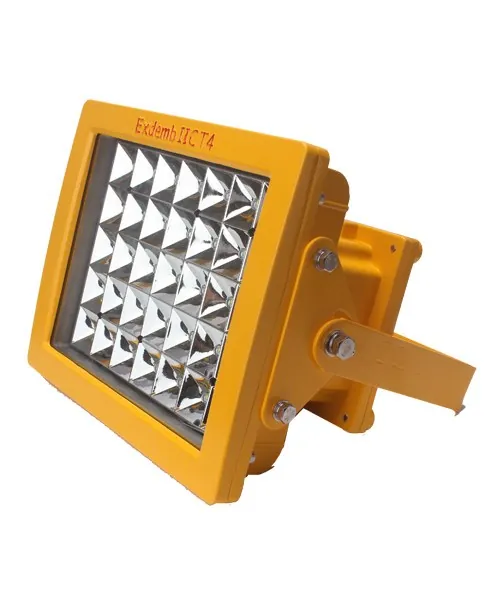
Take a crusher house 24 × 15 m with fittings at 10 m, dark surfaces (coal-blackened walls reflect very little), and a target of 100 lux for operation and inspection. With the BAD8599 at 150 W and 120 lm/W, a medium beam and a maintenance factor of 0.8, our lighting calculator gives:
| Result | Value |
|---|---|
| Room index | 1.00 |
| Utilisation factor | 0.44 |
| Fittings | 6 (3 × 2) |
| Spacing | 8.0 m × 7.5 m |
| Average illuminance | about 106 lux |
| Power density | 2.5 W/m² |
With 100 W fittings the calculator needs 12 (4 × 3) for about 141 lux. The 150 W layout uses fewer fittings, so fewer lifts to 10 m for cleaning, which in a coal plant happens often. Dark walls cut the utilisation factor from about 0.51 to 0.44; if the walls are painted light and cleaned, the same fittings give more light.
For maintenance, add a few fittings at the crusher drive and screen access platforms, mounted on the building steel at platform level.
Conveyor galleries and tunnels
Long galleries need a row of fittings along the walkway side, spaced so the light is even:
- mount above the walkway, not the belt, so the conveyor need not stop for relamping;
- space at no more than about 1.5 times the mounting height for wide-beam ceiling fittings;
- light pull-cord switches, belt-sway switches and fire extinguishers clearly.
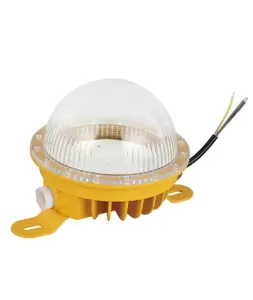
The BAD8501B ceiling light (15–30 W, Ex tD A21 IP66 T80 °C) suits galleries with low ceilings.
Coal yards and stockpiles
Open yards are usually lit with floodlights on high masts or on the stacker-reclaimer itself. Spontaneous heating of stockpiles is a separate fire risk, not a lighting one, but the yard must be lit well enough for patrols to spot smoke. We supplied 47 LED floodlights and 43 street light poles for roads inside the Xiangtan steel plant, a site with coal and coke handling. Our steel plant lighting guide covers the rest of such a site.
Cleaning schedule
Dust on fittings reduces light output and raises surface temperature. Include fittings in the housekeeping schedule:
- galleries and transfer towers: inspect and clean monthly or as dust levels require;
- after any spillage or chute blockage: clean nearby fittings before restarting;
- record lens condition and fixings at each inspection.
Our explosion-proof light maintenance guide lists what to check on flameproof joints and seals.
What to send us
- Plant layout with transfer towers, crushers and galleries
- Area classification drawing
- Dust test data (layer and cloud ignition temperatures), if available
- Mounting heights and target lux levels
- Whether the plant uses wash-down
With these we will check each fitting’s surface temperature against your coal data and return layouts like the example above.
Sources
Frequently asked questions
Is a coal handling plant a hazardous area?
Parts of it are. Coal dust is combustible, and areas where it forms clouds or layers, such as crushers, transfer points, bunker tops and dust collectors, are classified as combustible dust zones (Zone 20, 21 or 22, or Class II, Group F).
What surface temperature is safe for coal dust?
Under IEC 60079-14 the maximum surface temperature of the light must be no more than two-thirds of the dust cloud ignition temperature and at least 75 K below the 5 mm layer ignition temperature. Use the tested values for the coal you handle, because they vary with coal rank.
Why do lights fail in coal plants?
Mainly vibration, dust build-up and wash-down water. Loose fixings, cracked lenses and water in the driver chamber are the common faults. A sealed IP66 fitting with stainless fixings and a safety cable lasts longer.
Which of your lights suit coal handling?
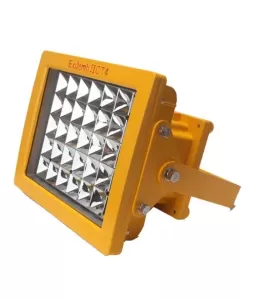
The BAD8599 floodlight (Ex d IIC T6 Gb / Ex tD A21 IP66 T80 °C) for crusher houses and transfer towers, the BAD8501B (Ex tD A21 IP66 T80 °C) for galleries, and our BED series (Ex tb IIIC T130 °C Db, certificate ZJEx23.0914).