Vehicle Inspection Pit Lighting: Fuel Vapour, Fitting Choice and a 6 m Pit Example
How to light a vehicle inspection pit: why petrol vapour collects there, when pit lights must be explosion-proof, how to light the vehicle underside, and a 6 m pit plus the workshop above.
Key points
- Petrol vapour is heavier than air and collects in pits, so pits in workshops that handle petrol vehicles are often treated as a hazardous zone even when the workshop floor is not.
- Pit lights should light the underside of the vehicle, not just the pit floor: mount them on the pit walls, recessed or guarded, aimed upward and across.
- For a 6 × 1 m pit 1.6 m deep, our calculator gives about 458 lux on the pit floor with 4 BDE507 fittings of 20 W at 1.5 m spacing.
- The workshop above, if unclassified, needs ordinary high bays: 12 GKP40G of 100 W give about 307 lux over a 20 × 12 m floor.
Inspection pits let mechanics work under vehicles without a lift. They are cheap to build, common in bus depots, truck workshops and MOT or roadworthiness test centres, and often poorly lit. They also sit below floor level, where heavier-than-air vapour collects. That combination makes pit lighting one of the small but real hazardous-area decisions in an ordinary workshop.
Why pits collect vapour
Petrol vapour is heavier than air. A fuel leak, a drained tank, a dropped fuel filter or even a hot engine dripping onto the pit floor releases vapour that flows down into the pit and stays there unless ventilation removes it. Diesel releases far less vapour at normal temperatures, but workshops rarely work only on diesel vehicles.
Guidance for repair workshops treats pits with care for this reason. In the UK, HSE’s HSG261 covers motor vehicle repair, including pits and fuel handling. In the US, NFPA 30A sets requirements for repair garages, including pits and ventilation. Under the IEC method, IEC 60079-10-1 is used to decide whether the pit is a zone, which depends on what is done in it and how it is ventilated.
| Pit situation | Typical outcome |
|---|---|
| Petrol vehicles, fuel work possible, no forced ventilation | Pit treated as a hazardous zone |
| Petrol vehicles, mechanical extraction at pit floor level | Smaller or less severe zone, per the assessment |
| Diesel-only fleet, no fuel heating | Often unclassified |
| Fuel draining done only outside the pit, on a drip tray | Lower risk; still check |
When a pit is classified, every fixed fitting and every portable lamp used in it must be rated for that zone. Our article on when explosion-proof lighting is required explains the principle.
Light the vehicle, not the floor
The mechanic in a pit looks up. Fittings in the pit floor or at the bottom of the walls light the floor and the mechanic’s feet; fittings above the pit, in the workshop, are blocked by the vehicle. Good pit lighting:
- mounts fittings on both long walls, near the top, aimed upward and across at the underside;
- staggers the two walls so shadows from one side are filled from the other;
- recesses the fittings into wall niches or protects them with guards, because a pit is narrow and people hit things;
- keeps the fittings out of the path of oil drains and transmission jacks.
Worked example: a 6 m pit
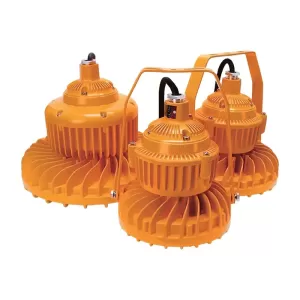
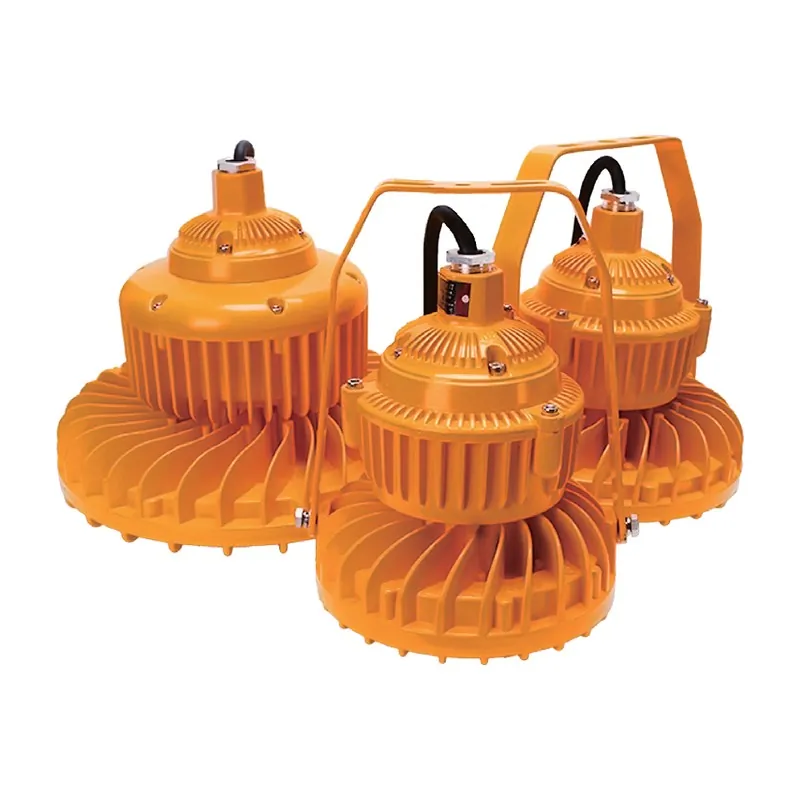
The pit is 6 m long, 1 m wide and 1.6 m deep, with white-painted walls. The target is 300 lux. A pit is far from the room shape a lighting calculator assumes, so treat the result as a first estimate. Using the BDE507 at its smallest size, 20 W (Ex d IIC T6 Gb, IP66, 110 lm/W), our lighting calculator gives:
| Result | Value |
|---|---|
| Room index | 0.54 |
| Utilisation factor | 0.39 |
| Fittings | 4 (in one row) |
| Spacing | 1.5 m |
| Average illuminance on the pit floor | about 458 lux |
| Wattage that would just reach 300 lux | about 13 W |
In practice we would place two fittings on each long wall, staggered, aimed upward at 30–45°. The floor figure falls but the light on the vehicle underside, where the work is, rises. The IIC T6 marking of the BDE507 covers petrol vapour with a wide margin. We supply its certificate with the quotation. For pits in long bus or truck bays, repeat the pair of fittings every 2–3 m.
Portable lamps
Fixed lighting never reaches every corner under a vehicle, so mechanics use hand lamps. In a classified pit, the hand lamp must be certified for the zone. Low voltage, such as 24 V, also reduces the risk of electric shock in a damp pit. Our 24 V explosion-proof light guide covers low-voltage options, and the explosion-proof portable linear lights article covers rechargeable hand lamps.
The workshop above
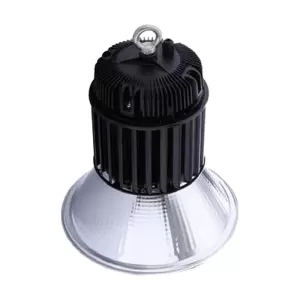
The workshop floor is usually unclassified, provided ventilation is adequate, though the zone around the pit opening may extend a short distance above floor level. Check the assessment. For an unclassified 20 × 12 m workshop with a 6 m roof at 300 lux, our GKP40G heat-pipe high bay at 100 W and 130 lm/W gives, by the same calculator:
| Result | Value |
|---|---|
| Fittings | 12 (4 × 3) |
| Spacing | 5.0 m × 4.0 m |
| Average illuminance | about 307 lux |
| Power density | 5.0 W/m² |
Place rows between the vehicle bays rather than over them, so light reaches the sides of the vehicles and into engine bays. Our high bay wattage by ceiling height guide helps with other workshop sizes.
Ventilation and housekeeping
Lighting is the last line of defence. The first is keeping vapour out of the pit:
- mechanical extraction from the pit floor, running whenever the pit is in use;
- draining fuel outside the pit, into approved containers;
- cleaning spills immediately and keeping the pit floor free of rags and oil;
- covering unused pits.
Switches and sockets
Put the pit light switch at floor level outside the pit, not inside it. Do not fit ordinary sockets in a classified pit; if power tools are needed, supply them from outside or use certified equipment. Our hazardous area light switches article covers the options for switches that must be inside the zone.
Bus and truck depots
Large depots with many pits often add a fuel island, a wash bay and battery charging, each with its own classification. The fuel island follows the logic in our gas station canopy lighting guide; battery charging rooms are covered in battery room explosion-proof lighting.
What to send us
- Pit dimensions and number of pits
- The workshop’s risk assessment or area classification for the pits
- Workshop dimensions and roof height
- Supply voltage and any requirement for low-voltage portable lamps
We return pit and workshop layouts with calculated levels, and the certificate for each Ex model.
Sources
Frequently asked questions
Do inspection pits need explosion-proof lights?
Often yes, where petrol vehicles are worked on or fuel can be drained in the pit. Petrol vapour sinks and collects in pits, so many workshops classify the pit as a hazardous zone. Check the workshop's risk assessment or area classification; the rules for repair garages differ between countries.
What voltage should pit lighting use?
Fixed pit fittings certified for the zone can run at mains voltage. Portable hand lamps used in pits should be low voltage, such as 24 V, and rated for the zone if the pit is classified.
How bright should an inspection pit be?
Inspection work under a vehicle needs good light on the underside: around 300–500 lux is a common target, with fittings arranged to avoid shadows from the mechanic's own body.
Are electric vehicles a hazard in pits?
Battery electric vehicles do not release fuel vapour, but workshops usually still service petrol and diesel vehicles in the same pits. Hydrogen vehicles release a gas that rises rather than sinks, which affects the ceiling, not the pit.