CNG Station Lighting: Why Natural Gas Changes the Canopy Design
Lighting a CNG fuelling station: why methane rising into the canopy matters, which areas around dispensers and compressors are zoned, and calculated layouts for the canopy and compressor room.
Key points
- Natural gas is mostly methane: gas group IIA, temperature class T1, and about half as dense as air. Unlike petrol vapour, a leak rises, so zones at CNG dispensers can reach up to the canopy underside.
- Canopy fittings that a petrol forecourt can treat as outside the zone may sit inside it at a CNG station. The area classification, not habit, decides.
- For a 24 × 12 m canopy at 5.5 m and 150 lux at ground level, our calculator gives 15 Ex fittings of 80 W, about 181 lux; for a 10 × 6 m compressor room at 4 m and 200 lux, 9 BDE507 fittings of 40 W, about 287 lux.
- The compressor package, priority panel, storage cascade and vent stack each have their own zones; light them from outside the zone where possible.
A CNG station looks like any fuel station: a canopy, dispensers, a shop. Behind the dispensers it is quite different, with a compressor package raising pipeline gas to around 200–250 bar, a cascade of high-pressure storage cylinders and a priority panel feeding the dispensers. And the fuel behaves differently. Petrol vapour sinks; natural gas rises. That one property changes how the canopy and its lights are designed.
Natural gas compared with petrol vapour
| Property | Natural gas (methane) | Petrol vapour |
|---|---|---|
| Gas group | IIA | IIA |
| Temperature class | T1 | T3 |
| Density relative to air | about 0.55 | about 3–4 |
| Where a leak goes | Up | Down, along the ground |
| Where zones extend | Upward from the source, under canopies and roofs | Down into pits, drains, low ground |
The temperature class is easy to meet. The density is what matters: hazardous zones around a CNG dispenser extend above it, and a solid canopy can trap gas that would otherwise disperse. Canopy designs for CNG often use open or vented structures for that reason.
Where the zones are
| Area | Typical classification |
|---|---|
| Inside dispenser housing | Zone 1 |
| Around the dispenser, including the space above | Zone 2, extent set by the classification |
| Compressor enclosure or room | Zone 2, Zone 1 near compressor seals and drains, depending on ventilation |
| Storage cascade and priority panel | Zone 2 around valves and fittings |
| Vent stack outlet | Zone 1 near the outlet, Zone 2 beyond |
| Gas inlet, metering and dryer skid | Zone 2 around flanges and valves |
| Shop, office, car wash | Unclassified |
NFPA 52 sets the requirements for CNG fuelling in North America, alongside NFPA 30A for the fuel station as a whole. IEC 60079-10-1 is used elsewhere, often with industry guidance from the station operator. Our guide to Class 1 Division 2 lighting explains the North American terms.
Calculated layout: the canopy
Take a canopy of 24 × 12 m over two islands, fittings at 5.5 m, dark ground surfaces (asphalt and concrete with tyre marks), 150 lux at ground level. If the classification puts the canopy fittings near the dispensers inside a Zone 2, they need Ex certification.
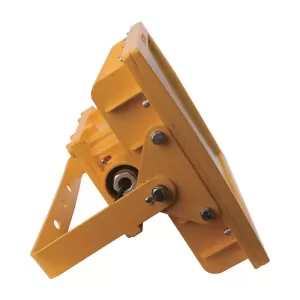
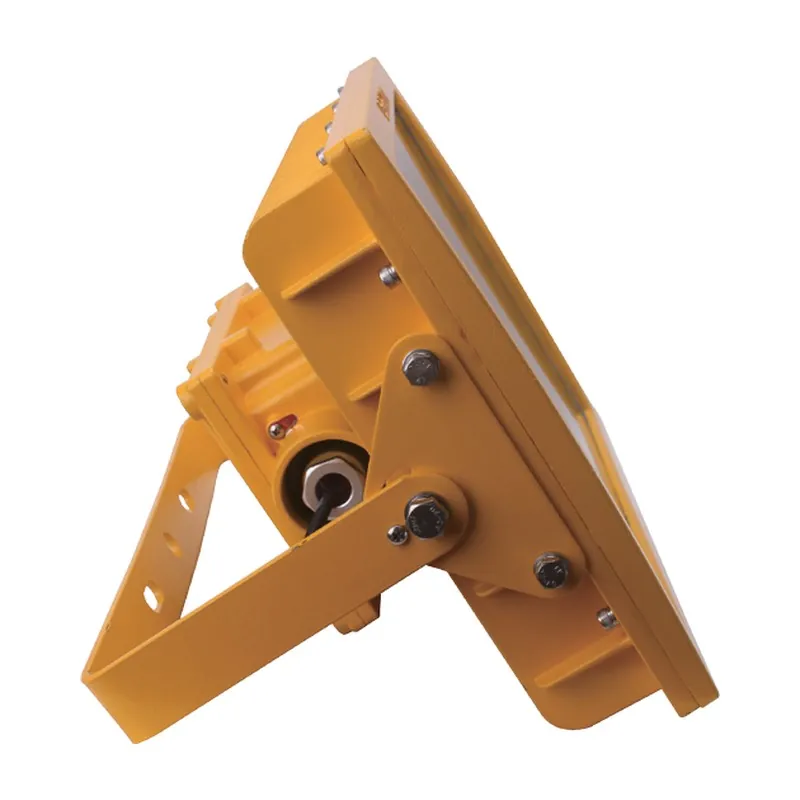
With our ExF explosion-proof flood and street light at 80 W (Ex d IIB T6 Gb, IP67, 110 lm/W), which covers IIA methane, our high bay lighting calculator gives:
| Result | Value |
|---|---|
| Room index | 1.45 |
| Fittings | 15 (5 × 3) |
| Spacing | 4.8 m × 4.0 m |
| Average illuminance | about 181 lux |
| Power density | 4.2 W/m² |
The ExF certificate is provided with the quotation. Where the classification needs a fitting from our own certified series, the BED (Ex db eb mb IIC T4 Gb, certificate ZJEx23.0914) is available at the same 80 W step and gives the same layout at the same efficacy.
Fittings over the drive lanes away from the dispensers may fall outside the zone and can be standard canopy lights, but at a CNG station that has to be shown on the classification drawing rather than assumed. Our outdoor canopy lighting ideas and gas station canopy and fascia guide cover the visual design: even light, low glare for drivers and a bright fascia.
A real forecourt
We supplied forecourt canopy lighting for a Sinopec petrol station in Xiangtan. The same principles apply at CNG and dual-fuel stations: certified fittings in the zones, sealed housings that survive vehicle exhaust and cleaning, and recessed or flush fittings that do not glare into drivers’ eyes.
Calculated layout: the compressor room
Many stations house the compressor in a ventilated room or acoustic enclosure. Take a room of 10 × 6 m, fittings at 4 m, 200 lux for maintenance work, classified Zone 2.
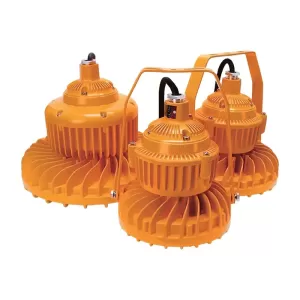
With the BDE507 round explosion-proof light at 40 W (Ex d IIC T6 Gb, IP66), the same calculator gives 9 fittings (3 × 3) at 3.3 m × 2.0 m spacing, about 287 lux. Its certificate is provided with the quotation.
Gas in the room rises, so the most likely place for an accumulation is under the roof, close to where the lights are. Ventilation outlets at the high point and gas detection near the ceiling are standard; the light fittings sit in that same space and must be certified for it.
Storage, priority panel and vent stack
High-pressure storage cylinders and the priority panel are usually outdoors behind a fence or wall. Light the valve panel and gauges with floodlights mounted outside the zone, aimed in. The vent stack outlet is a Zone 1 area at height; keep floodlights and poles well clear of it.
Dual-fuel stations
Many stations sell petrol, diesel and CNG on the same forecourt. The classification then combines two patterns: low-level zones around petrol dispensers, tank fills and vents, and upward zones around CNG equipment. A single fitting type certified for both, at T3 or better for petrol, keeps the canopy simple.
Shop, car wash and surroundings
The shop and car wash are unclassified, unless they sit within a zone distance. Perimeter and entrance lighting follow normal outdoor rules. For gas compression on a larger scale, see our gas compressor station lighting guide, and for another methane site, the biogas plant lighting guide.
What to send us
- Site plan with canopy dimensions and height
- The area classification drawing for dispensers, compressor, storage and vents
- The operator’s lighting standard, if any
- Supply voltage
We return a canopy and equipment layout with Ex fittings where the zones require them.
Sources
Frequently asked questions
Do CNG stations need explosion-proof lights?
Around the dispensers, compressors, storage and vents, yes: these are classified areas. Because natural gas rises, the zone around a dispenser can extend upward and include fittings on the canopy underside. Lights outside every zone can be standard IP65 fittings.
What gas group and temperature class is natural gas?
Methane, the main component, is gas group IIA and temperature class T1 (auto-ignition temperature well above 450 °C). Any certified IIA, IIB or IIC fitting with a T1 or better rating meets this, as long as it is certified for the zone.
How is a CNG canopy different from a petrol canopy?
Petrol vapour is heavier than air and stays low, so canopy-mounted lights are usually outside the dispenser zone. Natural gas rises and can collect under a solid canopy, so the canopy design needs vents or an open structure, and lights near the dispenser may be inside a zone.
How bright should a CNG forecourt be?
Similar to a petrol forecourt: bright, even light under the canopy for safe refuelling and clear CCTV images, often 150–300 lux depending on the operator's brand standard and local rules.