Gas Compressor Station Lighting: Why the Roof Space Matters and a 30 × 15 m Hall
Lighting natural gas compressor buildings: methane rises, so zones sit at roof level; gas group, temperature class, vibration, and a 30 × 15 × 9 m hall from our calculator.

Key points
- Natural gas is lighter than air, so in a compressor building the gas collects under the roof, exactly where high bay fittings are mounted.
- Methane is group IIA and needs only T1, but networks preparing for hydrogen blends should ask whether the classification will change, because hydrogen is IIC.
- A 30 × 15 m compressor hall with a 9 m roof needs 15 BED fittings of 150 W for about 244 lux by our lighting calculator.
- Vibration from reciprocating compressors loosens fixings and glands; mount fittings on the building structure, not on skids or pipework.
Compressor stations keep natural gas moving through pipelines and distribution networks. Inside each compressor building, engines or electric motors drive compressors that handle high-pressure gas around the clock, often unattended. The lighting is used mostly during maintenance and inspection rounds, but when it is used it has to work in the one part of the building where leaked gas goes first.
Natural gas rises: what that means for lighting
Most flammable vapours, such as petrol and solvents, are heavier than air and spread along the floor. Natural gas, which is mainly methane, has about half the density of air and rises. A leak from a compressor seal or flange goes up and collects under the roof unless the ventilation removes it.
This turns the usual picture upside down:
| Heavier-than-air vapour | Natural gas | |
|---|---|---|
| Where gas collects | Floor, pits, drains | Roof space, ridge, under beams |
| Most severe zones | Low level | High level, near roof vents |
| High bay fittings | Often outside the worst zone | Inside the zone most likely to see gas |
Area classification guidance for natural gas, such as IGEM/SR/25 in the UK, and the general method in IEC 60079-10-1 both take this into account. The building is normally Zone 2, with more severe zones near vents or in poorly ventilated pockets. The ridge vents and the inlets of roof extract fans are often the worst points, because that is where gas leaves the building.
Gas group, temperature class and hydrogen blends
Methane is group IIA and its auto-ignition temperature is high, so T1 is enough for pure natural gas. In practice, fittings rated IIB or IIC and T4 are common because they cover heavier hydrocarbons in wet gas, odorants and other substances used on site.
One question is new: several gas networks are testing or planning blends of hydrogen into natural gas. Hydrogen is group IIC. If your station may carry blends in future, ask the classification engineer whether the gas group on the drawing will change, and choose IIC fittings now to avoid replacing them later. Our hydrogen explosion-proof lighting guide covers what IIC means for the fitting.
Choosing the fitting
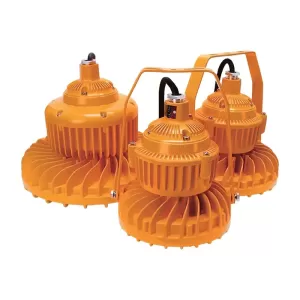
Compressor halls are tall, so high-output fittings are needed. Our BED series runs from 30 to 600 W, marked Ex db eb mb IIC T4 Gb (and Ex tb IIIC T130 °C Db for dust), IP65, and is covered by our own certificate ZJEx23.0914 under GB 3836. Its IIC marking covers natural gas today and hydrogen blends later. For lower plant rooms such as metering and regulator kiosks, the 20–70 W BDE507 (Ex d IIC T6 Gb, IP66) fits better; we supply its certificate with the quotation.
Worked example: a 30 × 15 m compressor hall
The hall measures 30 × 15 m with 9 m to the underside of the roof steel. It houses two gas-engine compressor sets. Walls are light-coloured cladding, floor is concrete, target is 200 lux at 0.8 m. Using the BED at 150 W and a conservative 110 lm/W with a medium beam, our lighting calculator gives:
| Result | Value |
|---|---|
| Room index | 1.22 |
| Utilisation factor | 0.55 |
| Fittings | 15 (5 × 3) |
| Spacing | 6.0 m × 5.0 m |
| Average illuminance | about 244 lux |
| Power density | 5.0 W/m² |
| Wattage that would just reach 200 lux | about 123 W |
The surplus is useful here. The compressor sets and their overhead crane block light, and the area between the sets is where technicians work. If the hall has a travelling crane, fittings go above the crane’s highest hook position or on the side walls, not in its path. Our explosion-proof high bay lighting guide covers mounting heights and crane clearance in more detail.
Keep fittings away from the vents
Within the roof space, plan positions that avoid the ridge vents and extract fan inlets. Even a metre or two of separation can move a fitting from a more severe zone into a less severe one, and makes inspection easier. Coordinate with the ventilation and gas detection layout: detectors also go at high level, and the cable trays for both can share routes.
Vibration
Reciprocating compressors and gas engines shake the floor and anything attached to the skid. Vibration loosens screws, gland nuts and pendant fixings over months.
- Mount fittings on the building steel, not on skids, pipe supports or compressor enclosures.
- Use a secondary safety wire on pendant-mounted fittings.
- Check gland tightness and fixings at every inspection; our explosion-proof light maintenance guide lists what to inspect.
Outdoor yard and pipe manifolds
Station yards with above-ground pipework, filters and pig launchers are usually Zone 2 around the release sources. Floodlights on poles or on the building wall can light the yard; position them outside the classified radius where possible so ordinary fittings can be used. Where they must be inside, explosion-proof floodlights are needed. The related biogas plant lighting article shows similar choices for another methane-handling site, and the chemical plant lighting guide covers sites with mixed gas groups.
Unattended stations
Many compressor stations run unmanned. Lights are switched on by staff on arrival, by a door switch, or remotely. LED fittings start instantly, unlike the metal halide lamps they often replace, which took minutes to restrike after a power dip. Put the switches outside the building or at the entrance outside the classified area.
What to send us
- Building dimensions, roof height and any crane
- The area classification drawing, including vent locations
- Whether hydrogen blending is planned
- Supply voltage and emergency lighting requirements
We return a fitting schedule, layout and calculated levels, with the certificate for each model.
Sources
Frequently asked questions
Is a gas compressor building a hazardous area?
Usually yes. Seals, valves and flanges on compressors are release sources, so the building is normally classified Zone 2, and sometimes Zone 1 near vents or where ventilation is limited. The classification depends on the ventilation and gas detection, so check the drawing.
Where should lights go in a compressor house?
Natural gas rises, so fittings at roof level are in the part of the room most likely to see gas. They must be rated for the zone at their mounting height. Keep them away from ridge vents and roof extract fans, which are often the most severely classified points.
What temperature class do I need for natural gas?
Methane's auto-ignition temperature is above 450 °C, so T1 is enough for pure natural gas. Most explosion-proof fittings are T4 or better anyway, which also covers heavier hydrocarbons and odorants.
What lux level does a compressor building need?
Operators commonly use 150–200 lux in compressor halls, with higher local levels at control panels and gauges. EN 12464-1 lists 200 lux for many industrial plant rooms.