Biogas Plant Lighting: Methane and H2S Zones, Digester Roofs and Gas Houses
How to light a biogas or anaerobic digestion plant: why H2S, not methane, sets the gas group and temperature class, zones around digesters and relief valves, corrosion, and a gas-house layout.
Key points
- Methane alone is group IIA and T1, but raw biogas also contains hydrogen sulphide, which is group IIB and ignites at about 260 °C, so most biogas specifications call for IIB and T3 or better.
- Zones form around digester roof membranes, pressure and vacuum relief valves, gas storage, the flare and the gas upgrading or CHP room.
- H2S and moist air corrode fittings fast; specify WF2 corrosion protection and stainless fixings.
- A 12 × 8 m gas house with lights at 4.5 m needs 6 fittings of 50–60 W for 150 lux by our lighting calculator.
Anaerobic digestion plants turn manure, food waste and sewage sludge into biogas, and they are being built on farms and at treatment works with small teams and tight budgets. Lighting is easy to overlook, but the gas mixture and the corrosive atmosphere change what a fitting must be. This guide explains which gas sets the rating, where the zones fall, and how many fittings a typical gas house needs.
What is in biogas
Raw biogas is a mixture. The proportions vary with the feedstock, but typical ranges are:
| Component | Typical share in raw biogas | Gas group | Auto-ignition temperature |
|---|---|---|---|
| Methane (CH4) | about 50–75 % | IIA | about 600 °C (T1) |
| Carbon dioxide (CO2) | about 25–50 % | not flammable | — |
| Hydrogen sulphide (H2S) | traces up to about 1 % or more | IIB | about 260 °C (T3) |
| Water vapour | saturated | — | — |
Two consequences for lighting:
- H2S sets the gas group and temperature class. Even in small amounts, the presence of H2S moves the requirement from IIA/T1 to IIB/T3. Specifying IIB or IIC fittings with T4 or better avoids arguments later. Our guide to IIB vs IIC gas groups explains the groups.
- H2S and water vapour attack metals. Copper and brass parts blacken, aluminium pits, and cheap steel fixings rust within a season.
Biogas density is close to that of air, so it does not reliably rise or sink. Releases can drift with the wind or collect in poorly ventilated rooms.
Where the zones fall
Every plant needs its own classification under IEC 60079-10-1, but the pattern is similar:
| Location | Typical zone |
|---|---|
| Inside digesters and gas storage | Zone 0 or Zone 1 (no lights installed) |
| Around pressure and vacuum relief valves | Zone 1 near the outlet, Zone 2 around |
| Digester roof membranes and their clamping joints | Zone 2 |
| Gas house: blowers, condensate traps, H2S filters | Zone 2, Zone 1 at drains and sampling points |
| Flare stack base | Zone 2 near the gas train |
| CHP engine room | Often unclassified with gas detection and ventilation, but check the drawing |
Relief valves vent gas whenever pressure rises, sometimes daily, so the zones around them are real and not just theoretical.
Lighting the digesters
Lights mounted on the digester roof sit in the classified area and are hard to reach. Most plants:
- light the digester roofs and walkways with floodlights from outside the zone, mounted on poles or nearby buildings;
- use small Ex fittings only on access platforms and at hatches, with a rating for the zone at that height;
- keep fittings away from the relief valves and their discharge path.
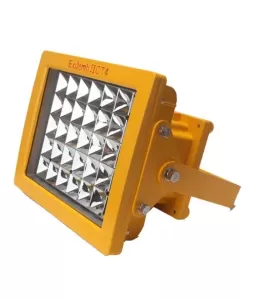
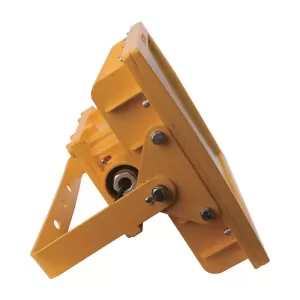
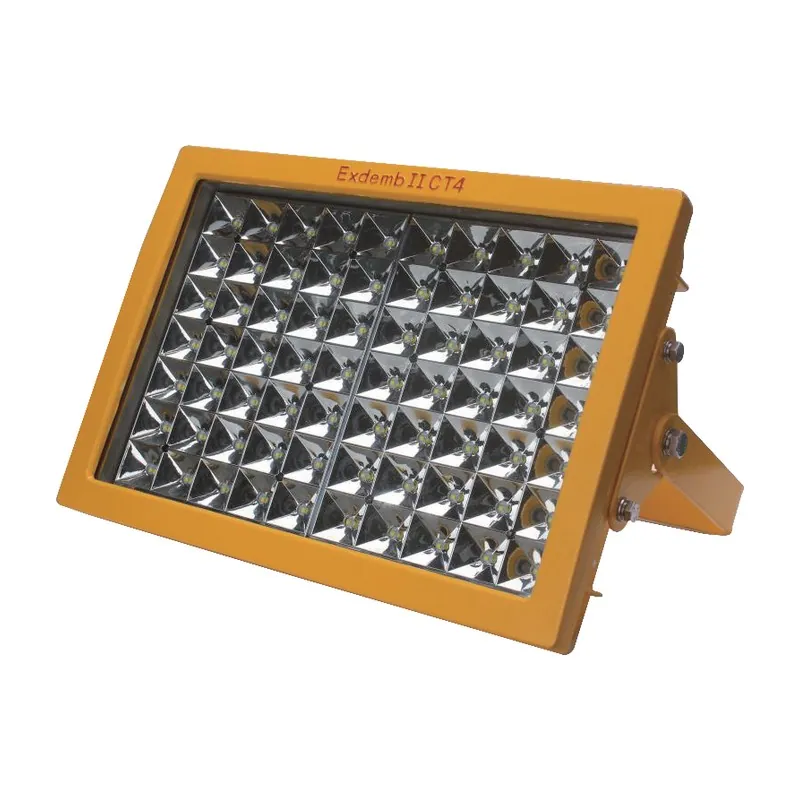
The BAD8599 floodlight (Ex d IIC T6 Gb, IP66, WF1/WF2) suits aimed lighting where the floodlight itself is inside the zone. Where it stands outside, a standard IP66 floodlight is enough.
Worked example: a 12 × 8 m gas house
The gas house holds blowers, the condensate trap, an activated carbon filter for H2S and the gas analyser. Assume 12 m long, 8 m wide, lights at 4.5 m, and 150 lux for operation and maintenance. With our ExF series at 60 W and 110 lm/W, our lighting calculator gives:
| Result | Value |
|---|---|
| Room index | 1.30 |
| Fittings | 6 (3 × 2) |
| Spacing | 4.0 m × 4.0 m |
| Average illuminance | about 187 lux |
| Power density | 3.75 W/m² |
The calculator shows about 48 W per fitting would meet 150 lux on the same grid, so the 50 W ExF-1050B is also an option. The ExF is marked Ex d IIB T6 Gb, which covers both methane (IIA, T1) and hydrogen sulphide (IIB, T3), with IP67 and WF2. Its certificate is supplied with the quotation.
Corrosion: the real enemy
An LED light is rated for tens of thousands of hours, but in H2S-laden air the housing, fixings and glands can corrode much sooner. Specify:
- WF2 corrosion grade for both indoor gas houses and outdoor fittings;
- stainless steel brackets, screws and gland bodies, not zinc-plated;
- no exposed copper or brass; specify nickel-plated or stainless glands;
- sealed cable entries so moist, H2S-laden air does not reach terminals inside the fitting.
Our explosion-proof light maintenance guide lists what to inspect on flameproof joints, which corrosion attacks first.
Light levels
| Area | Typical level |
|---|---|
| Digester roof walkways and platforms | 20–50 lux |
| Gas house, pump rooms | 150–200 lux |
| Reception hall, feed hoppers | 100–200 lux |
| Control room | 300–500 lux, standard fittings outside zones |
| Yard and roads | 10–20 lux |
Gas detection and emergency lighting
Most gas houses have methane and H2S detectors that start fans or shut the gas train. Lights inside the zone stay Ex rated whatever the detection does; detection is a second layer, not a reason to use standard fittings. Escape routes need emergency lighting rated for the zone; see our explosion-proof emergency light guide.
Wastewater treatment works
Digesters at sewage works follow the same rules, but the site also has inlet works, sludge thickening and screening areas with their own zones. Our wastewater treatment plant lighting guide covers those.
What to send us
- Site plan with digesters, gas storage, flare and buildings
- Area classification drawing
- Expected H2S level in raw gas
- Room sizes and target lux levels
- Supply voltage
With these we will return a fitting list with corrosion grades and Ex ratings, and a check of each room like the example above.
Sources
Frequently asked questions
What gas group is biogas?
Methane is group IIA, but raw biogas contains hydrogen sulphide, which is group IIB. Most plants therefore specify IIB equipment, or IIC to cover everything. Upgraded biomethane with the H2S removed can fall back to IIA.
What temperature class do biogas plant lights need?
Methane ignites at about 600 °C (T1), but hydrogen sulphide ignites at about 260 °C, which falls in the T3 band. T3 is therefore the usual minimum, and many plants choose T4 or T6.
Are lights on top of a digester in a hazardous zone?
Usually yes. Gas can escape at the roof membrane joints, the relief valves and inspection hatches, so the digester roof and the space around these points are classified. Most designers avoid fittings on the roof and light it from the side.
Which of your lights suit a biogas plant?
The ExF series (50–150 W, Ex d IIB T6 Gb, IP67, WF2) for gas houses and pump rooms, the BDE507 (Ex d IIC T6 Gb, WF2) for compact spaces, and the BAD8599 floodlight (Ex d IIC T6 Gb, WF1/WF2) for aimed lighting of digester areas.