LPG Bottling Plant Lighting: Heavier-Than-Air Zones, Filling Sheds and Pits
How to light an LPG cylinder filling plant: why propane and butane zones hug the floor, which fittings go high and which go low, pits and drains, and a 36 × 18 m filling-shed layout.
Key points
- Propane and butane are gas group IIA; butane ignites at about 365 °C, so LPG needs at least T2, and most plants specify T4.
- LPG vapour is 1.5 to 2 times heavier than air, so the worst zones are at floor level, in pits, trenches and drains, the opposite of hydrogen.
- Lights mounted high in a well-ventilated filling shed are often in Zone 2 or outside the zone, while floor-level and pit fittings sit in Zone 1.
- A 36 × 18 m filling shed with lights at 7 m needs 24 fittings of 100–120 W for 200 lux by our lighting calculator.
An LPG bottling plant fills thousands of cylinders a day from bulk tanks, through carousels or filling lines, with check-weighing, leak testing and storage. Every step can release a little gas, and LPG behaves very differently from the lighter gases most people picture. This guide explains why LPG zones hug the floor, where the lights should go, and how many fittings a filling shed needs.
LPG: the properties that matter
| Property | Propane | n-Butane |
|---|---|---|
| Gas group | IIA | IIA |
| Auto-ignition temperature | about 450 °C | about 365 °C |
| Temperature class needed | T1/T2 | T2 |
| Lower flammable limit | about 2.1 % | about 1.8 % |
| Density relative to air | about 1.5 | about 2.0 |
Commercial LPG is a mixture, so the lower ignition temperature, butane’s, decides: T2 is the minimum. Most plants specify T4 so the rating also covers ethyl mercaptan odorant, solvents and anything else stored nearby. Our guide to T3 vs T4 explains the check.
The low flammable limit matters too: less than 2 % LPG in air can burn, and one litre of liquid LPG becomes about 250 litres of vapour.
Heavier than air: zones from the floor up
Because LPG vapour sinks, it spreads along the floor and fills any low point. Compared with a hydrogen plant, where the roof is the worst place, the logic reverses. Our hydrogen lighting guide shows the opposite case.
| Location | Typical zone |
|---|---|
| Pits, trenches, drains and sumps below grade | Zone 1 |
| Around the filling heads on a carousel or line | Zone 1 |
| Filling shed floor area, up to a set height | Zone 2 (or Zone 1 near filling points) |
| Upper part of a well-ventilated shed | Zone 2 or unclassified, as the drawing shows |
| Cylinder storage and loading docks | Zone 2 near the ground |
| Bulk tank area, pumps and compressors | Zone 1 at seals and vents, Zone 2 around |
NFPA 58 in the US, and national codes elsewhere, give classified extents for these items. Many classify the area around filling and storage up to a fixed height above grade. Fittings above that height may be outside the zone, but the drawing decides.
Where to put the lights
- High in the shed, away from filling heads. Roof-level fittings in a ventilated shed are usually in the least hazardous part of the building.
- No fittings in pits unless unavoidable. If a pit or trench needs light for maintenance, use portable Ex lights during the work rather than permanent fittings in Zone 1.
- Floodlights for yards from above. Tanker bays and cylinder yards can be lit from masts or building faces, above the low-level zone.
- Cable routes above ground. Cable trenches that connect to classified areas can carry gas to other places; seal them or run cable on trays.
Worked example: a 36 × 18 m filling shed
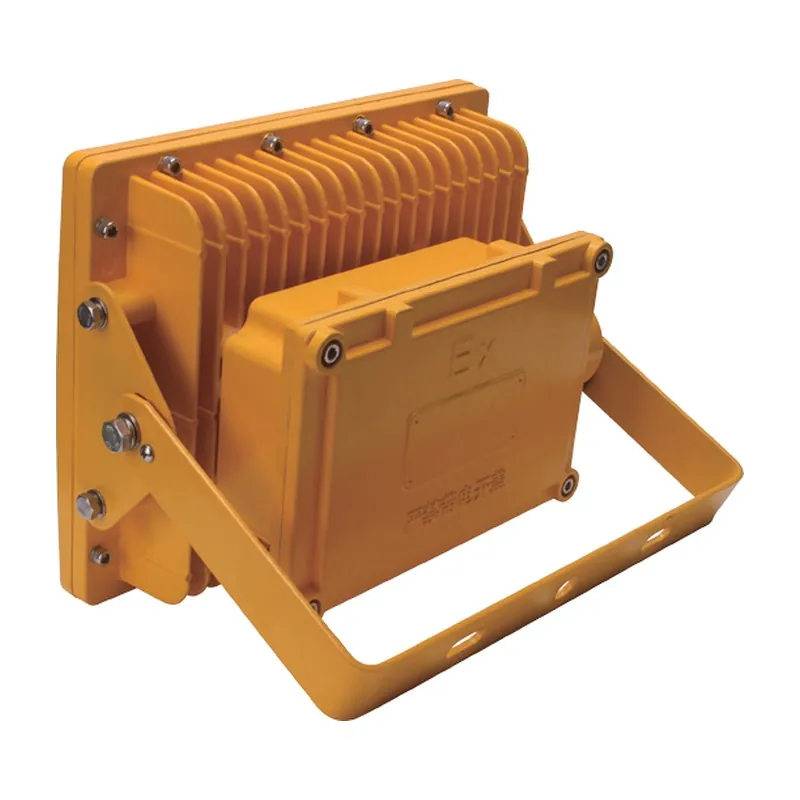
Take a filling shed 36 m long and 18 m wide with a carousel and check-weighing line, lights at 7 m and a target of 200 lux for filling, inspection and reading scales. With our ExF series at 120 W and 110 lm/W, our lighting calculator gives:
| Result | Value |
|---|---|
| Room index | 1.94 |
| Utilisation factor | 0.65 |
| Fittings by the lumen method | 19 |
| Fittings after the spacing check | 24 (6 × 4) |
| Spacing | 6.0 m × 4.5 m |
| Average illuminance | about 255 lux |
| Power density | 4.44 W/m² |
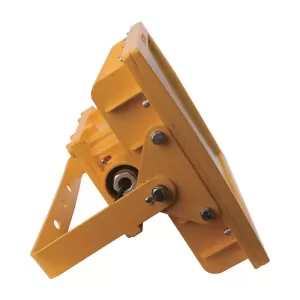
The spacing check adds five fittings, and the calculator shows that about 94 W per fitting would meet 200 lux on the 24-fitting grid, so the 100 W ExF-1100B also works. For a larger shed or higher roof, our BED series goes up to 600 W under our own certificate ZJEx23.0914 (Ex db eb mb IIC T4 Gb).
Add local light at the leak-test bath and the check scale if operators read small markings: 300 to 500 lux there is common.
Cylinder storage and loading
- Covered storage: fittings under the roof, above the classified height, in aisles rather than above stacks so forklifts do not hit them.
- Loading docks: floodlights on the canopy edge aimed at the truck bed, so drivers and loaders can read cylinder tags.
- Open storage: pole-mounted floodlights outside the zone, aimed in.
Bulk tank area and tanker unloading
The bulk tanks, pumps and compressors form their own zones. Lighting follows the same principle as a fuel tank farm: floodlights from outside the zones, aimed in, and small Ex fittings only on tank platforms, valves and the unloading point. Tanker unloading bays usually need 100 lux or more at hose connections.
Controls and switching
- Switches inside zones must themselves be Ex rated, or placed outside the zone with the light controlled remotely. Our hazardous area light switches guide covers the options.
- Many plants link lighting to the gas detection system so that lights stay on during an alarm while other non-essential loads trip.
Emergency lighting
A filling shed must be evacuated quickly in a leak. Escape routes need emergency lighting rated for the zone, with exits marked at both ends of the shed. Our explosion-proof emergency light guide covers duration and placement.
What to send us
- Plant layout with filling lines, pits and storage
- Area classification drawing, with heights
- Target lux levels per area
- Supply voltage
- Certificate scheme required (IECEx, ATEX or national)
With these we will return a fitting list, layouts like the one above, and a check of each fitting position against the zone heights.
Sources
Frequently asked questions
What Ex rating do lights in an LPG plant need?
LPG (propane and butane) is gas group IIA. Butane's auto-ignition temperature of about 365 °C puts it in the T2 band, so IIA T2 is the minimum. Most plants specify IIB or IIC with T4, which covers other substances such as odorant and cleaning solvents too.
Why are LPG zones at floor level?
LPG vapour is roughly 1.5 to 2 times as dense as air. A leak flows along the ground and collects in pits, trenches, drains and basements, so those spaces are classified more severely than the air near the roof.
Can I use standard lights in an LPG cylinder storage area?
Only where the area classification shows no zone. Many codes classify the space around cylinder storage up to a set height above the ground, so fittings mounted above that height may be outside the zone. Check the drawing for every fitting position.
Which of your lights suit an LPG plant?
The ExF series (50–150 W, Ex d IIB T6 Gb, IP67) for filling sheds, the BED series (30–600 W, Ex db eb mb IIC T4 Gb, our certificate ZJEx23.0914) for larger halls, and the BAD8599 floodlight for yards and tanker bays.